

“The 2025 Crawford Fund Conference was an excellent opportunity to gain insight into how agriculture connects to global challenges and to see the wide range of career pathways that exist within the sector” – Our scholar reflections from NSW
September 2, 2025
The Crawford Fund’s Annual Conference was held earlier this month in Parliament House, Canberra. As well as bringing together the world’s leading experts in agricultural science, research, policy, development and industry to address the conference topic, the Crawford Fund is committed to encouraging the next generation in international agriculture for development to the event via scholarships awarded through our State and Territory committees and scholar supporters.
Our conference scholarship program started in 2010 in the hope that by experiencing the Crawford Fund conference and network, our special program of activities around the conference and being mentored by inspirational experienced researchers, young researchers would be inspired and energised to be more involved. The results have been fantastic, with a great mix of youth and experience at our flagship event each August and a growing and enthusiastic conference scholar alumni approaching 485.
Our competitive conference scholarships are offered to young people with a genuine interest in international agricultural research and development to attend the conference and a special set of activities that we have developed and shaped over the past 15 years.
Our other activities to encourage university students and early career researcher include highlighting opportunities in volunteering for projects overseas through the Australian Volunteers Program; our work with Researchers in Agriculture for International Development (RAID), and our special Henzell and Student Awards to enable students to experience overseas agriculture for development research while still at university.
One of the requirements of the scholarship is that each scholar provides us with a reflection on their experience. We will be providing these reflections over the coming weeks, grouped by State/Territory.
Once again, we would like to thank our wonderful mentors, mentioned alongside the scholar they supported, who volunteer their time and offer valuable guidance, support and insights to the scholars throughout the conference.
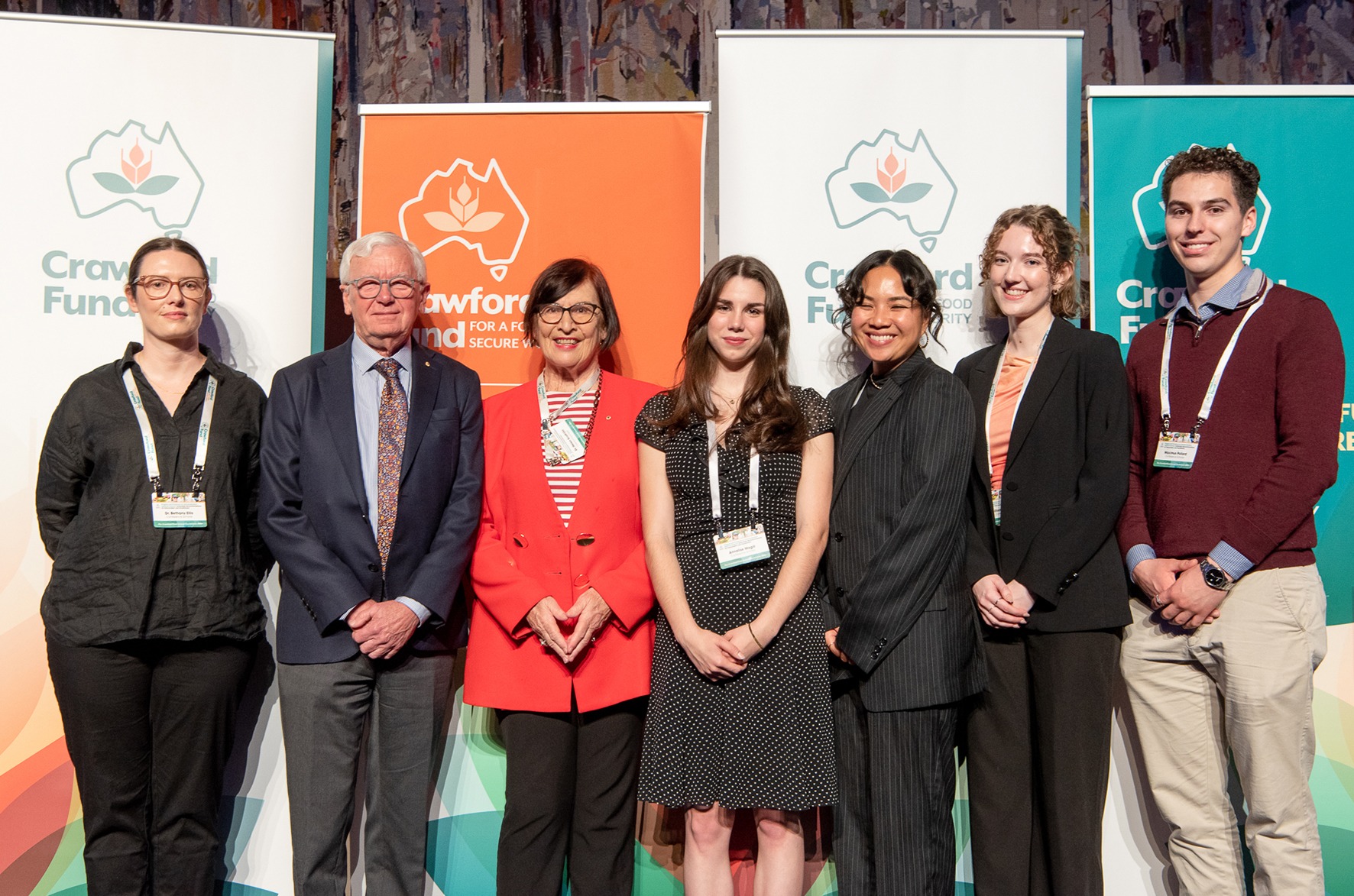
Five scholars from NSW attended the 2025 Crawford Fund conference, supported by our NSW Committee. Highlights of their experiences have been captured below:
Bethany Ellis, NSW Department of Primary Industries and Regional Development
“The scholar activities surrounding the 2025 Crawford Fund Conference provided an enriching experience, offering valuable learning, networking, and inspiration. Conversations with mentors, conference speakers and attendees helped clarify potential pathways in research, policy, and diplomacy.”
Annalise Magill, University of Sydney
“The 2025 Crawford Fund Conference was an excellent opportunity to gain insight into how agriculture connects to global challenges and to see the wide range of career pathways that exist within the sector.”
Elizabeth Markie, University of Sydney
“The opportunity to attend the 2025 Crawford Fund Conference and Scholar program couldn’t have come at a better time in my academic career. As I finish up my undergraduate and honours year, the thought of “what comes next” has been taking up considerable space in my brain. With a strong passion for research, I know that whatever I do next, I want it to be meaningful, both self-fulfilling and beneficial to wider society. This conference was a perfect way to frame a career in research from a wider agricultural lens.”
Maximus Pollard, University of Sydney
“The entire experience I believe has made me committed to agriculture and its development within the world. Coming into the conference I had no real interest in international work or agricultural research. Listening to the amazing storied from many speakers however really opened my eyes into the world of international agriculture which is now something I want to pursue. More so is my new commitment to pushing food security and equitability for all, something in which I will urge industry, people and government to do more in and hopefully one day work in that space.”
Sophia Thach, Applied Horticultural Research
“The conference also shifted my view of agriculture in a global context. I was struck by the framing of agricultural development as not only an avenue for improved livelihoods, but also as a form of soft power and through ACIAR, an important element of national security. It reinforced to me the urgency of strengthening food systems given the intersecting pressures of climate change, resource scarcity, and population growth.”
Read on for the full reflections of each NSW scholar:
Bethany Ellis, NSW Department of Primary Industries and Regional Development
Mentor: Joseph Vile
The 2025 Crawford Fund Conference was a powerful platform for connecting with global leaders and offering deep insights into food security and climate resilience, as well as the importance of agricultural research for development. The theme, “Progress and Prospects for Climate-Resilient Agrifood Systems: Actionable Recommendations for Policymakers and Practitioners”, resonated deeply with me as it touches on topics of my own research. The conference featured a broad range of experts presenting issues from across the field of climate-resilient agrifood systems, but also brought together a diverse array of attendees, united by a commitment to climate-resilient agriculture and sustainable development.
Climate-resilient agrifood systems face a significant challenge as they evolve to produce enough food for a growing population under the threats of a changing climate, while not compromising the planet’s health or increasing their carbon emissions. It was fascinating to hear insights from a wide range of Asian countries, African Nations, and Pacific Islands, including Vanuatu, Indonesia, Timor Leste, Cambodia, Fiji, and the Cook Islands. Not only were the studies geographically distributed, but a wide range of sectors were also included, from livestock, dairy, silvopastural systems, cocoa production, rice cultivation and marine fisheries. The interdisciplinary nature of the discussions highlighted the complexity of agrifood systems and the need for integrated solutions.
The conference also highlighted the importance of inclusive, community-led research and the value of traditional knowledge systems. A key takeaway from the conference was the emphasis on moving away from western-centric models of agricultural research and adaptation. Instead, the conference speakers promoted co-designed projects that integrate local knowledge and leadership to ensure relevance and ongoing sustainability of research. This approach is key for building climate-resilient agrifood systems through transdisciplinary research and to foster long-term impact. Another key takeaway was capacity building with speakers stressing the need to empower local farmers, researchers, and institutions. The speakers advocated for two-way learning, where knowledge is exchanged between researchers rather than imposed, leading to stronger outcomes and ensuring that research benefits are sustained over time.
The scholar activities surrounding the 2025 Crawford Fund Conference provided an enriching experience, offering valuable learning, networking, and inspiration. Conversations with mentors, conference speakers and attendees helped clarify potential pathways in research, policy, and diplomacy. These interactions highlighted the evolving nature of careers and the importance of staying open to new opportunities. The exposure to diverse perspectives and innovative approaches has inspired me to think more critically about the role of collaboration in shaping future climate-resilient agrifood systems.
Overall, the 2025 Crawford Fund Conference expanded my view of agricultural research for development, with an emphasis on the challenges and opportunities in building climate-resilient agrifood systems across the globe. It reinforced the importance of inclusive dialogue, evidence-based policy, and the transformative power of research in addressing global food and climate challenges.
Annalise Magill, University of Sydney
Mentor: Helen Scott-Orr
As a first-year student in Agricultural Science at the University of Sydney, majoring in Environmental, Resource and Agricultural Economics, my exposure to the industry has so far been limited. The 2025 Crawford Fund Conference was an excellent opportunity to gain insight into how agriculture connects to global challenges and to see the wide range of career pathways that exist within the sector.
The Scholar Program was a key highlight. It supported my travel to Canberra and created opportunities to meet a group of motivated young professionals with diverse interests in agriculture and food security. Engaging with other scholars was valuable in understanding the many directions a career in agriculture can take, from policy and economics to on-farm research and international development. The mentoring program was another strength of the experience. Speaking with professionals who have established careers across different areas of the sector helped me consider the skills I will need to build and the possible pathways available. The smaller group setting made conversations easier and encouraged practical discussions about career development.
The conference itself provided exposure to leaders in food security, agricultural research, and international development. Sessions highlighted the importance of climate-resilient agriculture in addressing food insecurity and adapting to environmental change. This message was consistent across many speakers and reinforced how research and innovation are central to agriculture’s future.
Several presentations stood out to me. A session on Silvopastoral agriculture showed how integrating trees and livestock can provide environmental and economic benefits, improving sustainability while supporting farmers’ productivity. Another discussion examined the role of the legal profession in agriculture and food security, which broadened my understanding of opportunities in the sector beyond farming and traditional research roles. These sessions emphasised that addressing food security requires collaboration across many disciplines.
The conference also underlined two key areas for future progress in agriculture. The first is the role of government policy in conservation, particularly how effective policy can support long-term sustainability. The second is the need to improve support for women in agriculture. Barriers to women’s participation remain, and hearing from speakers on this topic highlighted the importance of creating more inclusive opportunities across the sector.
Overall, the conference was an insightful and motivating experience. It allowed me to expand my understanding of agriculture’s role in global issues, develop networks with other scholars and mentors, and gain a clearer picture of the skills and knowledge needed to contribute to the sector. I am grateful to the Crawford Fund for the opportunity to attend and for investing in the development of young people interested in agriculture and food security.
Elizabeth Markie, University of Sydney
Mentor: Allen Wen
The opportunity to attend the 2025 Crawford Fund Conference and Scholar program couldn’t have come at a better time in my academic career. As I finish up my undergraduate and honours year, the thought of “what comes next” has been taking up considerable space in my brain. With a strong passion for research, I know that whatever I do next, I want it to be meaningful, both self-fulfilling and beneficial to wider society. This conference was a perfect way to frame a career in research from a wider agricultural lens.
As someone young in their academic career, the pre- and post-conference scholar activities were instrumental in helping me to feel more prepared for what the future may hold. Hearing from those further along in their careers about the paths they took and the places their research led them has me excited for what my future may hold. Learning about the RAID network and the supportive nature of working as a collective to encourage young researchers like myself to grasp once-in-a-lifetime opportunities to be involved in life-changing projects was inspiring and exciting. Having recently started looking into PhD programs, being able to discuss PhD life, research topics, industry involvement, work/life balance, and many other aspects with both my mentor and other mentors in the program has helped me to feel more prepared for the journey.
Attending the conference at Parliament House was an amazing experience; the location spoke to the significance of the work that the Crawford Fund supports. Having the opportunity to talk to attendees from overseas was a first-time experience for me. I particularly enjoyed conversing with a group of researchers from Timor-Leste, hearing about their area of expertise, the issues their country faces in terms of agricultural production and food security, and also learning more about their culture through discussing national dishes and activities.
My key takeaway from the conference was the importance of researchers, farmers and policymakers, both within their sectors, but most importantly in the collaborative space. Hearing about projects that were not successfully implemented due to cultural incompatibilities or lack of government support highlighted the importance of interdisciplinary work to facilitate meaningful and impactful research. Such examples of this included savvy technological tools that serve no purpose to a community that doesn’t have the internet access or infrastructure to implement. However, there were stories of great advancements, too. In particular, learning about the barriers women face in the agricultural sector overseas, it was encouraging to hear about how we are working to bridge those gaps, and in turn increasing food security for those at greatest risk.
In summary, attending the 2025 Crawford Fund Conference and Scholar Program was an amazing opportunity that I would strongly encourage any young researchers to pursue. It broadened my perspective on how agricultural research may be conducted, and gave me an appreciation for all of the different disciplines and how they come together to produce successful outcomes.
Maximus Pollard, University of Sydney
Mentor: Wendy Craik
The 2025 Crawford fund was my first conference in Agriculture and my first ever conference. I thoroughly enjoyed the three days I spent in Canberra as a scholar. I am a university student in my undergraduate degree of agricultural science majoring in Economics at Sydney university. Before attending the conference, I didn’t even know about ACIAR or RAID or many other acronyms. The conference has widened my scope of agriculture and certainly continued to push me into that direction.
Something which was so incredibly valuable at the conference as a scholar was having a mentor. My mentor Wendy Craik, who as a board member of the Crawford Fund and many other prestigious boards was crucial in helping me network and understand who’s who in the agriculture sphere. As an undergraduate who is only 19, I was quite nervous when first attending the conference and certainly had imposter syndrome. However, one of the first activities we did was a mini roundtable discussion between mentors and mentees which was most valuable. Through this we discussed different aspects of our lives, work and research. Though I didn’t have much to add I did have much to listen too, which is always vital. At the end of this discussion one member of the group was nominated to speak and tell the rest of the scholars what they heard. Dr Deirdre Lemerle looked at me and pointed, I simply said sure thing, not entirely realising that I had signed up to speak first in front of a crowd of 50 odd people. However, I must thank Deirdre for this greatly as she gave me the confidence and trust in the Crawford family to be able to get up an speak. From there I felt comfortable speaking to more people and asking questions through the conference itself directly to the speakers.
The entire experience I believe has made me committed to agriculture and its development within the world. Coming into the conference I had no real interest in international work or agricultural research. Listening to the amazing storied from many speakers however really opened my eyes into the world of international agriculture which is now something I want to pursue. More so is my new commitment to pushing food security and equitability for all, something in which I will urge industry, people and government to do more in and hopefully one day work in that space.
Personally, my favourite part of the conference was the dinner address given by Joel Fitzgibbon and introduced by John Anderson AC. Both speakers really resonated with me and mobilised me as a young person to do more. Not to be an activist with my words but to be an activist with my actions. Speaking to them over the dinner was a wonderful experience and helped guide me towards strong principles and just actions.
Overall, the conference was an incredibly rewarding and insightful experience. Hearing from past politicians, lawyers, farmers, researchers and other students really has widened my horizons and reminded me of the common goals we should all work for, that we are all humans on this ONE planet and food, will always bring us together.
Sophia Thach, Applied Horticultural Research
Mentor: Martin Blumenthal
Firstly, I would like to thank the Crawford Fund and the RAID Network for providing this memorable and career-shaping opportunity to attend the conference and scholar activities. I am also grateful to my organisation, Applied Horticultural Research, for their ongoing support, and to my mentor, Martin Blumenthal, for his openness, kindness, and guidance both in the lead up to and during the conference. I leave this experience with new knowledge, greater confidence, and many lasting connections with fellow scholars and professionals from leading research institutions and organisations around the world.
One of the key highlights for me was gaining a deeper understanding of the breadth of opportunities in agriculture for development. Hearing from experts and leaders in the field opened my eyes to the wide-ranging career pathways that exist, from on-ground project delivery to international policy. The sessions emphasised the importance of a whole-systems perspective and the value of research in exploring alternative approaches to long-standing challenges. I particularly appreciated hearing about projects from the perspective of developing countries, which highlighted the need for context-specific and bottom-up solutions that can create meaningful and lasting impact.
The conference also shifted my view of agriculture in a global context. I was struck by the framing of agricultural development as not only an avenue for improved livelihoods, but also as a form of soft power and through ACIAR, an important element of national security. It reinforced to me the urgency of strengthening food systems given the intersecting pressures of climate change, resource scarcity, and population growth. At the same time, I was challenged by discussions around declining investment in agricultural research and development. For a country like Australia, with both expertise and a responsibility to lead in this space, the message was clear: advocacy for research funding is critical if we are to address the pressing issues of food security and climate resilience.
My interactions throughout the scholar program and conference had a strong influence on how I think about my own career. Speaking with mentors, researchers, and practitioners expanded my vision beyond the boundaries of my current work, encouraging me to consider agriculture as a global issue and to explore new avenues for collaboration. The scholar activities also offered practical lessons: the importance of saying “yes” to opportunities, being humble and patient, recognising the value of networks, and remembering that imposter syndrome is a common experience even among highly accomplished people. There were many golden nuggets of information and advice sprinkled throughout the activities.
Looking ahead, I am motivated to apply these insights in my own work. I intend to provide input into projects with a stronger emphasis on local perspectives, ensuring that solutions are co-developed rather than imposed from the top down. I am also committed to continue using my role to help translate research into practical outcomes for growers and communities – important in Australia and developing countries. Most importantly, I see my responsibility as not only building capacity in others but also being open to having my own capacity built through mutual learning.
The theme of “progress and prospects for climate-resilient agrifood systems” has reinforced the importance of listening, engaging across cultures, and linking my work more directly to food security outcomes. This experience has strengthened my resolve to approach my research and career as a global citizen, contributing to sustainable agriculture and resilient food systems both in Australia and beyond.