

“The experience has made me re-evaluate the impact I can have as a researcher” – Our scholar reflections from WA
September 15, 2025
The Crawford Fund’s Annual Conference was held last month in Parliament House, Canberra. As well as bringing together the world’s leading experts in agricultural science, research, policy, development and industry to address the conference topic, the Crawford Fund is committed to encouraging the next generation in international agriculture for development to the event via scholarships awarded through our State and Territory committees and scholar supporters.
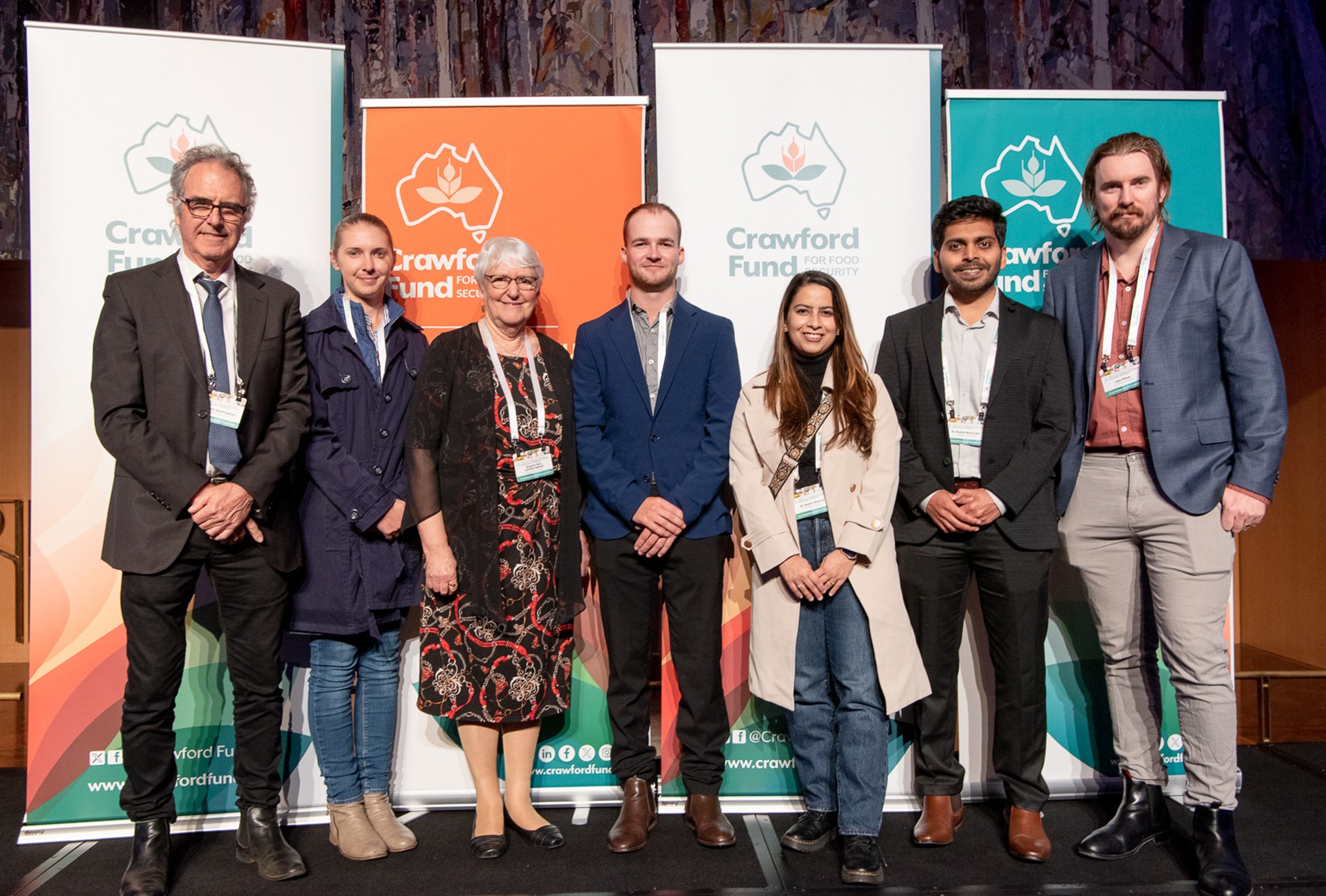
Our conference scholarship program started in 2010 in the hope that by experiencing the Crawford Fund conference and network, our special program of activities around the conference and being mentored by inspirational experienced researchers, young researchers would be inspired and energised to be more involved. The results have been fantastic, with a great mix of youth and experience at our flagship event each August and a growing and enthusiastic conference scholar alumni approaching 485.
Our competitive conference scholarships are offered to young people with a genuine interest in international agricultural research and development to attend the conference and a special set of activities that we have developed and shaped over the past 15 years.
Our other activities to encourage university students and early career researcher include highlighting opportunities in volunteering for projects overseas through the Australian Volunteers Program; our work with Researchers in Agriculture for International Development (RAID), and our special Henzell and Student Awards to enable students to experience overseas agriculture for development research while still at university.
One of the requirements of the scholarship is that each scholar provides us with a reflection on their experience. We will be providing these reflections over the coming weeks, grouped by State/Territory.
Once again, we would like to thank our wonderful mentors, mentioned alongside the scholar they supported, who volunteer their time and offer valuable guidance, support and insights to the scholars throughout the conference.
Five scholars were supported by our WA Committee. Highlights of their experiences have been captured below:
Rutwik Barmukh, Murdoch University
“Reflecting on the entire experience, I benefitted in three major ways: I gained a clearer understanding of the global policy context around climate-resilient agriculture; I strengthened my communication and networking skills through the Scholar Program activities; and I connected my research more directly to the real-world needs of farmers, policymakers, and practitioners.”
Stephanie Boyce, CSU/DPIRD WA
“I was particularly interested in the conference sessions discussing the trade-offs between food production and net-zero emissions targets. From a practical perspective, I see value in focusing on low-emission strategies that are both realistic and impactful…These conversations closely reflected the complexities we face in Western Australia and provided new insights.”
William Mutton, University of Western Australia
“The value of listening to the needs of the everyday farmer was a key message repeated various times throughout the conference. From working with rice growers in Sri Lanka to working with horticultural workers in the Cook Islands, synergy with researchers and farmers was shown to be a must.”
Luke Pilmer, Murdoch University/DPIRD WA
“More broadly, the experience has made me re-evaluate the impact I can have as a researcher…I now see greater potential for my role to contribute to food security, sustainable livelihoods, and community resilience.”
Sneha Sharma, DPIRD WA
“Overall, attending this conference was a rewarding experience. It expanded my knowledge and inspired me to consider how my research can help build climate-resilient food systems and get involved in international research and development.”
Read on for the full reflections of each scholar:
Rutwik Barmukh, Murdoch University
Mentor: Dr Ben Biddulph
Being selected by the Crawford Fund WA Committee to attend the 2025 Annual Conference and the Scholar Program was a rewarding and transformative experience. The event brought together leaders from science, policy, development, and industry to discuss how agrifood systems can adapt to climate change. For me, as a researcher in genetics and crop breeding, the combination of the conference and Scholar Program provided not only new knowledge but also the chance to reflect on how my own research can contribute to the broader challenge of building climate-resilient agriculture.
The Scholar Program provided a strong foundation for engaging with the event. The orientation and networking activities gave me the opportunity to connect with fellow scholars from across Australia, each bringing unique perspectives and research interests. Group discussions encouraged us to think broadly about our role in international agricultural development, while mentoring sessions offered tailored advice on career pathways and leadership. My mentor, Dr Ben Biddulph, provided valuable insights into linking research with practical impact, particularly around farming systems and enterprise resilience. The Scholar Program’s focus on communication skills and translating research into policy language was especially beneficial, as it underscored that research innovations only have impact when they are understood and adopted by farmers, advisors, and decision-makers.
The Annual Conference itself was a highlight. The keynote sessions and panels reinforced the urgent need to accelerate climate-smart agriculture. Presentations on low-emission innovations, silvopastoral systems, climate services, and crop diversification were particularly thought-provoking. Equally striking were the regional perspectives, which emphasised that climate change impacts are unevenly distributed and that adaptation strategies must be context specific. Hearing from speakers on gender and equity issues also made me reflect on how future efforts should be designed to ensure that women farmers and smallholder communities’ benefit.
Beyond the sessions, the real value of the experience lay in the people I met and the conversations I had. I had the opportunity to exchange ideas with my mentor, Dr. Ben Biddulph, WA Committee Chair Prof. Mark Sweetingham, WA Committee Coordinator Prof. Lynette Abbott, Crawford Fund Director of Special Projects Dr. Cathy Reade, Communications Manager Ms. Larissa Mullot, and many others. They generously introduced me to other scholars and experts, helping me expand my professional network in meaningful ways. The opportunity to establish new connections is invaluable, and the conference provided an ideal environment for fostering these relationships.
Reflecting on the entire experience, I benefitted in three major ways: I gained a clearer understanding of the global policy context around climate-resilient agriculture; I strengthened my communication and networking skills through the Scholar Program activities; and I connected my research more directly to the real-world needs of farmers, policymakers, and practitioners. The conference has left me inspired to ensure that my research work contributes not just to scientific knowledge, but also to practical solutions for food security and climate adaptation.
Stephanie Boyce
Mentor: Lyn Abbott
I am incredibly honoured to have been selected to represent WA as a scholar to attend the 2025 Crawford Fund conference, held at Parliament House in Canberra. As a 2025 Scholar, this experience has been invaluable, offering insights and connections that have directly benefited my current work in Western Australia.
My reason for applying was a recommendation from a colleague and former scholar who spoke highly of the experience. Before this, I had no idea of the work The Crawford Fund does. Alongside this, the strong alignment between this year’s conference theme and my professional work motivated me to apply. I currently work on the Western Australian Farming Systems (WAFS) Project, where our goal is to improve the resilience and profitability of local farming systems. This involves identifying break crop options that improve returns while managing risk, analysing the implications of changing seeding times, and evaluating management strategies that support profitability under low greenhouse gas emission scenarios. Attending this conference was a timely opportunity to engage with global experts addressing these very challenges, balancing food production, environmental sustainability, and climate adaptation.
During my university studies, I had intended to undertake an international agriculture subject to gain experience with global food systems, but unfortunately, the COVID-19 pandemic made that impossible. This conference offered a meaningful alternative by providing exposure to international perspectives on agrifood systems and a deeper understanding of Australia’s role within them.
I was particularly interested in the conference sessions discussing the trade-offs between food production and net-zero emissions targets. From a practical perspective, I see value in focusing on low-emission strategies that are both realistic and impactful. It was encouraging to see scientists and practitioners engaging in discussions about how to move forward in ways that are environmentally responsible, economically viable, and considerate of social impacts. These conversations closely reflected the complexities we face in Western Australia and provided new insights.
The Scholars’ Day and RAID Network activities were a highlight. These sessions allowed us to engage meaningfully with our mentors and peers, and I gained practical advice and new contacts. I was fortunate to be paired with a supportive mentor who helped guide me through the event and connected me with relevant experts in my area of interest.
One of the key takeaways from the conference was a better understanding of how much Australia’s agricultural sector depends on national security. Things like reliable supply chains, access to inputs, and protection from biosecurity threats are essential for keeping the sector running and supporting food production. The importance of reducing agricultural emissions, while maintaining food security and economic stability, was clearly framed as a national and global priority.
The conference has deepened my understanding, expanded my network, and strengthened my commitment to improving the long-term sustainability of agriculture in Western Australia and beyond.
William Mutton, University of Western Australia
Mentor: Sam Coggins
Heading into the 2025 Crawford Fund’s annual conference for international food security I was not sure what to expect. What I found was a diverse community of people eager to make a difference in the world through agricultural research and development.
The main theme of the 2025 conference was: Progress and Prospects for Climate-Resilient Agrifood Systems: Actionable Recommendations for Policymakers and Practitioners. Throughout the main conference day, speakers emphasised the continuing need for research and development, perhaps emphasising the need for policy makers to allow the extension of the research into the ‘real world’.
Two of the biggest messages of the day that I found were as follows:
- The need for synergy between farmers, policy makers and researchers.
- The need for continual funding in this sector especially considering the USAID cuts.
Clear communication is vital for all operations that involve multiple parties and stakeholders, and it is no different for agriculture. Professor Glen Denning finished his keynote address with a quote from Professor M.S. Swaminathan saying that “if synergy can be created among scientific know-how, political do-how and farmer participation, it should be possible to achieve the goal of overcoming chronic and hidden hunger…” This quote highlights the need for clear communication and collaboration between the key agencies involved in global food security.
Crawford Fund board member, Professor Tim Reeves, added to this idea by stating that the biggest agricultural innovation in recent times has been the change in the approach to research from top-down to bottom-up. He highlights the importance of listening to the needs of the farmers to inform how and what we research. This idea of the value of listening to the needs of the everyday farmer was a key message repeated various times throughout the conference. From working with rice growers in Sri Lanka to working with horticultural workers in the Cook Islands, synergy with researchers and farmers was shown to be a must.
The other big message that I took away from the day was the need for continual funding and global recognition of the importance of the sector. In a way this stems from the first point in that if synergy between the three parties is achieved the policy makers will be happy to fund the researchers. It was mentioned at the conference that agriculture is disappearing of the political agenda and farmers and researchers are losing their voice. One of the aims of this conference was to build public awareness for the Crawford Fund and its agenda. Considering the recent USAID funding cuts affecting global humanitarian efforts, the conference speakers urged Australian leaders to take the global lead, at least for our region, in our funding for international aid specifically relating to agricultural research and development.
I would like to thank the WA committee for selecting me, and Crawford Fund board, as well as all the mentors and industry representatives who are committed to this key area of international development.
Luke Pilmer, Murdoch University/DPIRD WA
Mentor: Geoff Allan
Attending the Crawford Fund Annual Conference as a scholar was an incredibly valuable and eye-opening experience. Before the event, I had little understanding of what ACIAR was or the breadth of its work. Over the course of the program, I came to see how its projects connect science, policy, and on-the-ground action to create tangible change in people’s lives across the globe.
The highlight for me was the mentor program. I was paired with a mentor whose experience and insights aligned perfectly with my interests and career stage. Our discussions were both practical and inspiring, giving me a clearer sense of how to navigate development-focused research, build meaningful partnerships, and position my skills where they can make the most difference.
I also valued the connections I made with other scholars and professionals. Meeting someone currently leading an ACIAR-funded project has already led to conversations about how I might contribute my aquaculture expertise to their work. This was an unexpected and exciting outcome, showing me, how quickly new opportunities can emerge when you step into the right networks.
More broadly, the experience has made me re-evaluate the impact I can have as a researcher. It has encouraged me to think beyond the technical aspects of my work and consider how my research can directly improve the lives of others, whether in Australia or overseas. I now see greater potential for my role to contribute to food security, sustainable livelihoods, and community resilience.
I am grateful to the Crawford Fund and the Western Australian Committee for supporting my participation. The program has not only expanded my understanding of international agricultural research but also inspired me to actively explore how I can make a real and lasting impact through my work.
Sneha Sharma, DPIRD WA
Mentor: Alison Bentley
It was an exceptional opportunity to attend the Crawford Scholarship Conference 2025 as one of the scholar representatives from Western Australia. I am sincerely grateful to the Crawford Fund for providing this platform to learn, engage, and connect with global experts, policymakers, and fellow professionals working on sustainable agriculture and international development.
This year’s theme, Progress and Prospects for Climate-Resilient Agrifood Systems, felt particularly relevant to my research interests. The sessions highlighted not only the scale of the challenges ahead but also the innovative pathways being developed worldwide.
On the first day, one of the most valuable aspects for me was learning about opportunities to contribute to international research through ACIAR and CGIAR. Hearing from leaders such as Dr Suzie Newman and Dr Alison Bentley was especially motivating, as they spoke about embracing challenges and creating space for women in agricultural science. Their words resonated with me as a young researcher, reinforcing the idea that persistence and courage can drive meaningful change. I also enjoyed the panel discussion, including Ms Selane Tairea, who shared inspiring, practical insights about working directly with farmers and adapting to cultural and language barriers. It reminded me that resilience is not just about systems, but also about people and relationships.
The case studies throughout the conference provided many thought-provoking lessons. Dr Ando Radanielson’s presentation on low-emission rice systems was a standout, showing that low-emission systems can balance rising demand for rice with climate goals, mainly the target of net-zero emissions. Similarly, Dr Tyron Venn’s discussion of silvopastoral systems in Fiji and Queensland presented concrete examples of how integrated approaches can support both productivity and environmental sustainability. These talks encouraged me to think more critically about how similar methods could be adapted in the Australian and regional context.
Equally powerful were the sessions focusing on climate resilience in Asia, Africa, and the Pacific Islands. Dr Aditi Mukherji outlined five key pathways towards climate resilience in agri-food systems, which gave me a structured framework for thinking about my research. Hearing from Professor Graham Sem about the challenges and emerging solutions in Papua New Guinea also reminded me of the importance of regional collaboration and context-specific policy support.
The conference also prompted me to reflect deeply on gender and community-driven adaptation. Presentations by Dr Sonia Akter on feminisation in Cambodian agriculture and Mr Acacio Sarmento da Silva on women’s voices in Timor Leste emphasised the crucial role of inclusivity. Coming from one of the least developed countries, Nepal, this session truly reflected the radical opportunity for women in the agriculture sector.
Finally, I would like to extend my gratitude to my mentor, D. Alison Bentley, for facilitating valuable connections and guiding me throughout the conference. Also, thanks to the RAID network and ACIAR for the networking activities, which provided a unique opportunity to connect with scholars across Australia. Overall, attending this conference was a rewarding experience. It expanded my knowledge and inspired me to consider how my research can help build climate-resilient food systems and get involved in international research and development.