

Supporting sustainable animal agriculture for developing countries
February 24, 2026
This training initiative supported by the NSW, Victorian and Tasmanian Committees of the Crawford Fund for Food Security (CFFS) provided opportunities for early career animal scientists and students to contribute to a program focused on current developments in animal production affecting predominantly small-holder farmers from the Asian and Pacific regions at the Sustainable Animal Agriculture for Developing Countries (SAADC) Conference, held in Vietnam in October 2025.
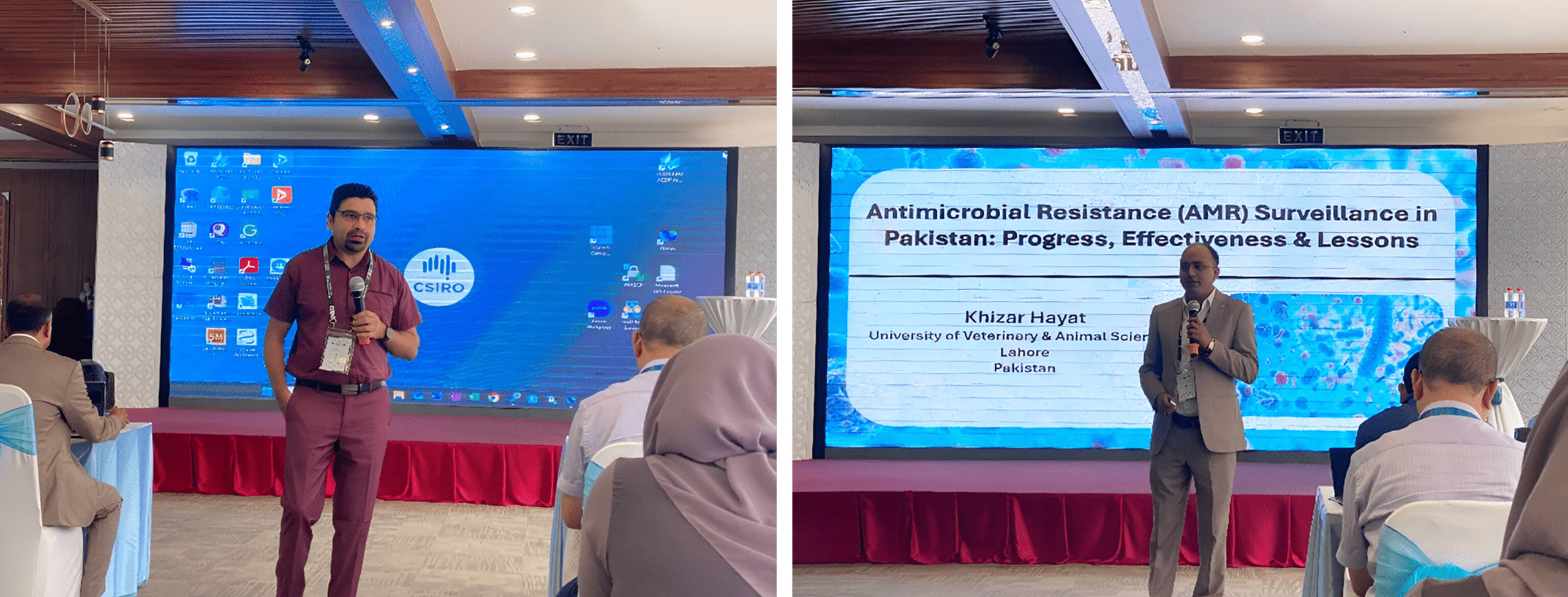
As a silver sponsor of the SAADC 2025 conference, the CFFS committees provided funding to facilitate training in three workshops within the program for this academic conference, as well as supporting the attendance of 80 young scientists from 18 countries.
Dr Shafi Sahibzada, from CSIRO’s Australian Centre for Disease Preparedness, supported by the Victorian Committee, presented a workshop covering the following:
- Building a foundational understanding of antimicrobial resistance (AMR), its global impact, and the role of surveillance in combating it.
- Providing an introduction to core principles of disease surveillance and its challenges in developing countries.
- Introducing an introduction to statistical methods for analysing AMR data and their practical application.
- Equipping participants with hands-on skills in data analysis and visualisation for AMR surveillance.
Secondly, Dr Sarah Fischer, from the Tasmanian School of Business and Economics (TSBE), at the University of Tasmania, was supported by the Tasmanian Committee to deliver a workshop exploring mechanisms for building partnerships and business systems that facilitate smallholder communities’ participation in high-value commercial livestock chains equitably in Vietnam.
And, Dr Anika Molesworth, from Climate Wise Agriculture, supported by the NSW Committee presented a workshop entitled “Communicating Climate Change with confidence and courage”. The session was designed to identify the multi-media avenues and methods that could be used to expand the knowledge of communities on the impacts of climate change and ways that can be adopted to help in mitigating the challenges we all face.
“Funding provided for early career scientists to contribute their research and participate in all workshops and sessions at the event was provided by both the CFFS Tasmania and NSW Committees. And, like the SAADC 2023 conference, our funding was matched by the University of California and JIRCAS Japan while additional funding came from other agencies including ILRI (Vietnam) and CGIAR,” said Peter.
“I was responsible for managing the scholarship program which provided support toward registration, accommodation and meals for 80 young scientists from 18 different countries,” said Dr Peter Wynn, Adjunct Professor, Gulbali Institute, Charles Sturt University.
The scholarship program aims to build the capacity and confidence of 80 young scientists to contribute to scientific colloquia and workshops in the future. The registration, accommodation and meal allowances for the scholars were jointly funded by the CFFS NSW and Tasmania Committees; JIRCAS, Japan; and, the University of California Global Methane Hub.
The success of including three early-career Australian researchers into the SAADC Conference program has the potential to be the foundation for future activities according to Dr Wynn.
“The Crawford Fund for Food Security’s NSW Committee has consistently supported training programs within the SE Asian region. The support provided for Dr Molesworth allowed her to broaden her network of like-minded personnel interested in amplifying the global message on the importance of climate change to our well-being across Asia. Subsequent discussions are in progress to identify the most effective means of funding educational activities across the younger generations in primary, secondary and tertiary education institutes in our region,” he said.
“Dr Shafi Sahibzada’s extensive workshop held over three sessions on the management of antimicrobial resistance has the potential to be developed into Masterclasses which could be held with the co-operation of animal health institutes within government and academic organisations across Asia broadening connections and collaborations in the region,” he said.
“Dr Sarah Fischer was able to promote the program already funded by ACIAR on the social development of business systems with the beef industry in Vietnam. This increased awareness has the potential to further develop collaborations with other institutes in Vietnam,” he said.
“Can Tho University, delivered a very effective international conference on animal science and production, and they appreciated the strong support from the Crawford Fund for Food Security,” he concluded.