

Assessing and building climate risk awareness of smallholder Arabica coffee producers in NW Vietnam
April 14, 2026
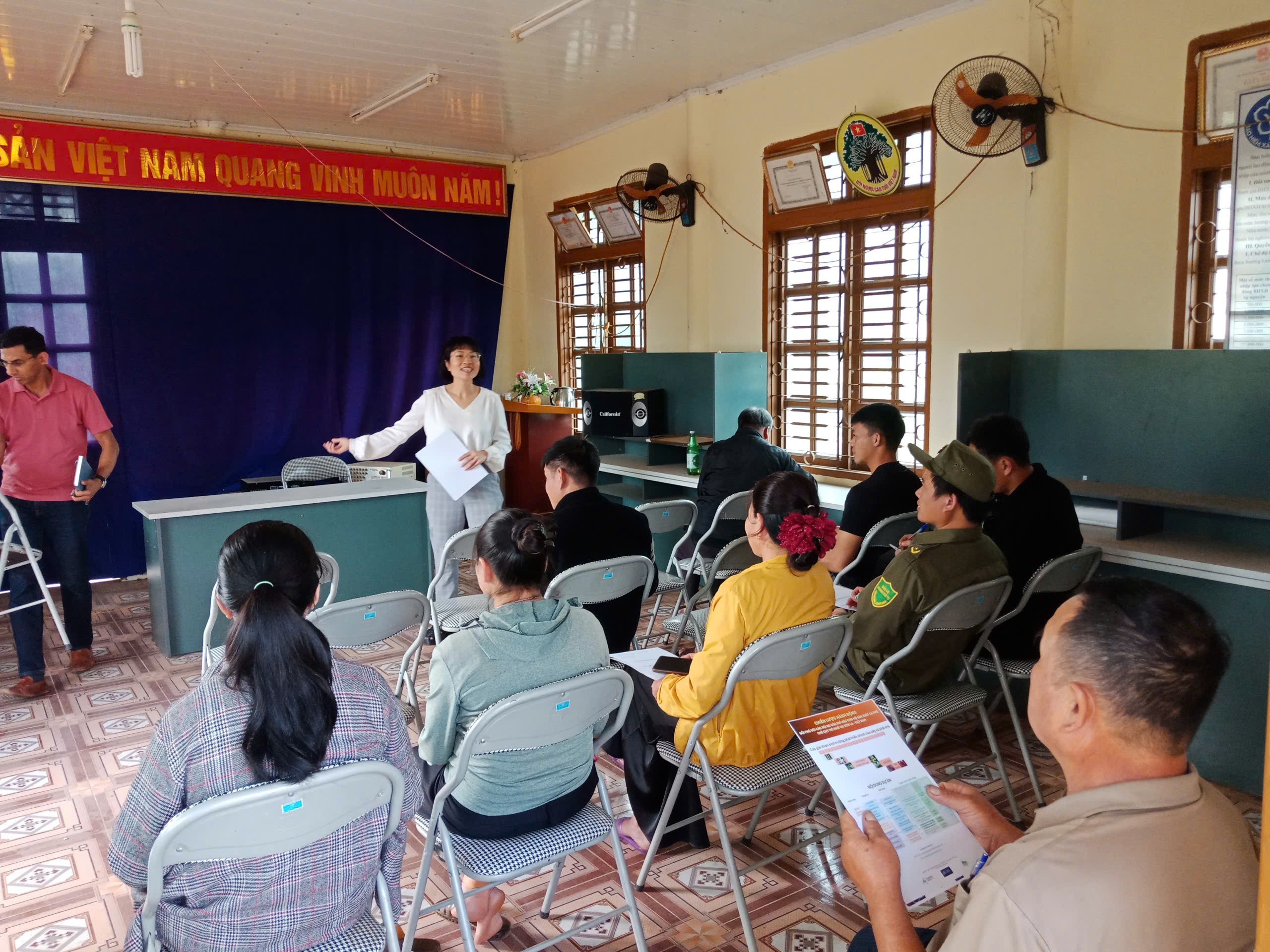
Dr Chi Mai Do, from Adelaide University, delivering a training workshop to Arabica coffee value chain stakeholders in Coi Quynh village cultural centre, Chieng Mai commune, Vietnam.
The Crawford Fund for Food Security’s SA Committee supported grower surveys and the delivery of three training workshops for Arabica coffee growers and fertiliser and pest control suppliers in Vietnam aimed at assessing and building awareness of the climate risks facing the industry.
The surveys were undertaken in Coi Quynh and Ngoi villages, and following compilation and assessment of the data, training workshops were then delivered in Coi Quynh village, Ngoi village and Mat village. In the workshops, growers were presented with the aggregated survey results that included data about their current farming practices, awareness of climate risks and current mitigation strategies, and challenges using these strategies.
“We worked closely with Northern Mountainous Agriculture and Forestry Science Institute (NOMAFSI) to identify the survey participants using farm sizes as a criterion. Arabica coffee value chain stakeholders selected for the survey included growers, processors, cooperatives, extension staff and the Son La Coffee Association. Four villages containing 32 growers in two communes were selected for the interviews,” said Associate Professor Vinay Pagay, from the University of Adelaide, who led the training initiative.
According to Dr Pagay, the surveys highlighted:
- knowledge of growers’ current coffee farming practices in shade trees/ intercropping, pruning, weed control, fertiliser application, pest integrated management (IPM) and irrigation scheduling (IS);
- understanding of growers’ awareness of climate risks related to frost, drought, water availability for irrigation, heat and light stress, pests and diseases and soil erosion;
- growers’ preparedness to mitigate climate risks by planting shade trees, applying irrigation when possible, cutting across coffee trunks, creating smoke on farms to heat up the air, burying young coffee trees with soil, and replanting new coffee trees;
- challenges with current farming practices.
“Using information gleaned from the surveys regarding current farming practices and the climate risks growers were facing, three training workshops were then delivered to the coffee growers with new farming methods suggested to address the main climate risks and build greater resilience to future climate risks,” she said.
Through the workshops, growers learnt they have been impacted by climate change in different ways. They obtained coffee production information not only from their villages, but also from other villages in their communities.
“The workshops ended with a group discussion of several actionable strategies to address some of the typical challenges in coffee production specific to each village. For example, Coi Quynh village is now known as the most frost-prone village in the region due to its topography being at and low-elevation. Using sprinklers to prevent frost damage is unfeasible in this village due to limited water availability and no or limited permanent on-farm irrigation infrastructure. However, given the availability of electricity, use of a frost fan could be a viable strategy to mitigate frost damage. Other frost protection methods were also discussed including using cover crops, mulching or increasing coffee tree height,” said Dr Pagay.
From the current climate challenges, eight key actionable strategies were proposed to mitigate the challenges including:
- frost – map frost-prone area, install frost fans, use more cover crops and mulching;
- nutrient and water requirements of coffee trees – understand water and nutrient requirements at different phenological stages;
- shade trees – improve shade tree selections with appropriate planting densities, apply fertilisers, and conduct trials to assess the effects of shade trees on coffee plantations; and,
- pest and disease management – improve cultural practices to reduce pest and disease incidence.
“After the workshops, all attendees expressed their high satisfaction with the program contents containing the survey and workshops, and they all were willing to join future training programs, requesting information to cover IPM, spraying methods , use of shade trees, weeding, pruning, and irrigation,” she said.
Both the survey results and the suggested farming strategies were summarised in a factsheet and distributed to growers and relevant stakeholders.
“Another key outcome of this project was networking between Adelaide University and Vietnamese private-public organisations and international organisations via face-to-face meetings over two trips and online meetings,” Dr Pagay concluded.
Representatives from these institutions and industry stakeholders were involved in the training initiative and/or associated meetings: the Department of Crop Production and Protection, Vietnam Academy of Agricultural Science: Institute of Agricultural and Environment (IEA), NOMAFSI, Plant Protection Research Institute, Western Highlands Agriculture and Forestry Science Institute, NOMAFSI (current project partner), Vietnam National University of Agriculture, Hue University of Agriculture and Forestry, Tay Bac University, Tay Nguyen University, Phuc Sinh Son La Corporation, Aeroco Specialty Coffee Farm and Khang Thinh Irrigation.