

“Reflecting on the experience, there was a profound amount of optimism for the future” – Our scholar reflections from SA
September 12, 2025
The Crawford Fund’s Annual Conference was held last month in Parliament House, Canberra. As well as bringing together the world’s leading experts in agricultural science, research, policy, development and industry to address the conference topic, the Crawford Fund is committed to encouraging the next generation in international agriculture for development to the event via scholarships awarded through our State and Territory committees and scholar supporters.
Our conference scholarship program started in 2010 in the hope that by experiencing the Crawford Fund conference and network, our special program of activities around the conference and being mentored by inspirational experienced researchers, young researchers would be inspired and energised to be more involved. The results have been fantastic, with a great mix of youth and experience at our flagship event each August and a growing and enthusiastic conference scholar alumni approaching 485.
Our competitive conference scholarships are offered to young people with a genuine interest in international agricultural research and development to attend the conference and a special set of activities that we have developed and shaped over the past 15 years.
Our other activities to encourage university students and early career researcher include highlighting opportunities in volunteering for projects overseas through the Australian Volunteers Program; our work with Researchers in Agriculture for International Development (RAID), and our special Henzell and Student Awards to enable students to experience overseas agriculture for development research while still at university.
One of the requirements of the scholarship is that each scholar provides us with a reflection on their experience. We will be providing these reflections over the coming weeks, grouped by State/Territory.
Once again, we would like to thank our wonderful mentors, mentioned alongside the scholar they supported, who volunteer their time and offer valuable guidance, support and insights to the scholars throughout the conference.
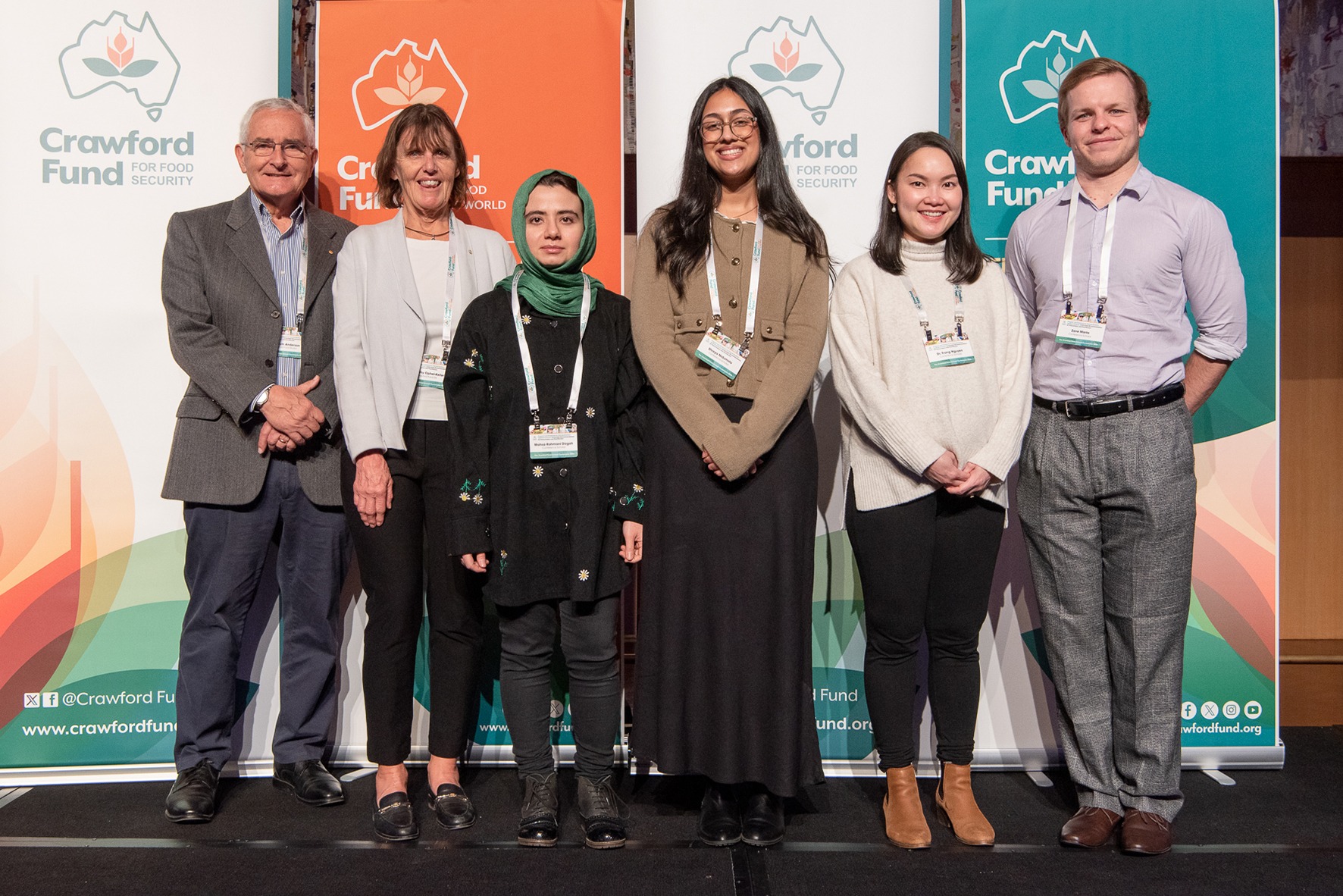
Four scholars were supported by our SA Committee. Highlights of their experiences have been captured below:
Zane Marks, University of Adelaide
“Reflecting on the experience, there was a profound amount of optimism for the future, not only with the mentors and the academics in the room but also with the other scholars from around Australia.”
Trang Thi Thu Nguyen, The University of Adelaide
“One of the major highlights for me was the chance to network with professionals working in international agricultural research. I was impressed by the range of contexts and countries represented, and it was inspiring to hear about the challenges and successes of their work.”
Shreya Nidumolu, University of Adelaide
“This conference has given me the kickstart to build a career shaped by a commitment to agricultural issues.”
Mahsa Rahmani Dizgah, University of Adelaide
“Sitting in the Great Hall and listening to international speakers share their experiences of tackling food insecurity, climate change, and agricultural innovation gave me fresh perspectives that go beyond the Australian context.”
Read on for the full reflections of each scholar:
Zane Marks, University of Adelaide
Mentor: Kathy Ophel-Keller
My name is Zane Marks, a third year PhD candidate with the University of Adelaide. I had the pleasure in 2025 of being selected to represent my university and become a Crawford Scholar. This involved attending the respective Crawford Conference entitled, Progress and Prospects for Climate-Resilient Agrifood Systems: Recommendations for Policy Makers and Practitioners.
A large believer in the scientific community’s ability to identify key issues the world is facing, and develop potential solutions to said issues, I applied to the conference to see how some of this research gets implemented long term into our nation’s policy. My experience with the Crawford Fund not only helped elucidate the impact that our research can make locally, but also internationally. As a person with almost a purely agricultural background, I found that the focus on the long-term impacts of agricultural efficiency on food security enlightening, as well as the impact that the climate can have in other countries; in that regard Professor Glenn Denning’s talk on Achieving Universal Food security stood out.
I was also pleasantly surprised to see a lot of community-based projects, where there was a lot of interactions with groups and stakeholders in the country that the research was based, with an emphasis of working with people and not just coming in with unfounded beliefs and expectations. We also were able to talk about research and the advocacy from a legal perspective, with Caitlin McConnel providing insight as a lawyer in the field of agriculture. I personally learnt from that talk that sometimes the way forward for progress must be through legal challenges, as sometimes advocacy and recommendations can fall drastically short of what is expected.
As a scholar, there were an additional two days of activities that I participated in which, added a great deal of both context and content around the experience. Firstly, I was paired with a mentor from my own state, who is on the Crawford Fund’s SA Committee. She provided me insights into her experiences as a strategic leader of the South Australian Research and Development Institute, with insight into crop science relating to biosecurity and industry partnerships. There was large discussion with several mentors about the future of research both locally and overseas and how some of the us may be able to make a difference long term. We also had the chance to talk to a journalist as one of our scholar activities, which lead to an important discussion around how science is presented to the public through media, in addition what makes for a good story and how to communicate effectively with an audience.
Reflecting on the experience, there was a profound amount of optimism for the future, not only with the mentors and the academics in the room but also with the other scholars from around Australia. The Crawford Fund remains committed to providing people with opportunities to explore the best of what we can do for the future and with the world being in a continuously perilous state, their continued effort has inspired me in that pursuit as well.
Trang Thi Thu Nguyen, The University of Adelaide
Mentor: Ha Duong-Nam
Participating in the 2025 Crawford Fund Conference and Scholar Program was an incredibly enriching experience that broadened my understanding of international agricultural research for development. The opportunity to engage with researchers, practitioners, and policymakers from around the world allowed me to see the diversity of projects being undertaken across different countries — from food security and climate resilience to gender equity and innovation.
One of the major highlights for me was the chance to network with professionals working in international agricultural research. I was impressed by the range of contexts and countries represented, and it was inspiring to hear about the challenges and successes of their work. These conversations deepened my appreciation for the complexity of global agri-food systems and the importance of locally grounded and culturally appropriate approaches. I was also especially pleased to meet many early-career researchers, including members of the RAID Network and ACIAR staff, who are actively contributing to agricultural research and development across different regions.
Throughout the scholar activities, I also gained valuable insights on best practices — and common pitfalls — when collaborating with partner countries and local communities. Presenters and mentors shared practical advice drawn from years of experience in the field. This included guidance on setting clear expectations, maintaining flexibility, and investing in long-term relationships built on trust and mutual respect.
A recurring theme across both days in my conversation with several people was the role of women in agriculture, which particularly resonated with me. Many speakers reflected on their own experiences as women working in international development and highlighted systemic challenges such as limited leadership opportunities, time constraints due to travel, and balancing caregiving responsibilities. These honest conversations were both affirming and thought-provoking, reminding me of the importance of inclusive policy and project design.
The mentor-mentee model was also a significant part of my learning. I truly valued the time I had with my assigned mentor, Dr Ha Duong, who offered thoughtful career advice and introduced me to others working in my field of interest. Thank you, Ha! Several mentors across the program provided guidance on navigating early-career pathways, and I now feel better equipped to plan my next steps.
Lastly, I was particularly intrigued by a session exploring the feasibility of achieving net zero emissions in agriculture, especially the talk presented by Prof. Richard Eckard from the Zero Net Emissions Agriculture CRC. It was inspiring to hear from a leading research group tackling these challenges with scientifically grounded and actionable solutions for Australia and case studies for other countries. The session encouraged me to think more critically about the science, trade-offs, and policy implications behind emissions reduction in agriculture, and how these strategies can be meaningfully integrated into food systems while ensuring global food security.
Overall, the conference and scholar program provided me not only with technical knowledge and career advice, but also with a sense of community and shared purpose. I leave the experience feeling more connected, inspired, and committed to contributing to inclusive, sustainable agri-food systems through my research and future work.
Shreya Nidumolu, University of Adelaide
Mentor: Rosemary Deininger
Having the opportunity to attend the 2025 Crawford Fund Conference as a scholar has been a formative and enriching opportunity at the intersection of completing my undergraduate degree and starting my career. This conference served as a platform to listen to the key issues in agriculture, where the message instilled in us was that food security is a matter of human security. Connecting with professionals in the field, whose backgrounds were varied yet served the same purpose, was inspiring. I am very grateful for this chance to attend the conference with the support of the Crawford Fund’s SA Committee.
As an undergraduate student in a field not directly related to agriculture, I initially felt nervous about entering this space. However, the conference presentations consistently emphasised the importance of agricultural policy as an interdisciplinary field where everyone can contribute. I was particularly interested in discussions highlighting Australia’s potential to be a regional leader in this area, alongside the careful consideration needed when supporting our neighbours by respecting their existing methodologies and perspectives. Additionally, connecting food security to challenges such as climate change, global conflict, and political instability was a key issue brought up by the presenters.
This year’s conference theme Progress and Prospects for Climate-Resilient Agrifood Systems: Actionable Recommendations for Policymakers and Practitioners was especially engaging for me, as an economics student who is interested in international development and public policy. While the day’s presentations focused on food security through different lenses, contexts, and case studies, the final connection to policy recommendations incited an invaluable real-word connection.
Connecting with my mentor, Rosemary Deininger, showed me how her vast experience across sectors can provide valuable guidance for approaching challenges and policymaking in agriculture. Her support gave me a lot of confidence and has helped me consider future pathways in a similar field. Another highlight for me was connecting with the other young scholars. Despite different educational backgrounds, our passion for agriculture and enthusiasm for the conference proceedings meant that we all clicked instantly. Seeing how comfortable we became with each other within two days was very special to me. I now have a network of 33 young professionals in agriculture and development whom I can reach out to for support and advice.
The scholar sessions were a very special experience, as we could listen to the speakers in an interactive environment. I enjoyed listening to the career pathways of all the speakers, particularly those of Glen Denning and Alison Bentley, whose international experiences were truly inspiring. I felt that the scholar activities helped build our confidence in networking and allowed us to ask specific questions.
This conference has given me the kickstart to build a career shaped by a commitment to agricultural issues. I would like to give my sincere thanks to the Crawford Fund and RAID. Particularly, I’d like to extend my thanks to Cathy Reade and Larissa Mullot. The dedication and effort they put into making this conference so inspiring, inclusive, and thought-provoking is truly appreciated by all of us.
Mahsa Rahmani Dizgah, University of Adelaide
Mentor: Deirdre Lemerle
I am very grateful for the opportunity to attend the 2025 Crawford Fund Annual Conference as a Scholar. As a PhD student at the University of Adelaide researching gender disparities in agriculture, the conference was an eye-opening experience that connected my academic interests with pressing global challenges. It was inspiring to be part of a community of scholars, researchers, practitioners, and policymakers who are all dedicated to improving food and nutrition security and building stronger agricultural systems worldwide.
The Scholar Days provided a dynamic start to the week. From the opening sessions at the Eastlake Football Club to the small-group discussions and practical workshops, I felt engaged and encouraged to think more broadly about career pathways in international agricultural research. Meeting other scholars from across Australia with diverse backgrounds reminded me of the importance of interdisciplinary collaboration. The mentor introductions were particularly valuable, as they allowed me to start building supportive professional relationships. The activities were well structured to give us both technical knowledge and the chance to reflect on personal development, which I found motivating.
The main conference at Parliament House was the highlight of the week. The Sir John Crawford Memorial Address and the Networking Dinner were memorable, both for the content and for the chance to connect with senior figures in agricultural development. Sitting in the Great Hall and listening to international speakers share their experiences of tackling food insecurity, climate change, and agricultural innovation gave me fresh perspectives that go beyond the Australian context.
I was particularly interested in the sessions that highlighted the intersection between climate change and smallholder livelihoods, as this aligns with my research on gendered vulnerabilities in agriculture. Hearing about case studies from around the world also helped me see how lessons from developing countries can inform my work in Australia and vice versa. The energy in the room, especially with scholars contributing questions and reflections, was a reminder of how important it is to engage young researchers in shaping future agendas.
This experience has already had a strong influence on my research and career direction. The conversations I had with my mentor and with other scholars reassured me about the relevance of my research and gave me ideas for possible collaborations. It was also encouraging to learn about opportunities through ACIAR and RAID for further involvement in international agricultural research. The event helped me think more strategically about how my PhD can contribute not only to academic debates but also to real-world development outcomes.
Networking with peers who share similar passions has motivated me to remain actively engaged with RAID, as I can see the value of staying connected to a network that continues beyond the conference.
Overall, the Crawford Fund Annual Conference was a transformative experience. It reinforced the importance of bridging research and practice in agriculture, while also providing a supportive environment for young scholars to grow. I would like to sincerely thank the Crawford Fund, my state committee, and my mentor for this invaluable opportunity. I look forward to staying engaged in future activities.