

“Exchanging ideas, challenges, and solutions with others who share a drive for sustainability left me energised…”- Our scholar reflections from TAS
September 16, 2025
The Crawford Fund’s Annual Conference was held last month in Parliament House, Canberra. As well as bringing together the world’s leading experts in agricultural science, research, policy, development and industry to address the conference topic, the Crawford Fund is committed to encouraging the next generation in international agriculture for development to the event via scholarships awarded through our State and Territory committees and scholar supporters.
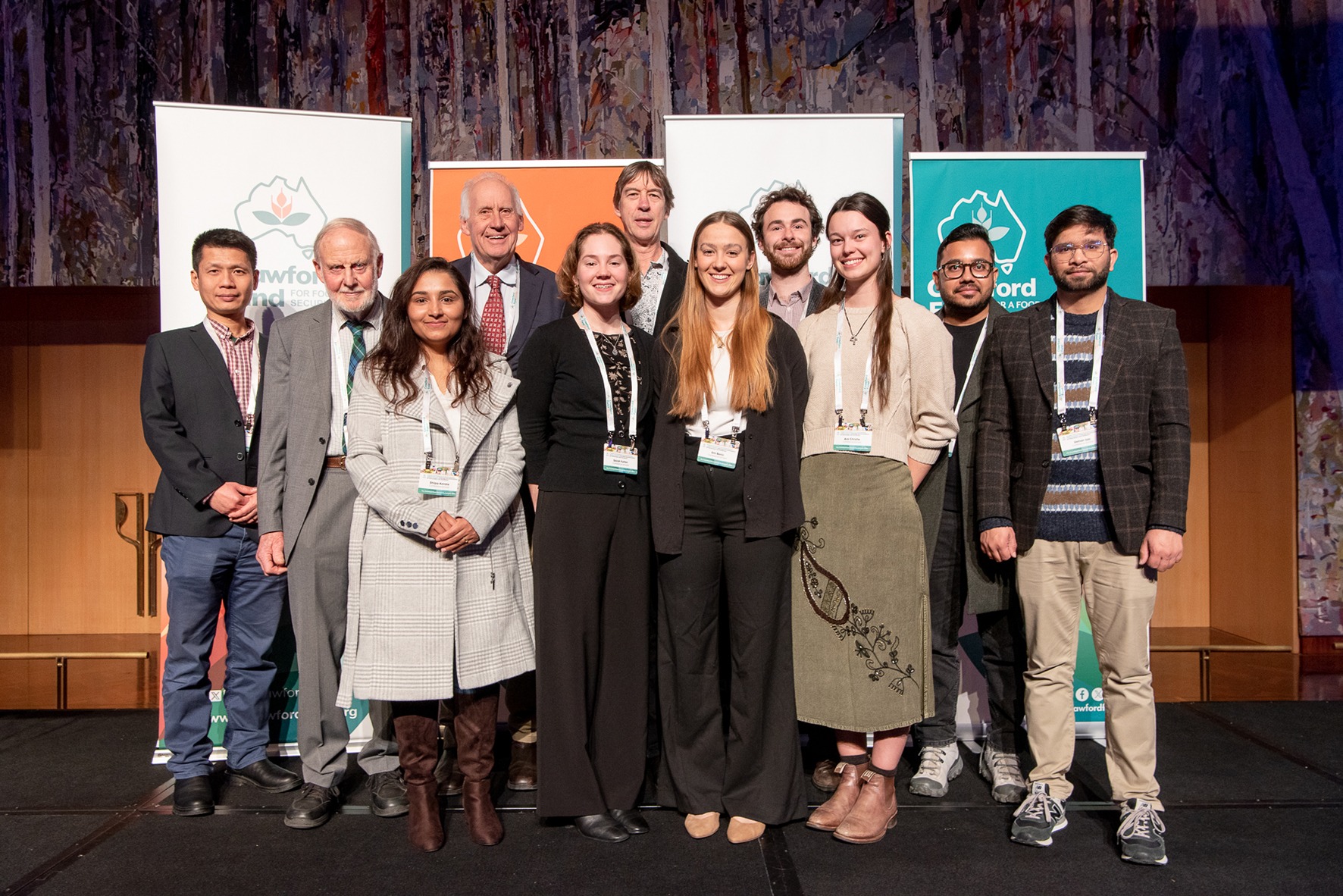
Our conference scholarship program started in 2010 in the hope that by experiencing the Crawford Fund conference and network, our special program of activities around the conference and being mentored by inspirational experienced researchers, young researchers would be inspired and energised to be more involved. The results have been fantastic, with a great mix of youth and experience at our flagship event each August and a growing and enthusiastic conference scholar alumni approaching 485.
Our competitive conference scholarships are offered to young people with a genuine interest in international agricultural research and development to attend the conference and a special set of activities that we have developed and shaped over the past 15 years.
Our other activities to encourage university students and early career researcher include highlighting opportunities in volunteering for projects overseas through the Australian Volunteers Program; our work with Researchers in Agriculture for International Development (RAID), and our special Henzell and Student Awards to enable students to experience overseas agriculture for development research while still at university.
One of the requirements of the scholarship is that each scholar provides us with a reflection on their experience. We will be providing these reflections over the coming weeks, grouped by State/Territory.
Once again, we would like to thank our wonderful mentors, mentioned alongside the scholar they supported, who volunteer their time and offer valuable guidance, support and insights to the scholars throughout the conference.
Seven scholars were supported by our Tasmanian Committee. Highlights of their experiences have been captured below:
Emi Benic, University of Tasmania
“Having an experienced cohort of experts to offer advice and facilitate professional connections was invaluable to the scholars and is something that I am truly grateful for.”
Ava Christie, University of Tasmania
“This experience has had a lasting impact on not only my professional aspirations, but on my view of climate change, international agriculture and food security, and I couldn’t be more grateful to the Crawford Fund for such a marvellous event.”
Sarah Fulton, University of Tasmania
“A consistent message throughout the three days was the importance of genuine community engagement and consultation…This strongly resonated with me and encouraged me to think more critically about how I approach my own research.”
Usman Ijaz, University of Tasmania
“I engaged with like-minded individuals and look forward to applying the knowledge gained to improve my personal and professional growth.
Fahad Khan, Tasmanian Institute of Agriculture, University of Tasmania
“Networking proved especially valuable, the conference connected me to a diverse community of peers, mentors, and future potential collaborators. Exchanging ideas, challenges, and solutions with others who share a drive for sustainability left me energised and more hopeful about our collective capacity for change.”
Shilpa Koirala, University of Tasmania
“A key lesson I took away was the critical role of food systems in strengthening resilience. The emphasis on adaptation alongside mitigation was particularly relevant and shifted my perspective on how to approach climate challenges in agriculture.”
Finlay Walton, University of Tasmania
“The event’s highlights, including the focus on sustainability, have inspired me to pursue research and collaborate in international agricultural development. I am now more committed than ever to contributing to efforts that ensure everyone has access to safe, nutritious, and sufficient food.”
Read on for the full reflections of each scholar:
Emi Benic, University of Tasmania
Mentor: Jen Bond
The 2025 Crawford Fund Conference was an incredible experience which shone light on agricultural research, food security and sustainability. The 2025 central theme of Progress and Prospects for Climate-Resilient Agrifood Systems: Actionable Recommendations for Policymakers and Practitioners felt both timely and urgent, addressing the complex challenge of secure food production and net-zero emission goals. Over the course of the conference, a range of sessions were thoughtfully structured around key themes. Session 1 featured Professor Glenn Denning and was exceptionally engaging, exploring the realistic challenges of achieving universal food security amid climate adversity.
His insights were a reminder that technical solutions must be paired with social and political movements in order to truly be impactful. The second session explored the question of whether humanity and planet earth can ‘feed the world with net-zero emissions’. As such, a range of speakers covered cutting-edge developments like carbon farming, low-emission rice cultivation, climate services, and silvopastoral systems. I found this session particularly engaging as it provided solid insight into current cutting edge projects and technological agricultural advancements. These early sessions particularly highlighted that innovation must adapt to the realities of farming, especially in diverse ecosystems.
The third session was again of particular interest, where speakers from Asia, Africa, and the Pacific offered lessons drawn directly from these regions. The shared message was clear – locally grounded adaptation strategies are essential for genuine and effective resilience. Session 4 addressed themes of equity, inclusion, and community participation, where case studies underscored the role of women and marginalised groups in shaping more resilient systems. Stories ranged from Cambodia to Timor‑Leste, the Cook Islands and Indonesia, revealing both the progress and the gaps in empowering communities at the frontline of climate change. The final session, session 5, brought these threads together in a multi-stakeholder conversation, where Caitlin McConnel – Australian Farmer and Lawyer – was a strong and captivating speaker, shining a light on the urgent need to bridge the gap between on ground farming practices and legal frameworks.
Beyond content, the conference shone in its inclusive atmosphere and networking opportunities, largely thanks to the professional team of young leaders from the RAID Network that was led by Mikayla Hyland-Wood. The intergenerational scholar-mentor program was a touching addition that helped early career research scientists like myself feel connected to and supported by the industry. These connections and conversations provided many opportunities and ensured that scholars felt well supported throughout the conference. Having an experienced cohort of experts to offer advice and facilitate professional connections was invaluable to the scholars and is something that I am truly grateful for.
Two key takeaways from the conference: 1) although global food security is a challenging problem, there are viable solutions only IF collaboration occurs across nutritional, technological, sustainability and agricultural disciplines and 2) scholars, leaders, practitioners and everyday people must work TOGETHER to shape a future where food security and sustainability walk hand in hand.
Ava Christie, University of Tasmania
Mentor: Richard Warner
The 2025 Crawford Fund Conference provided a remarkable opportunity to be exposed to high-order exchange of knowledge and experiences from across a breadth of nations, industries and projects. The theme, Progress and Prospects for Climate-Resilient Agrifood Systems: Actionable Recommendations for Policymakers and Practitioners, highlighted the global discourse between efficient food production and emissions-conscious goals for agricultural systems, as well as the pressing requirement for effective translation of research into practice with deep social and cultural consideration. For me as an undergraduate student still early in my degree, this was an incredibly insightful and an invaluable event that I am so grateful to have been able to attend.
This conference was exceedingly successful in taking both a broad perspective on the theme, whilst also narrowing in on notable cases of research, change and potential pertaining to the interplay between climate and food. I came away from this event with a sense of urgency for food system change that coupled with an understanding that a ‘ground up’ approach to such change is required. Such a multifaceted undertaking seemed vastly overwhelming at the beginning of the day. However, as we heard from Glenn Denning in his keynote address, partnerships in the Indo-Pacific region in particular have great potential to further climate-resilient food security in regional communities, with an outlook to an associated cumulative effect on universal food security.
Of the case studies of the day, highlights for me were delivered by Dr Tyron Venn and Dr Aditi Mukherji. Not only did Dr Mukherji detail the devastation of climate change on animal and cropping systems in Africa and Asia, she provided clear and encouraging solutions to such pressures, and I was left with a awareness that, with effective application of research and associated technology, a real difference could be made in affected nations. Similarly, Dr Venn’s summary of the potential for silvopastoral systems, a very new concept to me, was exceptionally inspiring. As someone deeply passionate about both human and planetary health (and likely quite impressionable so early in my exposure to international agriculture), I found the inclusion of such a broad range of experts and practitioners so enriching.
I was struck by the networking aspect of this conference, and particularly by how passionate and eager to engage a number of the mentors were across the broader three days. Richard Warner was an unbelievable mentor for me, and I cannot thank him enough for the learning, conversation and connection he facilitated for me. I was incredibly lucky in that number of other mentors also stepped in and ‘took me under their wing’ over the event, including Joseph Vile, Neville Mendham, Sam Coggins and the wider RAID team.
With an upcoming trip to Vietnam with the incredible Henzell Award, I went into this conference with the goal of preparing as much as I could for my first taste of international agriculture. A key takeaway was the immeasurable merit in listening to local communities and prioritising this perspective in policymaking. I predict this approach will be evident in our visit to Vietnam!
This experience has had a lasting impact on not only my professional aspirations, but on my view of climate change, international agriculture and food security, and I couldn’t be more grateful to the Crawford Fund for such a marvellous event.
Sarah Fulton, University of Tasmania
Mentor: Tim Reeves
The 2025 Crawford Conference, together with the scholar activities, was an inspiring and unforgettable experience. As Agricultural Science Honours student undertaking research in Fiji, it resonated deeply with me and reaffirmed the vital importance of Australia’s work in this field for advancing global food security.
Professor Glenn Denning spoke both at the conference and to the scholar cohort, delivering captivating presentations. His work on universal food security was both passionate and grounded, emphasizing that achieving a world without hunger or malnutrition requires transforming how food is grown, managed, and distributed through sustainable, equitable systems. He also stressed that a step-up in action and investment by Australia in agricultural research and development would be welcomed across the Indo-Pacific, as the nation’s expertise and strong partnership models could play a vital role in advancing food security and supporting regional peace and prosperity. For the scholar cohort, he also shared valuable advice on building a career in international agricultural development. His words of wisdom have stayed with me— “if in doubt, say yes,” the importance of gaining real “boots on the ground” experience, and the reminder that while you may need to be a jack of all trades in this field, you should also strive to be a master of one.
A consistent message throughout the three days was the importance of genuine community engagement and consultation. Rather than arriving with pre-determined solutions, the focus needs to be on asking people what they need, want, and value, and involving them in shaping the way forward. Without this, even the most well-intentioned interventions risk missing the mark; with it, solutions are far more likely to be meaningful, sustainable, and embraced by the communities they are designed to serve. This strongly resonated with me and encouraged me to think more critically about how I approach my own research.
Another highlight was networking with attendees and hearing the diverse pathways that professionals had taken into international agricultural research for development. Some stumbled into the field by accidentally attending the “wrong” lecture, while others began their journeys through volunteering in developing countries and being offered opportunities that shaped their careers. Networking with the other scholars was equally rewarding, as we were able to share our research, compare experiences, and build connections that I know will be valuable well beyond the conference. This reminded me that there is no single “right” path into this space—there are many ways to find your place in this field of work.
I am incredibly honoured to have been a part of the 2025 Crawford Fund Scholars Program. I would like to sincerely thank the Crawford Fund for coordinating such a meaningful event, the TAS Committee for sponsoring my attendance, and the RAID volunteers for their tireless contributions. A special thank you also goes to my mentor, Tim Reves, for his guidance throughout the program and for opening my eyes to future pathways and opportunities. As I return to complete my Honours project, I do so with a renewed sense of purpose and excitement.
Usman Ijaz, University of Tasmania
Mentor: Daniel Tan
Attending the Crawford Conference was a really inspiring experience. It gave me the chance to learn from leading experts and meet people who are passionate about agriculture and food security. I enjoyed the open discussions and the chance to share ideas with others who are facing similar challenges in their work.
I was especially grateful to attend with my mentor, Professor Daniel Tan. His guidance made the experience even more valuable, as he encouraged me to engage in conversations, ask questions, and think about how the topics discussed connect to my own research. Having his support throughout the conference gave me more confidence and helped me take away practical lessons for my growth. Overall, the conference not only expanded my knowledge but also motivated me to apply what I learned to both my research and my professional journey moving forward.
Fahad Khan, Tasmanian Institute of Agriculture (TIA), University of Tasmania
Mentor: Kaye Basford
Attending the Crawford Fund Conference 2025 on Progress and Prospects for Climate-Resilient Agrifood Systems was an invaluable experience that has deeply influenced my professional outlook and commitment to impactful research. While the sessions covered a remarkable breadth of topics; from net zero emissions and technological innovations to social equity in adaptation; the greatest value for me came from the practical insights, peer connections, and renewed sense of purpose that the event furthered.
The program featured distinguished speakers discussing pathways to net zero food systems, the importance of localized solutions, and the role of advocacy in enabling transformative change. Sessions offered impactful examples from Australia, Asia, and the Pacific, each demonstrating that progress in climate resilience is collaborative, context-driven, and rooted in partnerships between science and community. However, for me, the true highlights emerged not just from the formal presentations, but from the conversations that happened around them, organized meetings with mentors, dialogues with early-career researchers, and shared reflections with practitioners who are driving change at grassroots level.
What I found most rewarding was the spirit of inclusion and open exchange. Panelists repeatedly stressed that building climate-resilient agrifood systems demands more than research excellence; it requires humility, listening to local voices, and a willingness to co-design solutions. I was inspired by stories from Pacific Island nations and Southeast Asia that highlighted the powerful impact of locally led adaptation and the central role of women and marginalized communities in leading responses to climate change. These stories challenged me to consider how I can ensure equity and collaboration in my own research practice.
Networking proved especially valuable, the conference connected me to a diverse community of peers, mentors, and future potential collaborators. Exchanging ideas, challenges, and solutions with others who share a drive for sustainability left me energized and more hopeful about our collective capacity for change. The importance placed on actionable recommendations and real-world impact was a strong message: science and policy must go hand-in-hand, and our work must always be responsive to the needs of the communities we aim to serve.
Key takeaways I am bringing forward: transformation is a collective enterprise; diversity and participation are essential to resilience; and ultimately, resilient food systems depend on partnerships that blend evidence, innovation, and empathy. I leave the conference inspired, better equipped, and committed to translating these lessons into action, both in my current research and in future scientific endeavours.
TOGETHER, WE WILL MAKE THIS WORLD, A BETTER PLACE TO LIVE IN!
Shilpa Koirala, University of Tasmania
Mentor: Sally Norton
Attending the 2025 Crawford Fund Annual Conference, Progress and Prospects for Climate-Resilient Agrifood Systems: Actionable Recommendations for Policymakers and Practitioners was not just another event for me but a truly inspiring and transformative experience that combined learning, networking, and personal growth. The event brought together a vibrant mix of scholars, experts, and practitioners, all working toward the shared goal of creating a food-secure world. From the very beginning, the scholar–mentor pairing made a strong impact, providing both guidance and encouragement to the Scholars throughout the conference. I am especially grateful to my mentor, Dr Sally Norton, whose support made it easier to engage fully in the sessions and network with other participants. The speed meet facilitated by RAID, offered a space to share stories, exchange perspectives, and build meaningful connections. Likewise, the Scholar Day activities broadened my awareness of the opportunities available globally in areas of international agriculture research.
The conference, addressed some of the most urgent challenges of our time: climate change, food security, and the need for more effective policies and practices. The discussions emphasized the importance of systemic transformation, collaborative approaches, and knowledge sharing to drive real change. A key lesson I took away was the critical role of food systems in strengthening resilience. The emphasis on adaptation alongside mitigation was particularly relevant and shifted my perspective on how to approach climate challenges in agriculture.
Professor Glenn Denning’s session on achieving universal food security in an adversely changing climate was a highlight, as he stressed that while food security is achievable, it requires cross-sectoral, multi-level strategies, reformed institutions, and greater investment in research and development. Equally valuable were the regional case studies, which showcased innovative approaches to climate resilience from Asia, Africa, and the Pacific. These provided concrete examples of how different regions are responding to shared challenges while reinforcing the importance of context-specific solutions. The panel discussion featuring Dr Sonia Akter, Mr Acacio Sarmento da Silva, Ms Selane Tairea, and Ms Vyta Hanifah was insightful, offering diverse perspectives and practical insights on how to move forward collectively.
Overall, I returned from the conference with a wealth of knowledge and many meaningful connections. Each interaction offered new perspectives and reinforced my appreciation for the importance of global cooperation. The experience has opened my eyes to future opportunities and left me motivated to contribute meaningfully as a global citizen in building climate-resilient agrifood systems. It has also strengthened my commitment to pursuing impactful and collaborative research in sustainable agriculture development.
Finlay Walton, University of Tasmania
Mentor: Neville Mendham
I would like to begin by thanking the Crawford Fund for providing the opportunity to attend this year’s conference. The foundation of productive agricultural research and development is established through the meaningful collaboration and connection of scientists, and the Crawford Fund’s 2025 conference facilitated this very well. This year’s event focused on the current progress of climate adaptation in food systems, providing policymakers with actionable and tailored recommendations to build resilience in the industry. Paired with the scholars’ activities before and after the conference, the three days spent in Canberra were full of networking, insightful conversations with professionals and incredible presentations detailing the current state of our industry. It truly was a career highlight unfolding right in front of our eyes.
The conference has enhanced my understanding of global food security challenges and equipped me with new ideas and approaches to contribute to this field. The event’s highlights, including the focus on sustainability, have inspired me to pursue research and collaborate in international agricultural development. I am now more committed than ever to contributing to efforts that ensure everyone has access to safe, nutritious, and sufficient food.
One main highlight of the conference for me was the captivating keynote speech by Dr Glenn Denning, the Professor of Professional Practice at Columbia University in the US with a storied past in international agricultural development. His address on achieving universal food security in an increasingly changing climate was both thought-provoking and inspiring. By outlining the broader areas of financial and development investment for increasing food security and sustainability within our food systems, he laid the perfect foundation for the more targeted case study presentations later in the day. These affirmed the teachings from Glenn and provided science-backed evidence for recommendations moving forward. It is important to note how diverse the studies were, with professionals from many different sectors within science (social, modelling, plant, animal, etc) and even legal representatives bridging the much-needed gap across disciplines. By addressing the divide between professionals across disciplines, the global community can unlock the full potential of agricultural innovation and ensure more equitable development outcomes.
The scholar activities pre- and post-conference provided both context and a platform to foster collaboration amongst the young scientific community interested in international development. I was particularly engaged by the two panels on breaking in and working in research in a different country. The discussions offered valuable practical insights from leaders in the space, allowing us to make more informed decisions about our future. The key throughline of the need to take advantage of any salient opportunities became very clear. Considering I am heading into my honour’s year at the University of Tasmania, I felt that this content was incredibly important for considering my next steps after I graduate. Needless to say, I believe the word “yes” will be highly employed in my future career!
A final note on the importance of the mentorship program. I have to thank the Crawford Fund for supplying each scholar with a mentor, as I am very lucky to have met Neville Mendham. His wealth of knowledge in the industry and his passion for facilitating collaboration were apparent as soon as I met him, and I am sure I will stay connected with him for some time. It was only because of the networking insight gained through the meaningful discussions I had with him over the 3 days that I was able to build a generous portfolio of connections with professionals also attending the event. Without his guidance and careful encouragement, I am certain the week would not have been the success it was. Thank you Neville.