

“I left Canberra humbled by the scale of the challenges ahead, yet energised by the people I met, the stories I heard, and the possibilities that lie ahead.” – Our scholar reflections from VIC
August 28, 2025
The Crawford Fund’s Annual Conference was held earlier this month in Parliament House, Canberra. As well as bringing together the world’s leading experts in agricultural science, research, policy, development and industry to address the conference topic, the Crawford Fund is committed to encouraging the next generation in international agriculture for development to the event via scholarships awarded through our State and Territory committees and scholar supporters.
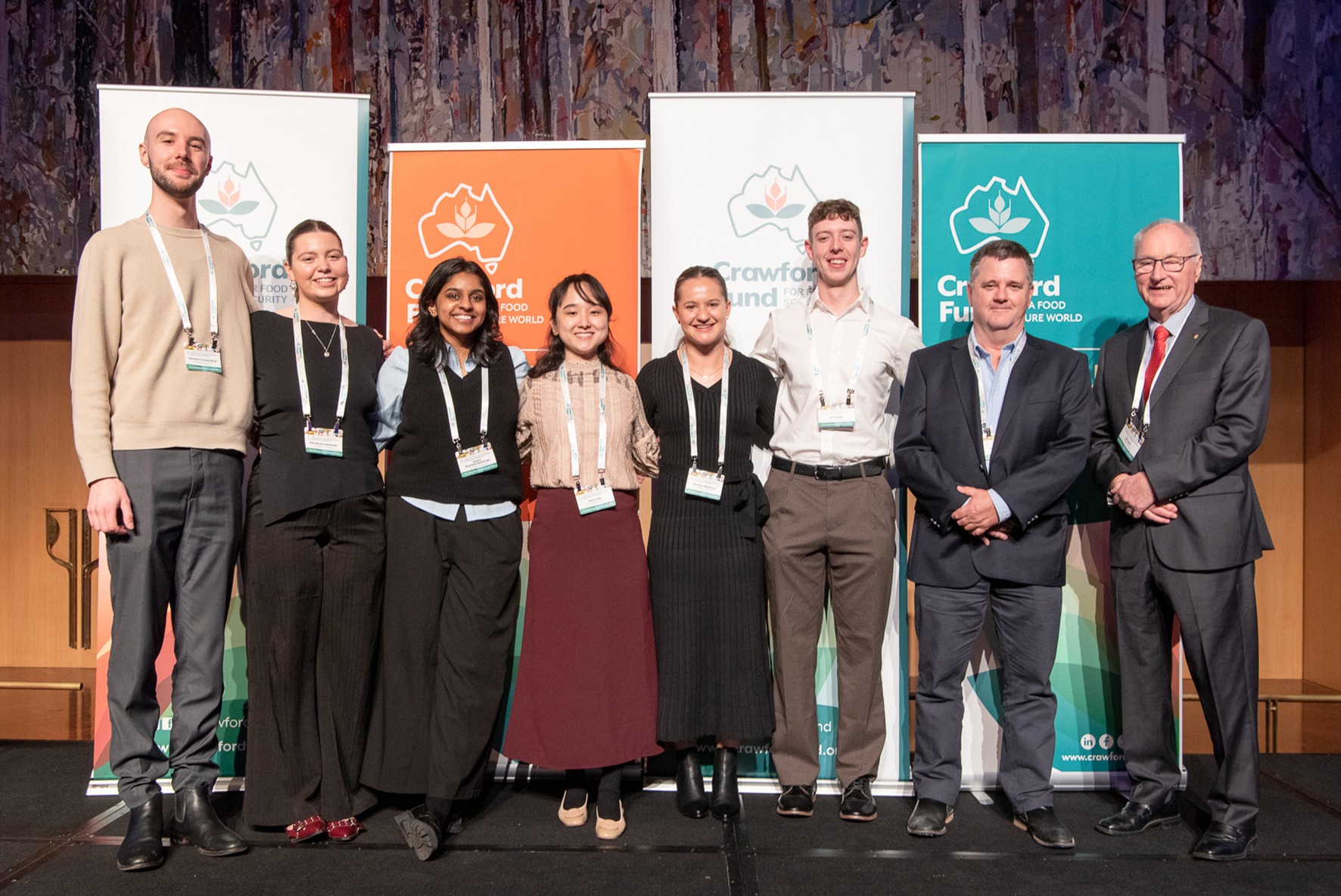
Our conference scholarship program started in 2010 in the hope that by experiencing the Crawford Fund conference and network, our special program of activities around the conference and being mentored by inspirational experienced researchers, young researchers would be inspired and energised to be more involved. The results have been fantastic, with a great mix of youth and experience at our flagship event each August and a growing and enthusiastic conference scholar alumni approaching 485.
Our competitive conference scholarships are offered to young people with a genuine interest in international agricultural research and development to attend the conference and a special set of activities that we have developed and shaped over the past 15 years.
Our other activities to encourage university students and early career researcher include highlighting opportunities in volunteering for projects overseas through the Australian Volunteers Program; our work with Researchers in Agriculture for International Development (RAID), and our special Henzell and Student Awards to enable students to experience overseas agriculture for development research while still at university.
One of the requirements of the scholarship is that each scholar provides us with a reflection on their experience. We will be providing these reflections over the coming weeks, grouped by State/Territory.
Once again, we would like to thank our wonderful mentors, mentioned alongside the scholar they supported, who volunteer their time and offer valuable guidance, support and insights to the scholars throughout the conference.
Four scholars supported by our Victorian Committee and two scholars supported by the Gardiner Foundation attended the 2025 Crawford Fund conference from Victoria. Highlights of their experiences have been captured below:
SUPPORTED BY THE CRAWFORD FUND VICTORIA COMMITTEE:
Brandon Conway-Rusk, Department of Agriculture, Forestry and Fisheries
“The emphasis on youth engagement and capacity building resonated strongly with me, as I see the role of early-career professionals as crucial to sustaining momentum in agrifood development. These peer-to-peer connections were invaluable, and I look forward to keeping in touch with my fellow scholars as we grow in our respective careers.”
Ellie Maeve Gerhardy, Deakin University
“Overall, the conference was a fabulous and enriching experience that gave me the confidence to build networks and friendships with like-minded peers. It also helped me better understand the real-world challenges that lie ahead for us as future researchers and practitioners working in global food and nutrition security.”
Sneha Rajackal Senthil Vel, University of Melbourne
“This opportunity has not only expanded my professional network but has also strengthened my sense of purpose in bridging the gap between research and policy. The conference taught me that food security is world security. I am determined to contribute to agricultural systems that are productive, sustainable, equitable, and resilient.”
Gracia Sie, University of Melbourne
Mentor: John Dalton
“I left Canberra feeling both humbled and energised: humbled by the scale of the challenges ahead, yet energised by the people I met, the stories I heard, and the possibilities that lie ahead. I carried not only notes and connections as I returned to Melbourne, but also a renewed sense of purpose and a quiet confidence that my work can, and will, make a difference.”
SUPPORTED BY THE GARDINER FOUNDATION:
Monique Berkhout, La Trobe University and Agriculture Victoria
“I wouldn’t hesitate to recommend the Crawford Fund Scholar Program to eligible peers, as both a personal and professional growth and development opportunity.”
Ian Hodge, University of Melbourne
“The breadth of topics covered from issues confronting agriculture in emerging economies to strengthening global partnerships broadened my perspective and challenged me to think critically about how my own work fits within the bigger picture.”
READ ON FOR THE FULL REFLECTIONS OF EACH VIC SCHOLAR:
Brandon Conway-Rusk, Department of Agriculture, Forestry and Fisheries
Mentor: Kym Anderson
The Crawford Fund’s 2025 conference was an amazing opportunity to gain insight into the agriculture for development field, and to connect with influential researchers, program designers, and scholars in the field. I am grateful to have attended as a scholar, as it allowed me the opportunity to not only learn from leaders, but also from other scholars in similar positions to me.
As a graduate working for the Department of Agriculture, Fisheries and Forestry, I was drawn to this year’s theme ‘Progress and Prospects for Climate-Resilient Agrifood Systems: Actionable Recommendations for Policymakers and Practitioners’. The conference helped me to realise that food security has greater sociological impacts than simply meeting one’s caloric needs. Food security plays a part in overall health, community resilience, economic stability, and even national security. It was particularly valuable to hear how different regions are approaching resilience in ways that balance productivity, sustainability, and equity.
In particular, Glen Denning’s discussion on achieving universal food security in an adversely changing climate helped place Australia’s role in global food security into perspective. Dr Purnima’s talk and subsequent panel discussion also reminded me that climate change isn’t felt equally, and that there needs to remain a focus on equitable solutions to food security and resilience. Another key theme that stood out was the importance of cross-disciplinary collaboration – recognising that climate resilience is not only a matter of agricultural science, but also of economics, sociology, and policy.
I also found the informal conversations between sessions to be just as insightful as the panels themselves, as they gave me a sense of the diversity of pathways young professionals are taking in this field. The emphasis on youth engagement and capacity building resonated strongly with me, as I see the role of early-career professionals as crucial to sustaining momentum in agrifood development. These peer-to-peer connections were invaluable, and I look forward to keeping in touch with my fellow scholars as we grow in our respective careers.
While still in my infancy as a public servant, the conference has given me invaluable insights and connections in the agricultural development space that I am excited to carry forward. It also reminded me of the importance of strong partnerships between Australia and our neighbours in the Indo-Pacific, particularly in sharing knowledge and strengthening regional food systems.
I’d like to express my sincere gratitude to the Victorian Crawford Fund Committee for the opportunity to attend the conference as a scholar, and to Kym Anderson for his mentorship throughout the program. It was a wonderful experience that I cannot wait to share with friends and colleagues. I look forward to keeping up with both the Crawford Fund and the Researchers in Agriculture for International Development (RAID) network, and I feel motivated to continue contributing to the development of climate-resilient agrifood systems in my work.
Ellie Maeve Gerhardy, Deakin University
Mentor: Cathy O’Mullan
As a Nutrition Science student, my journey into the agriculture sector has been somewhat indirect. However, nutrition security is a deep passion of mine and an area I hope to work in after completing my Master of Dietetics. Attending the Crawford Fund Conference in 2025 Progress and Prospects for Climate-Resilient Agrifood Systems: Actionable Recommendations for Policymakers and Practitioners was an exciting and enlightening experience. Being my first ever conference, it gave me valuable insights into food insecurity and agriculture for development, but also the opportunity to connect and collaborate with other scholars and established professionals in the sector. It was inspiring to be in a room filled with people who are passionate about creating sustainable and inclusive food systems.
I currently work with a social enterprise that tackles food insecurity across Greater Geelong through food rescue, nutrition and employment education. One of my biggest takeaways from the conference was the importance of truly listening to communities, rather than arriving with preconceived ideas of what they need. The concept of a “boots on the ground” approach really resonated with me, and I will carry this forward in my own work; particularly as I aim to continue my studies in remote Australian communities.
I particularly enjoyed the sessions focused on gender equity and inclusion, and the impact these issues have on food insecurity worldwide. Talks by Dr Sonia Akter and Dr Purnima Menon were especially impactful. I found their research and experiences highlighted just how vital inclusivity is when designing food and agriculture programs that are effective and sustainable.
A true highlight of the conference was the brilliant conversations I had with my fellow scholars. It was a unique and special experience to meet students and early-career professionals who are equally passionate about the future of food security. These discussions challenged and inspired me, and I left feeling energised and hopeful.
Another special part of my experience was being mentored by Cathy O’Mullan, who generously shared her career journey and research insights with me. Learning from someone whose work continues to shape the field was both inspiring and motivating. Overall, the conference was a fabulous and enriching experience that gave me the confidence to build networks and friendships with like-minded peers. It also helped me better understand the real-world challenges that lie ahead for us as future researchers and practitioners working in global food and nutrition security. A big thank you to the Crawford Fund for this incredible opportunity and for investing in the next generation of professionals in agriculture, development and food security.
Sneha Rajackal Senthil Vel, University of Melbourne
Mentor: Brendan Rodoni
I was privileged to attend the 2025 Crawford Fund Annual Conference as a Crawford Fund Scholar. This year’s conference theme was Progress and Prospects for Climate-Resilient Agrifood Systems: Actionable Recommendations for Policymakers and Practitioners, and I was privileged to listen to interesting discussions on how science and policy intersect to address the challenges of food security in a changing climate.
The three-day experience involved various Scholar activities, the main conference, and many networking opportunities. These sessions presented opportunities for me to learn from experts in agricultural research, development, and policy. I am grateful for this experience, which expanded my knowledge and understanding of the policy dimensions of agrifood systems. It also emphasised the role of governance, economics, and international collaboration in creating meaningful change. Cross-sectional collaboration is vital to making equitable food systems, and addressing underlying barriers to food security.
The “Can We Feed the World with Net Zero Emissions?” symposium was the most interesting for me. The session opened with an overview by Professor Richard Eckard, followed by case studies from Dr Ando Radanielson, Ms Caitlin, Dr Leanne, and Dr Tyron Venn. The presentations were diverse, each with unique policy recommendations, which was insightful for me to learn. The speakers also explored the complex trade-offs between agricultural productivity and environmental impact, noting that current political infrastructure is not adequate to ensure equitable and secure agrifood systems. Cross-sector policy frameworks, market incentives, and community-driven solutions will need to work together if we are to achieve net-zero food systems without compromising livelihoods or food access.
There were sessions run by DFAT and ACIAR, which made me appreciate the role of international collaboration, especially because regulations, trade agreements, and international cooperation will ultimately shape how fair systems can be implemented.
Finally, the highlight of the Scholar Program was meeting all the other scholars, a diverse group of emerging researchers and scientists from various disciplines, all brought together by their commitment to solving food insecurity. It was lovely to meet and collaborate with these people, and the friendships we made were the most enriching aspect of the program.
As a Master of Biotechnology student, I have often focused on the research and innovation side of sustainable agriculture. However, after the symposium, it became clear that science and policy must operate together to develop more equitable and secure food systems.
I am deeply grateful to the Crawford Fund for awarding me this scholarship and for their dedication to supporting the next generation of agricultural scientists. This well-structured program blended knowledge-sharing, networking, and mentorship, which was invaluable for me. I am also appreciative of the RAID network for helping facilitate this program and for their hard work in ensuring it was a rewarding experience. This opportunity has not only expanded my professional network but has also strengthened my sense of purpose in bridging the gap between research and policy.
The conference taught me that food security is world security. I am determined to contribute to agricultural systems that are productive, sustainable, equitable, and resilient.
Gracia Sie, University of Melbourne
Mentor: John Dalton
August 2025 marked my sixth month in Australia and in Melbourne as I embarked on my journey as a graduate research student at the University of Melbourne. I am honoured and grateful to have been awarded the Crawford Fund Scholarship, which allowed me to attend the Crawford Fund Annual Conference 2025. This wonderful opportunity had truly been a highlight of my academic experience. As a part of one of my firsts as an international student, attending this conference as one of the conference scholars was one of the most exhilarating experiences I have ever had so far.
I remember when I first met my mentor, John Dalton, who had a rich experience in development projects across the world. Both of us clicked instantly in our conversation in our first meeting at the Day 1 kick-off on August 11. We passionately discussed the state of development projects, how some faced failure despite the well-meant objectives, and what can be done better. I am keen to have him as my mentor along my research and possible career journey in livelihood development projects for the longest run.
Having only finished my MPhil candidature confirmation seminar less than two weeks before, attending this conference not only strengthened my determination to pursue a career in environmental consultancy, sustainable livelihoods, and ecosystem restoration, but also greatly helped build my confidence and networking skills. I remember my mentor introduced me to Helen Scott-Orr, with whom I also had long conversations. Through her I learned how to build my confidence and connect with people in these events and subsequently exercised it.
I attended the conference day on Tuesday, 12 August, with my research in mind—exploring representations of Dayak Ngaju indigenous women and men in land use and livelihood interventions in Central Kalimantan. Session 4 on Resilience Through Equity, Inclusion, and Community Participation resonated well with my work and enabled me to understand the gendered lens of maintaining resilience in achieving sustainable livelihoods and food security. In addition, Selane Tairea provided an interesting perspective on balance in community participation in Rarotonga, Cook Islands, which ideally should be implemented elsewhere.
Recognising the complex dynamics of current global predicaments and their effects on the climate, environment, and the people within, I remember Alison Bentley’s quote on the reality that we cannot change the world instantly, which keeps me on my toes. Nevertheless, this conference reminded me of why I chose this path in the first place—to contribute in my own way to building more sustainable and equitable livelihoods. I left Canberra feeling both humbled and energised: humbled by the scale of the challenges ahead, yet energised by the people I met, the stories I heard, and the possibilities that lie ahead. I carried not only notes and connections as I returned to Melbourne, but also a renewed sense of purpose and a quiet confidence that my work can, and will, make a difference.
READ ON FOR THE FULL REFLECTIONS OF EACH GARDINER FOUNDATION SCHOLAR:
Monique Berkhout, La Trobe University and Agriculture Victoria
Mentor: David Magill
The 2025 Crawford Fund Scholar Program was an extremely valuable experience to which I had the privilege of participating in. This year’s theme, Progress and Prospects for Climate-Resilient Agrifood Systems: Actionable Recommendations for Policymakers and Practitioners, aligns closely with the research projects I am involved in as part of my employment and my PhD research.
The conference itself provided valuable insights and perspectives that have helped me grow both as a person and a researcher. I was able to gain a deeper understanding of the complexities around food security in a changing climate and contextualise my own contributions towards sustainable agricultural development at the global level.
Some key takeaways for me include:
- there are challenges involved with sustainable intensification of agriculture and conflicts between the provision of global food security and achieving our commitment to mitigating greenhouse gas emissions,
- there needs to be more focus on the ‘net’ of our net zero emissions goal by placing more focus on sequestration,
- synergy between smallholder producers, agricultural researchers and policymakers, as well as addressing global inequality, is required to simultaneously achieve food security and resilience in the agri-food sector,
- potential solutions exist to sustainably address the climate crisis, but they are not cost-effective and agricultural research is grossly underfunded, thus more investment is needed into climate resilient technologies to help farmers transition to a low emissions system that is sustainable and cost-effective, and
- shifting our mindsets around capacity building; rather, to engage in capacity exchange where both parties learn from each other.
Attending the Scholar Program gave me the opportunity to meet a diverse range of inspiring people who I hope to stay in touch with for life. From other scholars, to leading agricultural researchers and other industry professionals, to policymakers; I was able to connect with like-minded people who come from diverse backgrounds and are on a wide variety of different pathways. Scholars were encouraged to say yes to opportunities, promote and advocate for sustainable agricultural research, stay openminded, and listen more than talk.
The Crawford Fund committee and the RAID Network created a safe and supportive space that empowered scholars to approach a new person, introduce themselves and engage in meaningful conversations. This experience has removed some of the fear around networking and equipped me with the confidence to engage in future opportunities. Additionally, mentors and mentees were strategically matched to suit both parties. I knew straight away that mine was the right fit for me. My mentor, David McGill, immediately made me feel at ease and supported me to step out of my comfort zone and get the most I could out of the program and the networking opportunities, and for that I am incredibly grateful. I wouldn’t hesitate to recommend the Crawford Fund Scholar Program to eligible peers, as both a personal and professional growth and development opportunity.
It was an honour to have been given the opportunity to attend the 2025 Crawford Fund Scholar Program. I look forward to continuing to work towards an agriculture sector that is resilient to the changing climate and remains socially, economically and environmentally viable into the future.
Ian Hodge, University of Melbourne
Mentor: Jonathan Rushton
Attending the 2025 Crawford Fund Conference as a scholar was a truly enriching and inspiring experience, offering a rare opportunity to connect with like-minded individuals passionate about agricultural research for development. Over the three days in Canberra, I was able to engage with mentors, peers, and leaders in the field, deepening my understanding of the challenges and opportunities in global agriculture, while also expanding my professional network.
Our program began on Monday with the first half-day of scholar activities and great advice from speakers at Eastlake Football Club. Listening to Kate Thwaites share practical advice for those interested in engaging in international agricultural research was particularly insightful. The introductory day provided a welcoming environment to meet my mentor and fellow scholars, participate in group sessions designed to spark conversation, share experiences, and gain insights into diverse perspectives on agricultural sustainability and strategies to address climate vulnerability. These discussions created a sense of camaraderie early on and laid the foundation for the networking to come.
That evening, we gathered at Parliament House for the Sir John Crawford Memorial Address and networking dinner in the Great Hall. Being in such a prestigious venue added a special significance to the evening, I found the atmosphere both energising and humbling. Networking over dinner was a highlight, it allowed me to engage with a diverse range of participants, from policy makers to researchers, all committed to making a difference.
Tuesday was the core of the conference, a full day in the Great Hall with plenary presentations, panel discussions, and Q&A sessions. The keynote address from Professor Glenn Denning was thought-provoking, providing technical advice for agricultural innovation while addressing global food security. The breadth of topics covered from issues confronting agriculture in emerging economies to strengthening global partnerships broadened my perspective and challenged me to think critically about how my own work fits within the bigger picture. The event also reinforced the importance of interdisciplinary approaches in tackling agricultural and environmental challenges, a point effectively illustrated by Professor Richard Eckard through his discussion on questionable carbon offsets and the push to reduce livestock numbers in pursuit of climate targets. That evening’s RAID (Researchers in Agriculture for International Development) networking event at the Kingston Hotel was an enjoyable and relaxed opportunity to connect with early-career researchers and exchange stories, ideas, and advice.
The final morning on Wednesday brought the second half-day of scholar activities. These sessions were practical and forward-looking, focusing on skills, strategies, and opportunities to continue contributing to agricultural development beyond the conference. The closing discussions left me feeling motivated and equipped to take the insights I had gained back into my own work.
Overall, the Crawford Fund Conference was an invaluable professional experience. It not only deepened my understanding of agricultural research in an international context but also strengthened my confidence in contributing to this space. The connections made, both personal and professional, are ones I hope to maintain and build upon in the years ahead. I am grateful to have been part of this program and for the generosity of the Gardiner Foundation for sponsoring my scholarship and those who shared their knowledge, time, and experiences so openly.