

Biosecurity training for forage and livestock systems of mid-career scientists from Laos and Cambodia
March 19, 2026
The Crawford Fund for Food Security’s SA Committee supported a training activity which involved a study mission for Dr Chhay Ty from Cambodia and Dr Ammaly Phengvilaysouk from Laos, to Australia, where they received training on modern livestock systems with a focus on biosecurity, feed management and meat science and were taken on visits to best-practice agricultural facilities and enterprises.
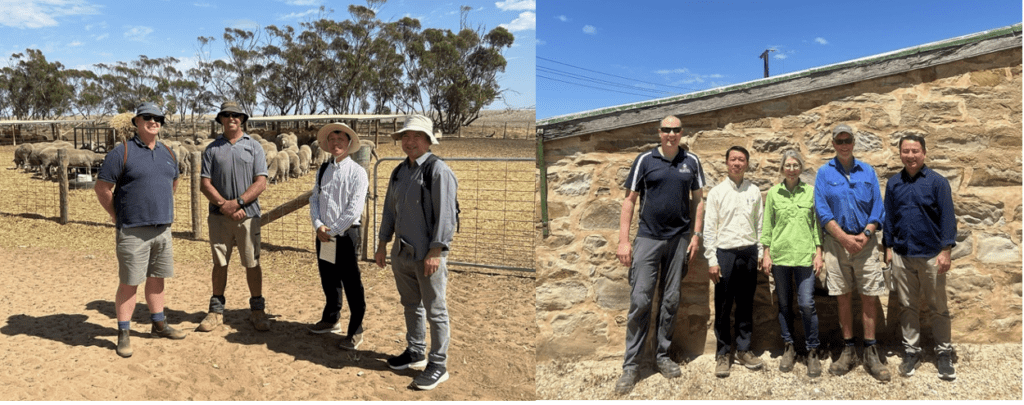
Left: Participants Chhay Ty (second from right) and Ammaly Phengvilaysouk (far right) meet with Mallee farmer Mr Brenton Kroehn (second from left) and Dr Andrew Smith (far left) to discuss containment feeding to reduce erosion control and enhance livestock finishing. Right: Chhay (second from left) and Ammaly (far right) meet with livestock producers Sally (green shirt) and Joe Keynes (second from right) and Dr Matt Denton (left) Andrew Smith (far left) to discuss sheep production, technologies and biosecurity.
“The livestock sector provides critical role to support livelihoods and provide jobs in Cambodia and Laos, however, the mostly smallholder-based production systems remain challenged by limited access to knowledge on effective animal husbandry practices and measures to improve productivity,” said Prof Matthew Denton from the School of Agriculture, Food and Wine, at Adelaide University.
“Increasingly, markets and consumers are demanding that the sector deliver more meat and dairy products with higher quality standards, better food safety measures, and production practices that are equitable, sustainable and climate friendly,” he said.
“Local thought leaders with appropriate vision and guidance are necessary to ensure that development activities deliver improved livelihoods alongside safe, affordable, and nutritious diets for all, and Drs Chhay Ty and Ammaly Phengvilaysouk were carefully chosen for this opportunity because of their leadership roles and excellent potential to deliver impact within their countries across the next decade,” said Matthew.
“Both Chhay and Ammaly have been involved in facilitating and managing pastures and livestock systems in our ACIAR project that serves to integrate forages into cropping systems to improve smallholder livelihoods. Given that the livestock systems in Laos and Cambodia are currently poorly developed, this was an opportunity for the participants to see firsthand Australian best practice in livestock feed provision, livestock management and biosecurity through the value chain from production to meat processing, visiting key stakeholders in these businesses,” he explained.
“Further, the two participants are highly engaged in the pasture and livestock research and production in their respective countries and have connections to government, universities and to international projects, and likely have an extraordinary opportunity to use these skills in the future endeavours to promote best practice management to their current and future staff,” he said.
During the training, the participants visited numerous businesses and government facilities that showcased best practice in industry production values and biosecurity technologies in both South Australia and Western Australia.
In Western Australia, they met with world leading animal production scientists, and pasture scientists Murdoch University. They also visited a state of the art laboratory focusing on antimicrobial resistance, and farms in York, Brookton and the Avon Valley that showcased best practice farming in those regions.
In South Australia, the two researchers visited leading sheep farmers in the Barossa and in the Murray Mallee regions. Here they discussed topics such as automated drafting, sorting and weighing of livestock using electronic tag systems, and the use of containment feeding to both protect land quality and to finish livestock. Additionally, the group visited a 30,000 head feedlot at Tintinara and a world class meat processing facility in Murray Bridge. At all of these sites, the participants had the opportunity to discuss in detail the constraints and opportunities in the industry and how both production and by security were optimised.
The researchers will share the knowledge and experience gained from their visit with their Cambodia and Laos collaborators particularly around pastures, legume intercropping, soil quality, feed use and livestock supplements.