

Detection of triazole pesticide residues and its impact on food safety in rice production systems, TropAg
October 29, 2025
The Crawford Fund’s Queensland Committee has again partnered with the TropAg International Agriculture Conference to assist 10 young researchers from developing countries attend and present their science at this international conference which will be held in Brisbane from 11-13 November 2025.
Successful conference scholarship candidates must be an Honours or Postgraduate student from a developing country who is currently studying at a Queensland tertiary institute, and they must be an author or co-author on a submitted TropAg 2025 Conference abstract.
In the lead-up to the conference we will be publishing short blog posts written by the young researchers about their work. Here is the latest blog.
By Michelle Anne Bunquin, University of Queensland
My project addresses a major challenge in Vietnam’s rice industry. To meet high yield demands, Vietnam relies heavily on pesticides, particularly triazole-based fungicides such as tebuconazole, hexaconazole, and tricyclazole to control the devastating rice blast disease.
However, these compounds are chemically persistent and can accumulate in rice grains at levels exceeding the maximum residue limit (MRL), raising food safety concerns and limiting access to international markets.
Recognising these implications, there is a pressing need for regular residue monitoring, ideally conducted before harvest and market distribution. While liquid chromatography coupled with mass spectrometry (LC-MS) remains the gold standard for pesticide residue analysis, these methods are costly, time-consuming, and require technical expertise. This highlights the importance of developing rapid, on-site detection strategies that are both reliable and accessible.
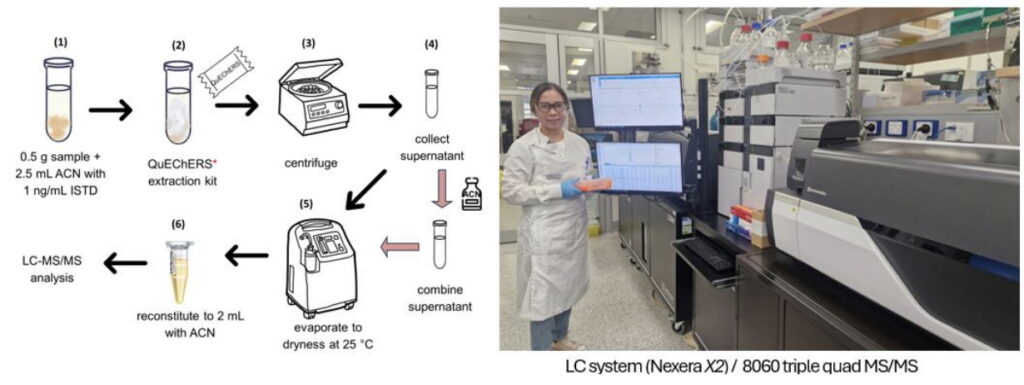
To address this, my research integrates instrumental and biochemical approaches to detect triazole fungicide residues. As a preliminary activity, I developed and validated an LC-MS/MS method for fungicide detection in rice grains (see image), which will serve as the core analytical technique for generating baseline residue data and for validating alternative detection strategies. Building on these results, I am exploring how tebuconazole, a triazole fungicide, affects tyrosinase enzyme activity, which establishes the groundwork for quantification and biosensor development.
The long-term goal is to translate this foundational science into a practical, field-deployable detection model that supports rapid monitoring of pesticide residues in rice systems.
This research supports the Future Foods theme by promoting innovative, sustainable, and safe food production that strengthens the reliability of the global food supply chain.