

Holistic management for Ugandan small landholders
October 9, 2025
Earlier this year, with support from the Crawford Fund WA Committee, educators from the Institute of Regenerative Leadership travelled to the Kassanda district of Uganda to deliver Holistic Management education to small landholders in partnership with the Agri-Aid Foundation, based at Barnebe Farm.
“This trip marked the beginning of a grassroots initiative to empower local farmers with the tools and knowledge to restore ecological balance, improve food security, and build long-term resilience in the face of environmental change,” said Barb Howard from the Institute of Regenerative Leadership.
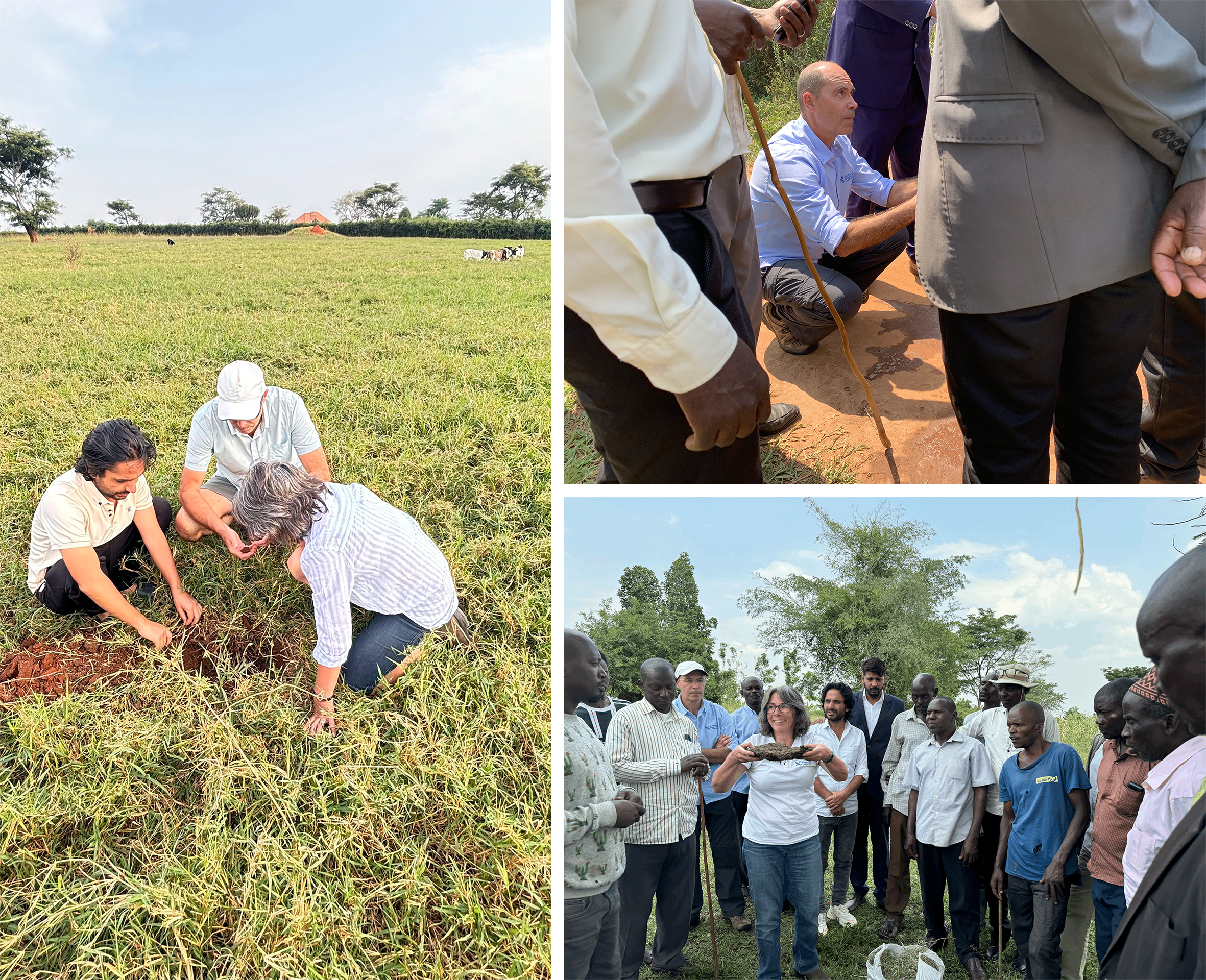
grazed pasture. Top right: Dr Bernard Callus demonstrates the difference in water infiltration between bare soil and ground covered with mulch showing how simple practices can prevent erosion and improve moisture retention. Bottom right: Barb Howard leads a hands-on compost-making demonstration showing how simple, local materials can build soil fertility and support regenerative farming practices.
According to Barb, the need for such a program was clear. Farming communities in Kassanda are facing mounting challenges caused by a drying climate, widespread deforestation, and decades of extractive agricultural practices. Many small-scale farmers in the district experience declining yields due to soil erosion, compaction, loss of biodiversity, and unpredictable rainfall patterns. These problems are further complicated by limited access to technical support, affordable inputs, and formal education opportunities.
In response, the visiting team, Barb and Dr Bernard Callus, delivered a simple, hands-on training program using the Holistic Management framework.
“This globally recognised decision-making tool teaches farmers to manage four interrelated ecological processes: the small water cycle, mineral cycle, community dynamics (biodiversity), and energy flow. The framework helps participants understand how to restore landscape function and soil fertility by working with nature rather than against it,” she explained.
Recognising the language and literacy barriers in the region, most participants spoke little or no English, the team adapted their approach to be as practical and visual as possible. Simple illustrations, demonstrations, and fieldwork were used to convey key concepts.
“Participants learned about the importance of ground cover and compost, tree planting to stabilise microclimates, and how overgrazing and monocropping disrupt the water cycle and lead to declining soil health. Workshops also included demonstrations on water infiltration and the benefits of regenerative techniques like mulching, crop spacing, and mob grazing,” said Barb.
“Importantly, the sessions were conducted with deep respect for local knowledge and customs. Rather than delivering a top-down message, the training emphasised shared learning, collaboration, and the value of community-led solutions,” she said.
“This approach resonated strongly with participants, and the workshops were enthusiastically received, with some expressing excitement about testing the ideas on their own farms. Women and youth were especially engaged, highlighting the potential of regenerative agriculture to offer opportunities for future generations.”
As far as the future goes, the trip also laid the foundation for a longer-term initiative – the Plant Rain Project – which aims to reach 45 villages over the next three years through a “train-the-trainer” model. The next phase includes the construction of a scaled-down community tree nursery at Barnebe Farm and the rollout of a monthly farmer education program that will build on these workshops.
“The Plant Rain Project program will prioritise inclusive participation, community development, and careful rollout to prevent unintended conflict or inequality,” said Barb.
“This collaboration between Ugandan and Australian partners exemplifies the potential of cross-cultural, locally driven regeneration projects. With the right support, smallholder farmers can become the stewards of a more hopeful future—restoring not only their landscapes, but the social fabric and economic resilience of their communities,” concluded Barb.