

Mentoring and training in disease and pest diagnostics in Laos
March 19, 2026
The Crawford Fund For Food Security’s NSW Committee recently supported a mentoring and training activity at the Department of Agriculture and Environment Pakse City in Champasak Province, Laos. This activity is part of a long term program established in 2012 to assist the technical staff of the Champasak Provincial Agriculture and Forestry Office (PAFO) to identify diseases in over 55 vegetable, fruit and industrial crops. In addition isolates of pathogens have been deposited in the International Collection of Microorganisms from Plants (ICMP) in New Zealand to support the crop disease lists used for underpinning export initiatives. It has also involved the development of a diagnostic clinic for plant diseases and pests.
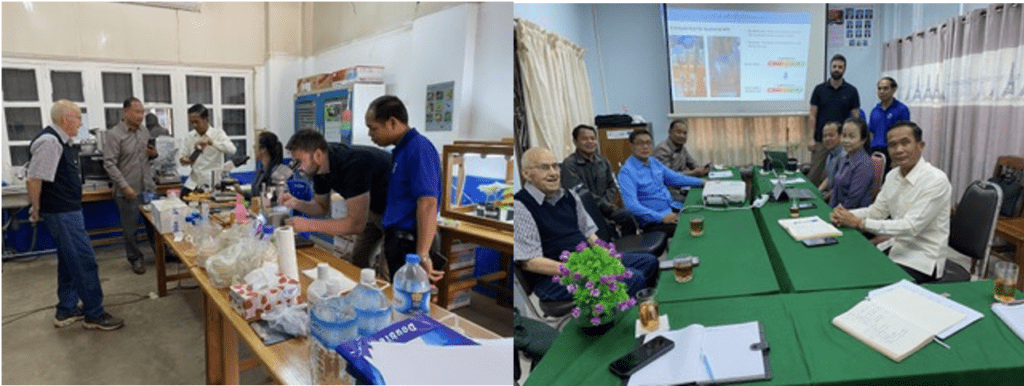
Left: Stacy Cavanagh and PAFO staff in the Crop Disease Diagnostic Laboratory. Right: Stacy with PAFO and DAFO and university staff during his presentation.
“This project provided a valuable professional development experience for Mr Stacy Cavanagh from the NSW Department of Primary Industries’ Elizabeth Macarthur Agricultural Institute (EMAI) as he was able to survey diseases in a wide variety of crops in the field and collect specimens for isolation studies in the laboratory. This contrasts with his diagnostic role at EMAI where he mainly works with specimens submitted to the diagnostic laboratory by growers,” said Prof Lester Burgess from the University of Sydney, who has been leading pathology mentoring and training activities in Vientiane, Laos since 2009.
Stacy’s focus was on bacterial wilt and Pythium spp. Dr Len Tesoriero kindly provided plates of selective media for isolation of Pythium species, and eight cultures were purified and forwarded to the ICMP in Auckland for preservation and sequencing.
“Stacy presented an engaging PowerPoint presentation on his findings to the technical staff at PAFO, DAFO and a lecturer from the Champasak University. He outlined the key steps in isolating fungal and bacterial pathogens, and the nature of plant pathogenic nematodes. Following the presentation participants asked to inspect isolation plates in the laboratory and were also shown live nematodes under the microscope,” said Lester.
While in Laos, Lester also followed up on research underway to monitor Huanglongbing (HLB) Disease of Citrus. From a biosecurity perspective, HLB disease continues to be a focus of activities in Laos as it is not present in Australia, but represents a serious exotic threat to the citrus industry.
“As the citrus team at EMAI have a key interest in this disease we have been collecting leaf midrib samples for use in refining their detection protocols for many years. HLB continues to cause tree decline and death in backyard plantings and small farms along the Mekong River. Samples of leaf midribs were again collected from various locations,” he said.
The team also monitor for the presence of the vector of HLB (Diaphorina citri) which has not been found above 1,000 metres. Monitoring also includes a thirty hectare, Lao Thanathon citrus plantation on the Boloven Plateau and a relatively new small citrus plantation at Lao China Farm. No symptoms of HLB were seen at either location, and leaf midrib samples were collected at both locations for checking by the citrus team at EMAI. It was noted that the citrus trees showed symptoms of stress despite regular irrigation, so follow-up visits are planned by an experienced citrus pathologist to address concerns there may be unrecognised issues with tree health.
“Mr Viengvilay, our key counterpart at PAFO observed much of the laboratory work closely and I was delighted when he asked if I could teach him how to undertake diagnostic studies in the laboratory as Stacy had been doing. He is the first of the male staff in the Technical Section of PAFO to express such an interest, and plans are underway for me to return to provide intensive training for Vieng on fungal and bacterial pathogens in plant disease diagnostics,” he said.
“This training and development program has contributed significantly to the professional development of PAFO technical staff and senior staff over the past 12 years thanks to the generous support of the NSW Committee of the Crawford Fund for Food Security. It has also significantly benefitted over 20 Australian plant pathologists and entomologists who have volunteered with the program. In addition, over 200 cultures have been deposited in ICMP in New Zealand along with plant disease pressed and dried specimens deposited with the Plant Disease Herbarium at OAI, DPIRD NSW. These depositions provide reference material related to biosecurity and trade,” concluded Lester.