

Participatory Action Research with dairy cooperatives in Central Java
March 20, 2026
The Crawford Fund’s highly sought after Student Awards are one way we support and encourage the next generation of Australians into study, careers and volunteering in international agricultural research.
Our 2026 Student Awards are now open. Don’t miss this opportunity – apply now!
The awards are funded by our State and Territory Committees and made possible by organisations including ACIAR, international centres, Australian and overseas universities and NGOs who host our awardees.
We would like to share the experience of Rebecca Cotton from the University of Queensland, from our 2025 Student Award cohort, who travelled to Indonesia to undertake research co-designing performance indicators with team members and dairy cooperatives for their smallholder dairy farmers. This research is linked to an ACIAR project (AGB/2021/124), Evaluating service provision approaches and value-chain interventions to support milk cooperatives to grow the smallholder dairy sector of Indonesia (IndoDairy 2).
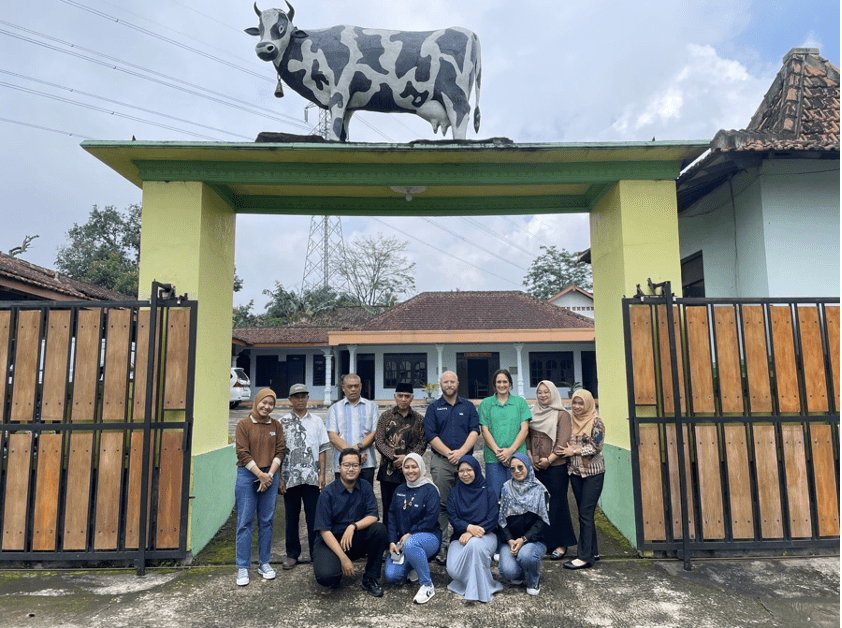
“The Crawford Fund for Food Security Student Award facilitated my firsthand exposure to participatory rural appraisal in Central Java as part of the Indo Dairy 2 research project, where I assisted the research team while at a dairy cooperative in central Java and participated in various research activities,” said Bec.
“The specific objective of this trip was to better understand whether current project interventions at the dairy cooperative level in Indonesia, were delivering appropriate smallholder benefits and outcomes, using a participatory rural appraisal (PRA) approach (more specifically a participatory monitoring, evaluation and learning approach, PMEL),” she said.
PRA typically incorporates a family of methods for farming systems research, problem identification, and analysis. It is frequently used to identify constraints faced by dairy farmers and cooperatives. PRA enables farmers and cooperative management to share, enhance and analyse their knowledge.
The Indo Dairy 2 research project is a 5 year, $3.7 million ACIAR-funded research project which aims to improve farmer livelihoods by working with milk cooperatives to improve their engagement with the private sector, and to build more inclusive and sustainable value chains. It is led by Central Queensland University in partnership with Indonesian research institutions.
“The IndoDairy2 PMEL Workshop I was involved in was held in Salatiga and KUD Musuk. The workshop aimed to refine the Objective 2A participatory monitoring, evaluation and learning (PMEL) framework, as well as strengthen the capacity of the research team, and prepare for Round 2 baseline activities with participating dairy cooperatives,” she said.
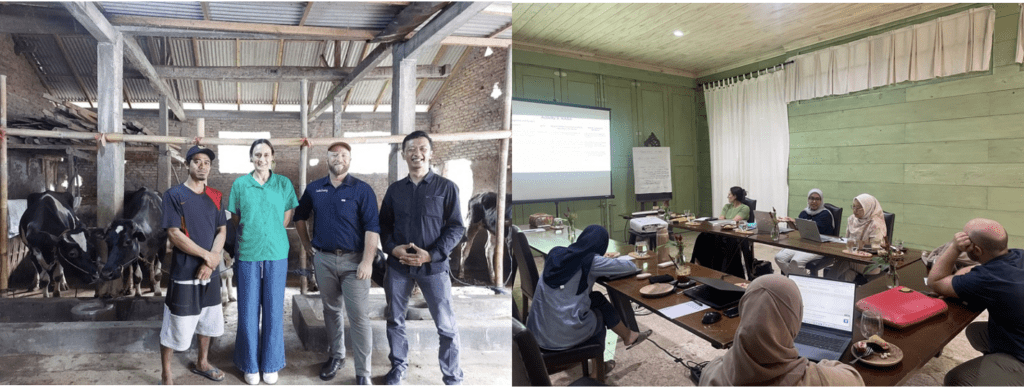
Left: Rebecca with Dr David McGill (Indo Dairy Project Leader from CQU), and two Musuk Cooperative dairy farmers during a local farm visit. Right: Workshop discussions with the Indo Dairy team.
The agenda spanned five days and included a workshop with discussions, breakout sessions, reflections, role‑plays, and cooperative priority‑setting and making plans for future visits and training.
“I helped to both deliver, and operationally manage, the workshop activities with Dr David McGill. During the week, I led various sessions, contributed to most of the activities and discussions, and fully delivered Fridays agenda of the workshop. This facilitated Dr McGill’s engagement in other, external project related meetings, whilst the workshop continued effectively,” she said.
“In addition, we were involved in research activities and field visits to KUD Musuk (1 hour travel from Salatiga). This included a two hour PAR session with KUD Musuk cooperative management representatives, as well as visits to three small holder farms,” said Bec.
“From my engagement with Indo Dairy 2, I have gained a better understanding of how to work with Javanese farmers, in a co-design manner, and how to evaluate the appropriateness of project interventions. These skills include: capturing local knowledge, aspirations, and perspectives; adaption during the project to remain relevant to the needs and priorities of locals; accountability of all participants; and insights into the results to see differences between groups, including for example, between men and women. Specifically, I have gained a better understanding of the importance of aligning the research agenda with the realities in field,” she said.
These skills and lessons can be directly applied to Rebecca’s planned PhD field work with farmers in Queensland.
“There are a number of benefits to Queensland that have arisen directly from this experience. Through my working with dairy farmers in Indonesia, I have had exposure to various cooperative models, as well as to low‑cost innovations and adaptive management approaches that have evolved in resource‑constrained environments. I have strengthened my skills in participatory learning, data use and community engagement, which are increasingly important in Australian extension and sustainability programs,” said Bec.
“The exposure and learning of the Participatory Action Research tools and methods will also have future application to research with Queensland farmers, ensuring that research is both end-user orientated and facilitates end-user priorities. It is also central that research has direct and beneficial application to QLD based land holders (with whom I am engaging in as part of my PhD),” she said.
“Perhaps most importantly, these partnerships should deepen regional relationships, build trust across agricultural communities, and open pathways for shared research between institutions,” she concluded.