

Recommendations for Policymakers and Practitioners
September 10, 2025
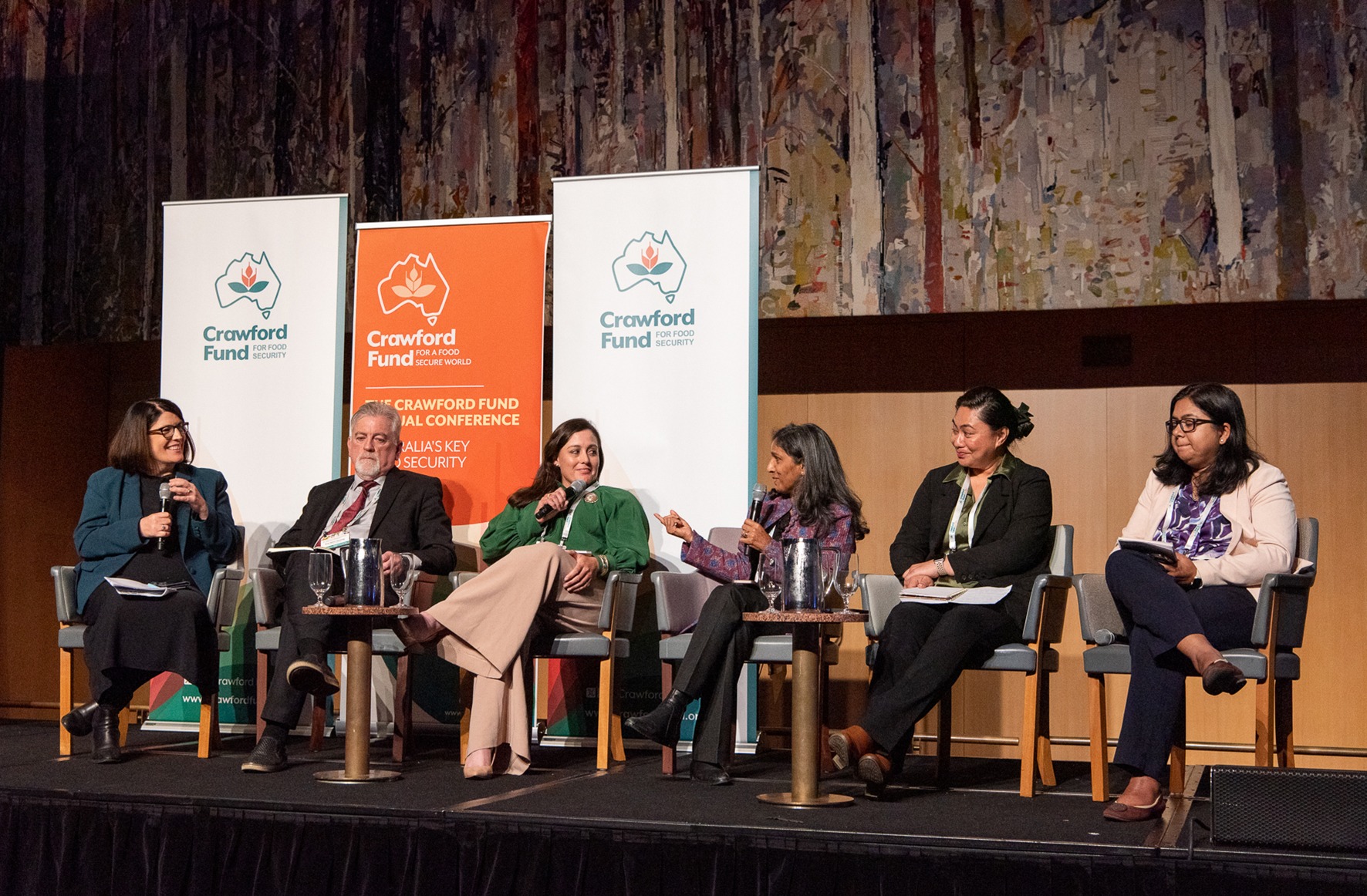
The Crawford Fund’s Annual Conference, Australia’s key food security event, held in August focused on the theme, Progress and Prospects for Climate-Resilient Agrifood Systems: Actionable Recommendations for Policymakers and Practitioners, and captured the urgency and complexity of transforming agrifood systems in response to climate change.
All speakers responded to the conference challenge to provide recommendations for Australian policymakers and practitioners involved in international agricultural development and below is a summary of the key messages discussed:
- Advance Australia as the “go-to” regional leader on food security. Already the Pacific’s largest donor, Australia has decades of development and outreach experience and world-class universities and institutions to partner in-country. As the US withdraws AID funding, Australian leadership through increased investment and partnerships will not only improve food security but promote good will, trade and regional stability.
- Increase the profile and priority of agriculture and food security in DFAT’s Official Development Assistance portfolio. In light of Australia’s already good track record and given the geopolitical changes in the Indo-Pacific region, the national interest would be well served by increased funding through the national development assistance budget.
- Support the G20 Global Alliance of Ending Hunger and Poverty. The Global Alliance against Hunger and Poverty was established as a proposal from the Brazilian presidency of the G20 to support and accelerate efforts to eradicate hunger and poverty (Sustainable Development Goals (SDGs) 1 and 2), while reducing inequalities (SDG 10). It encourages members to collaborate with other Alliance members to develop innovative solutions and share good practices in learning and knowledge exchange to ultimately alleviate hunger and poverty.
- Rejoin the International Fund for Agricultural Development (IFAD). IFAD covers five regions and 92 countries and invests in small scale rural producers to support them to take charge of their own future and produce enough nutritious food for their communities.
- Expand and enhance regional partnerships led by ACIAR in partnership with national governments and Multilateral Development Banks (MDBs). Demonstrate the real impact of partnerships for the sustainable development goals (SDG17).
- Step up the support to the Crawford Fund to deliver informed advocacy, continued collaboration, and recognition of agriculture’s central role in addressing climate, environmental, social and political challenges.
- Continue to focus on five key investment pathways:
- Increase production of sustainable, healthy and nutritious food, particularly in low and middle-income countries, and encourage more resilient land use patterns.
- Designing production and distribution systems that add value to natural capital – soil, water and biodiversity and protect ecosystem services.
- Reduce unsustainable consumption where such consumption has harmful effects on health, communities, climate, and the environment.
- Reduce emissions, either absolute emissions or emissions intensity with the ultimate aim of reducing absolute emissions.
- Prioritise the needs and interests of small producers through digital services, crop and livestock breeding, agroecological approaches and social safety nets, including good governance and the empowerment of disadvantaged or underrepresented social groups.