

Water governance in Papua New Guinea
March 24, 2026
By Shaun Coffey FTSE FAIA CRSNZ FAICD
Rewiring Water Governance in Papua New Guinea
Water figures prominently in many discussions at present. I have just finished reading the August 2025 Australian Centre for International Agricultural Research report, Improving Water Governance in Papua New Guinea. It is one of those documents that quietly does important work. It does not announce reform. It maps it.
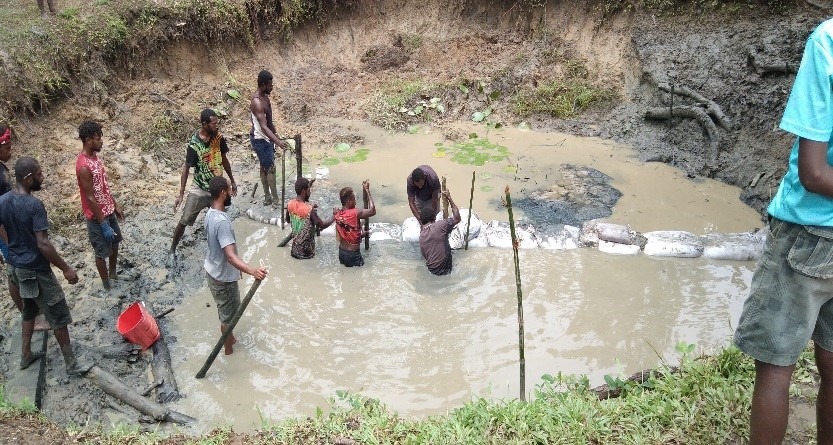
Funded by ACIAR and delivered by the Development Policy Centre at the Australian National University in partnership with World Vision PNG and WaterAid PNG, the project examines how water governance functions on the ground. Not how policy says it works. How it really works.
The report centres on District WaSH Committees, an institutional innovation introduced during what the authors describe as PNG’s “WaSH era” — a decade of intensified policy focus on water, sanitation and hygiene. These committees are intended to bridge national policy and district implementation. In theory, they create local coordination. In practice, the story is more complex.
What emerges from interviews and network analysis in South Fly and Wewak is a system with energy but uneven foundations.
First, NGOs are doing much of the bridging work. That is not inherently problematic. During reform rollouts, capable organisations often fill coordination gaps. Yet the network maps show a heavy reliance on a handful of well-connected actors. If government ownership does not deepen, the model risks fragility.
Second, influence is concentrated. National WaSH officials and major NGOs shape policy. At the district level, Local Level Government managers and District CEOs carry implementation weight. The system works, but it depends on specific individuals and institutional relationships. Resilience requires broader participation.
Third, inclusion remains incomplete. Women interviewed in the study spoke with clarity about daily water burdens. They emphasised community involvement and equitable access. Men were more likely to focus on funding and political engagement. These differences matter. If District WaSH Committees are to endure, representation cannot be symbolic.
The report also expresses caution regarding mandate expansion. Some stakeholders see potential for DWCs to assume broader roles in water resource management. The researchers advise sequencing. Consolidate the core first. Expansion without capacity can undermine credibility.
The report is realistic and recognises genuine progress during the WaSH era while making clear that institutional durability is not yet secured.
The recommendations are pragmatic:
- Improve predictable funding.
- Strengthen coordination between national and district levels.
- Increase community participation, especially of women and marginalised groups.
- Improve data systems to support evidence-based planning.
- Gradually transition coordination roles from NGOs to government actors.
What this ACIAR project demonstrates is that water governance is not primarily a technical problem. It is institutional. Pipes and pumps can be installed quickly. Governance capacity takes longer.
For PNG the necessary reform architecture exists. Whether it matures into a resilient governance system depends on consolidation, political will and inclusive practice.
Climate, Community and Environmental Limits: Water Governance in Papua New Guinea
Reading further into the ACIAR report, what becomes clear is that this is not only a story about committees and coordination charts. It is a story about environmental limits.
The project — Improving Water Governance in Papua New Guinea — does something important. It places water governance inside a climate and planetary boundaries frame. That shift matters.
PNG is climate-exposed. Rainfall variability, extreme events, and rising temperatures stress already fragile infrastructure. When systems are weak institutionally, climate pressure magnifies vulnerability.
The research shows how inadequate WaSH services can intersect with environmental degradation. Over-extraction, contamination, and poor catchment management undermine local hydrological systems. Weak data systems obscure the scale of stress. Fragmented governance slows adaptation.
The report points to possibilities for progress.
District WaSH Committees, if properly supported, can embed local knowledge into planning. Community experience of seasonal patterns, land tenure arrangements and social dynamics can inform infrastructure design. Inclusion becomes a resilience mechanism.
There is also a strong environmental argument embedded in the findings. Well-governed water systems generate co-benefits. They reduce disease burdens. They strengthen public trust. They protect ecosystems. They enhance adaptive capacity. Conversely, poorly governed systems amplify risk.
The authors are careful not to romanticise decentralisation. Capacity constraints are real. Funding volatility is real. Expanding mandates without resourcing is risky. But they point to a path forward that integrates service delivery with stewardship.
The message is subtle but significant: PNG’s water challenge is not only about access. It is about governance that operates within environmental limits. This is where the ACIAR framing becomes particularly relevant. Agricultural research and water governance intersect in catchments, livelihoods and food systems. Water is infrastructure. It is also ecology.
Climate resilience cannot be built solely through infrastructure. It requires institutions that can coordinate, adapt and include.
PNG’s experience is therefore instructive beyond the water sector. It illustrates how environmental pressure tests the capacity of governance. Where institutions strengthen, communities adapt. Where they remain fragile, shocks compound. The WaSH era has laid the groundwork. The climate era will test it.
Why Researching Water Governance in PNG Matters for Australia
As I worked through the ACIAR report on Water Governance in PNG, one question kept surfacing. Why should Australians pay close attention to district water governance in Papua New Guinea?
The answer is straightforward.
PNG is our nearest neighbour. Its institutional resilience affects regional stability. Water governance is foundational to that resilience.
The implications of the ACIAR project extend well beyond this single project.
First, water security underpins health and productivity. Improved sanitation reduces disease burden. Reliable access reduces time burdens, particularly for women. Stronger district institutions increase accountability in public spending. These outcomes contribute to social stability.
Second, climate adaptation is a shared Indo-Pacific challenge. PNG faces acute vulnerability.
Strengthening district-level governance enhances local adaptive capacity. For Australia, supporting credible climate resilience efforts in the region reinforces both moral commitment and strategic credibility.
Third, environmental systems are interconnected. Poor water management affects fisheries, coastal ecosystems and agricultural productivity. Strengthening catchment governance in PNG supports regional ecological health.
Fourth, institutional partnerships matter. This ACIAR project demonstrates a model of collaboration between Australian research institutions and PNG practitioners. It builds capability rather than dependency. That distinction is important in a region of increasing geopolitical competition.
There is also a quieter benefit.
Australia’s own debates about decentralisation, Indigenous water rights and community engagement can learn from PNG’s experience. Governance reform in one context often illuminates blind spots in another.
The report identifies funding gaps, political ownership challenges and capacity constraints. Yet it shows momentum. Water governance may appear local. It is not. It sits at the intersection of development, climate resilience and institutional legitimacy.
For Australia, investment in such reform is not peripheral. It supports a stable, resilient neighbour and reinforces a partnership built on shared capacity rather than transactional aid. And, importantly, it provides valuable information and experience we can use at home to benefit Australia.
That is why this ACIAR project matters.
See: ACIAR (2025) Improving Water Governance in Papua New Guinea: Final Report, Project WAC/2023/180, Canberra.