

Strengthening international agricultural research for a more food secure world
June 17, 2026
The world faces a profound food security challenge.
Over the coming decades, agriculture must produce more food, more nutritious food and more diverse food for a growing population, while adapting to climate change, managing scarce natural resources and responding to emerging pests and diseases. Meeting these challenges will require innovation on a scale not seen since the Green Revolution.
Few institutions have contributed more to agricultural innovation than the CGIAR and its international agricultural research centres. For more than half a century, they have developed improved crop varieties, strengthened food systems, enhanced agricultural productivity and helped millions of farming families improve their livelihoods. Their work has contributed to higher yields, lower food prices and improved food and nutrition security across much of the developing world.
The achievements of CGIAR deserve recognition and celebration. Yet success should not prevent reflection.
The challenges facing global agriculture are changing rapidly. New scientific capabilities are emerging. Artificial intelligence, advanced breeding technologies and digital agriculture are reshaping the research landscape. At the same time, public resources are under pressure, and international development institutions face increasing scrutiny regarding their effectiveness and impact.
At the CGIAR System Council meetings (SC24) on 10-11 June in Turkiye, CEO Ismahane Elouafi notes that:
CGIAR must become a system that is smaller in bureaucracy, larger in ambition, and clearer in purpose. We must protect the science, serve the scientists, and meet the world where it is heading — not where it was. That is the CGIAR we must build together.
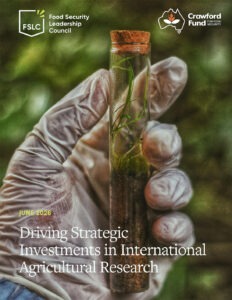 Against this backdrop, the Food Security Leadership Council and the Crawford Fund for Food Security have jointly prepared the discussion paper Driving Strategic Investments in International Agricultural Research.
This paper contributes to an important global discussion about how international agricultural research can maximise its impact in a period of growing food insecurity, climate pressure and resource constraints.
It begins from a simple premise: the world needs a strong CGIAR. Indeed, it needs a stronger CGIAR than ever before.
The centres remain uniquely positioned within the global research landscape. They combine scientific capability, long-standing partnerships, deep local knowledge and a commitment to delivering international public goods. They operate where the need is greatest and where alternative sources of research investment are often limited.
The paper is guided by three broad themes.
First, strategic focus. International agricultural research centres have a unique comparative advantage in developing technologies, practices and innovations that improve sustainable agricultural productivity.
Second, long-term investment. Scientific breakthroughs require patient funding, strong institutions and enduring partnerships.
Third, simplification. Research organisations around the world face growing administrative complexity. The paper explores opportunities to simplify governance, reduce transaction costs and strengthen collaboration so that more effort can be directed towards science and impact.
These themes align closely with CGIAR’s own aspiration to become a system that is clearer in purpose, stronger in science and more agile in delivery.
The objective is simple: to make it easier for researchers to conduct world-class science, for centres to collaborate, for leaders to prioritise investments and for donors to support and achieve long-term impact.
The international agricultural research system has earned its place at the centre of global food security efforts. The task now is to ensure it remains fit for purpose, adequately resourced and positioned for even greater success in the decades ahead.
The future of global food security will depend upon science, innovation and collaboration. Strengthening international agricultural research is one of the most important investments we can make in that future. Driving Strategic Investments in International Agricultural Research should be read and discussed as an expression of confidence in CGIAR, its people and its future role at the centre of global food security.
Shaun Coffey
Chief Executive Officer