

“Seeing so many people, particularly young people, bringing energy, ideas and commitment was genuinely encouraging” – presenting our first scholar reflections
September 1, 2026
The Crawford Fund for Food Security held its Annual Conference last month at Parliament House in Canberra. The event brought together leading experts in agricultural science, research, policy, development and industry to explore the theme Emerging Voices Shaping Regional Integration for a Food Secure World, with a particular focus this year on the theme’s Emerging Voices element.
The Crawford Fund is committed to encouraging the next generation working in international agriculture for development through conference scholarships awarded by our State and Territory committees and scholar supporters. This year, we introduced a poster session showcasing the work of nine young researchers and created more opportunities for scholars and early career researchers to take part in conference Q&A sessions, helping to raise their profiles and expand their networks.
Our conference scholarship program started in 2010 in the hope that by experiencing the Crawford Fund for Food Security conference and network, our special program of activities around the conference and being mentored by inspirational experienced researchers, young researchers would be inspired and energised to be more involved. The results have been fantastic, with a great mix of youth and experience at our flagship event each August and a growing and enthusiastic conference scholar alumni approaching 525.
Our competitive conference scholarships are offered to young people with a genuine interest in international agricultural research and development to attend the conference and a special set of activities that we have developed and shaped over the past 16 years.
One of the requirements of the scholarship is that each scholar provides us with a reflection on their experience. We will be providing these reflections over the coming weeks, grouped by State/Territory.
Once again, we would like to thank our wonderful mentors, mentioned alongside the scholar they supported, who volunteer their time and offer valuable guidance, support and insights to the scholars throughout the conference.
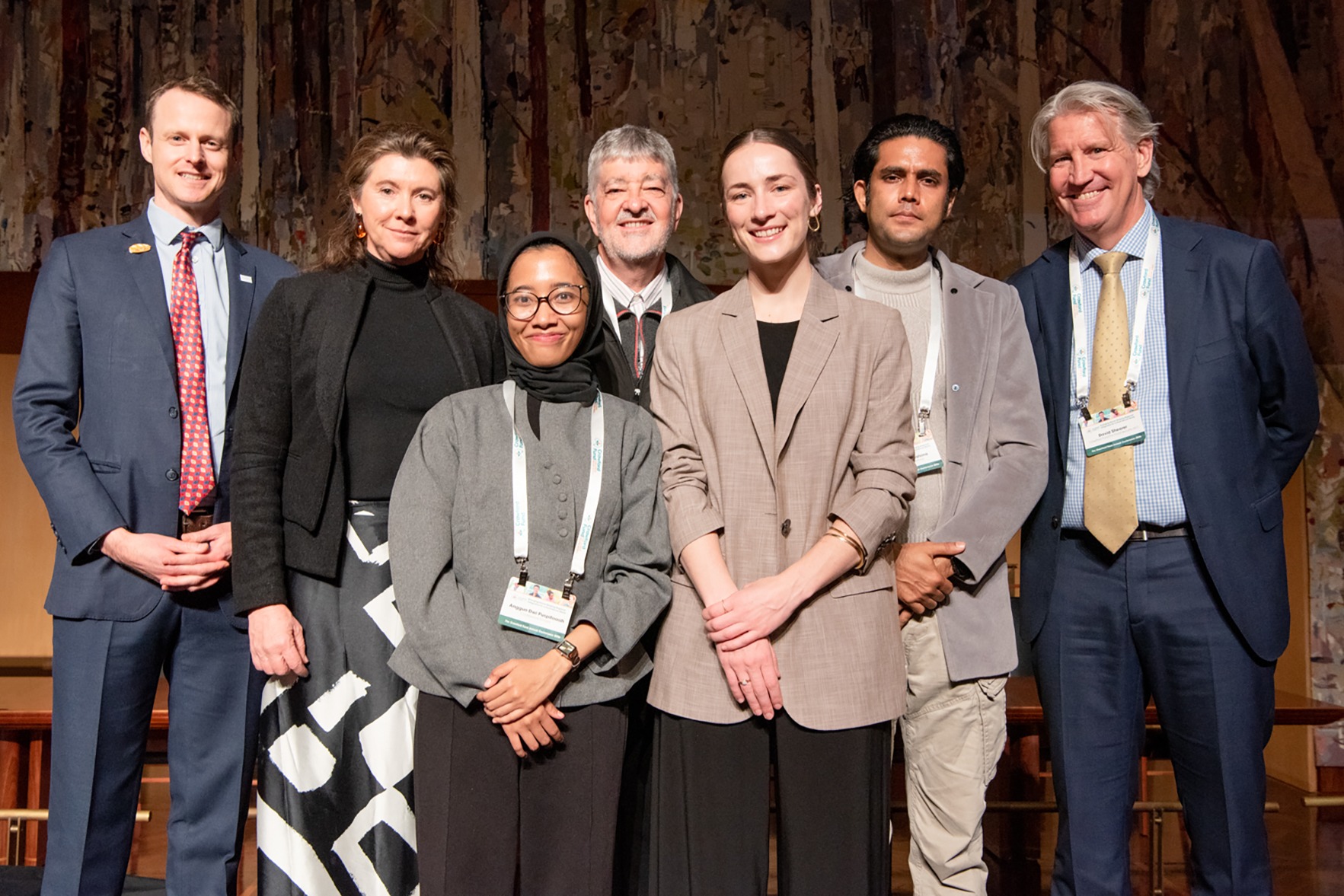
Our 2026 scholars from the Australian Capital Territory were Ramhari Timalsina from the Australian National University (ANU) supported by the Australasian Agricultural and Resource Economics Society (AARES); and Mary Higgins and Anggun Dwi Puspitoasih also from ANU, who were both supported by the Crawford Fund for Food Security’s ACT Committee.
Highlights of their experiences have been captured below:
“This experience strengthened my understanding of integrated systems thinking as an approach to addressing the complex and multifaceted challenges facing agriculture”
– Ramhari Timalsina
“The conference offered insights into practical opportunities to engage in agricultural international development, as well as valuable advice for young professionals entering this space on understanding our value and being driven by purpose. I walked away with the mindset that we are living in one interconnected system, and that solutions must be long-term and multidisciplinary.”
– Mary Higgins
“Seeing so many people, particularly young people, bringing energy, ideas and commitment to this space was genuinely encouraging.”
– Anggun Dwi Puspitoasih
Read on for the full reflections:
AARES Supported Scholar
Ramhari Timalsina, Australian National University
Mentor: Wendy Craik
Participation in the Crawford Fund Conference gave me the opportunity to interact with and learn from a diverse range of stakeholders from Australia and around the world, including students, academics, scientists, researchers, policymakers, politicians, farmers, and NGOs. Despite their different backgrounds and areas of expertise, they shared a common goal: making agriculture more productive, resilient, food-secure, climate-smart, and sustainable.
This experience strengthened my understanding of integrated systems thinking as an approach to addressing the complex and multifaceted challenges facing agriculture. It also helped me recognise the substantial benefits that can be achieved when different stakeholders, disciplines, and institutions work collectively rather than in fragmented or isolated ways.
As an agricultural economist, I particularly realised the important role that agricultural economists and policymakers can play in translating innovation into real-world outcomes while creating a continuous positive loop of learning, action, and improvement. Innovations in agriculture often emerge from diverse streams and their connections; including scientific research, farming practices, markets, finance, infrastructure, and institutional development. Effective policies and institutional frameworks are therefore essential to connect these streams, facilitate knowledge exchange, and provide the necessary support services for the adoption and scaling of innovations. At the same time, experiences and lessons from implementation can feed back into research, policy, and future innovation, creating a dynamic process of continuous learning and adaptation. By strengthening these connections, we can help ensure that innovations and initiatives achieve their full potential.
ACT Committee Supported Scholars
Mary Higgins, Australian National University
Mentor: David Shearer
Walking into Day 1 of the Crawford Fund For Food Security Conference, into a room filled with technical experts and scientists, I questioned how my background in social science and security could contribute productively to the conversation. Over the course of the three days, I quickly realised that solving the biggest challenges requires collaborative efforts, and that every discipline has a role to play. The conference offered insights into practical opportunities to engage in agricultural international development, as well as valuable advice for young professionals entering this space on understanding our value and being driven by purpose. I walked away with the mindset that we are living in one interconnected system, and that solutions must be long-term and multidisciplinary.
The variety and expertise of panellists at the conference and Scholar Days broadened my understanding of how agricultural challenges are being addressed across different levels. This ranged from cutting-edge scientific research, to community-led innovations developed by young people leveraging existing mechanisms, and ultimately to the role of international partnerships in scaling and sustaining these efforts. Importantly, I gained an appreciation of both the opportunities and challenges that exist across each level.
Beyond the content of the conference, one of the most valuable aspects was connecting with like-minded peers, each bringing unique experiences and perspectives to our conversations. These connections extended beyond the conference itself, fostering relationships that I hope will develop into future opportunities for collaboration and collective action in the agricultural space.
The experience for scholars was both intentional and thoughtfully supported. Prior to the conference, each scholar was paired with a mentor who acted as both a guide and a network enabler throughout the program. The calibre of the mentors, and the depth of advice and perspectives they offered, was a particular highlight. I was fortunate to be paired with David Shearer, ACT Committee Coordinator, whose extensive experience across government and the private sector in agricultural research and development provided invaluable insight. Beyond the mentorship itself, the program helped scholars navigate the conference, maximise networking opportunities, and build connections across the agricultural sector.
The key message from the conference was that, when it comes to agricultural research for international development, listening to communities and supporting locally led initiatives is fundamental to developing successful programs. This idea was introduced during the opening session of the Scholar Days by Su McCluskey, Chair of the Crawford Fund, and echoed by panellists throughout the conference, as well as practitioners with experience in agricultural development work.
Ultimately, the conference challenged me to think beyond the boundaries of my own discipline and consider how my background in social science and security can contribute to broader questions of food security and development. I left with a stronger appreciation that meaningful and sustainable solutions are not created by one discipline or one actor, but through collaboration, locally led action, and a shared commitment to long-term impact.
Anggun Dwi Puspitoasih, Australian National University
Mentor: Imelda ‘Dada’ Bacudo
Being part of the 2026 Crawford Fund Conference Scholar Program was an incredibly enriching experience, particularly as a Master of Public Policy student with an interest in food security and rural development. The program gave me the opportunity to look at food security from a much broader perspective. Across the Scholar Days and the conference, I heard perspectives from agricultural science and technology, policy, social research and community development. What I appreciated most was seeing how these different ways of working can complement one another, especially when they are brought into the same conversation.
The Scholar Activities were one of the highlights for me. Panel speakers shared not only their expertise, but also their career journeys, challenges and the opportunities that shaped where they are today. Meeting the other scholars was equally memorable. Coming from different backgrounds, we were able to learn from one another’s research, experiences and aspirations. The openness and enthusiasm within the group created such a positive learning environment.
The mentoring component was another highlight. Being paired with an experienced mentor and having the opportunity for one-on-one conversations gave me space to ask questions about career pathways, future opportunities and how I might contribute more meaningfully in this field. The guidance gave me both clarity and encouragement, particularly in thinking about how to connect the dots across different fields, while developing a clearer sense of the knowledge, experience and perspective I bring to the table.
The conference also gave me the chance to hear from a wider range of voices. Hearing directly from government and policymakers, scientists and researchers, international and development organisations, community practitioners and youth advocates gave me a broader understanding of how food security is approached from different perspectives. The poster session was also memorable because I could see the work of fellow scholars and young researchers up close. Seeing so many people, particularly young people, bringing energy, ideas and commitment to this space was genuinely encouraging.
One word that stayed with me throughout the program was listen. It appeared repeatedly in conversations about development, research, policy and community engagement. For me, this meant listening to the communities, to perspectives different from our own, and to other stakeholders. One quote that particularly stayed with me was, “development works best when it is less about the credit and who gets the spotlight.” It captured an important message of the conference: meaningful impact is often built through collaboration, humility and a willingness to learn from others.
I am deeply thankful to my mentor, the ACT Committee, the Crawford Fund, the RAID Network and everyone who made the program such a supportive experience. Being surrounded by people with deep expertise, different experiences and a shared sense of purpose made the program especially inspiring. It reminded me that there are many different pathways to make a meaningful contribution. I left the program with a stronger sense of hope, more confidence in my own journey and greater motivation to keep learning and exploring new opportunities.