

Socio-ecological assessment of the seaweed farming communities in the Philippines
November 11, 2026
The Crawford Fund’s highly sought after Student Awards are one way we support and encourage the next generation of Australians into study, careers and volunteering in international agricultural research.
The awards are funded by our State and Territory Committees and made possible by organisations including ACIAR, international centres, Australian and overseas universities and NGOs who host our awardees.
Eighteen talented university students from around Australia were awarded our 2025 Student Awards. As part of this cohort, we would like to share the experience of Maria Noriza Quijano Herrera from the Australian National University who travelled to the Philippines to undertake research into socio-ecological assessment of the seaweed farming communities in Palawan, Philippines in collaboration with Palawan State University.
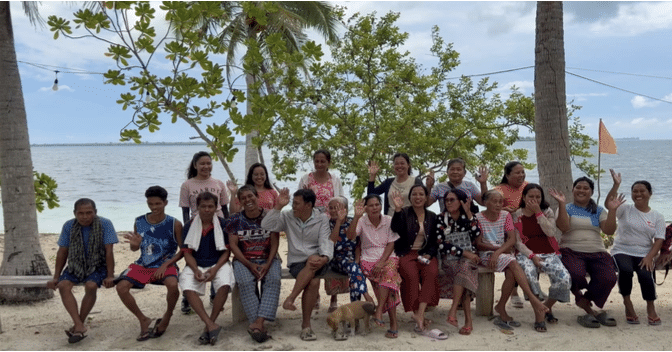
Maria’s research aimed to assess the socio-ecological and value chain dynamics of the Philippine seaweed industry with Dumaran and Balabac, Palawan as case study sites focusing on institutional and governance structures for their sustainability and inclusivity.
Specifically, as part of her Student Award research, she set out to:
- map the current socio-ecological system (SES) and the seaweed value chain of Dumaran, and Balabac, Palawan, Philippines;
- analyse the roles, capacities and interactions of the institutions (i.e. government, NGOs, cooperatives, informal groups and private sectors) for the sustainability and inclusivity of the Philippines seaweeds industry;
- assess the governance gaps, policy incoherence, and institutional barriers towards a sustainable and inclusive seaweeds industry, and;
- recommend policies and governance innovations for a sustainable and inclusive seaweed industry in the Philippines.
“My research can potentially fill the gap in institutional and policy analysis of marine- based agri- food value chain in the Philippines. Previously conducted studies have focused on production and market challenges. Thus, overlooking how institutional arrangements (IAs), governance fragmentation, and policy incoherence constrain the performance and adaptability of the seaweed value chain,” she said.
“My research would attempt to systematically map the roles, mandates, capacities, and interactions of key actors—including government agencies, cooperative, NGO and informal groups. Thereby, providing a comprehensive view of the governance landscape,” said Maria.
Consequently, by applying the systems thinking, particularly, Dyball and Newell’s (2023) cultural adaptation template (CAT), the study moves beyond linear or sectoral analyses which most of the researches conduct. It would identify the feedback loops, interdependencies, and leverage points within the seaweed value chain that traditional frameworks may neglect.
“Potentially, this method can contribute into a more adaptive and resilient governance models, especially amid the various challenges- climate change, price volatility, and socio-economic marginalisation of smallholder producers,” she said.
Seaweed farming is a cornerstone livelihood to many coastal households. Aside from economic benefits, seaweed also helps the environment through carbon sequestration and has cultural underpinning. However, a decreasing trend in seaweed (Kappyphycus and Eucheuma spp) production was observed globally and in the Philippines. From mid-2000, the decrease of Eucheumatoid in the Philippines is attributed to several factors including outbreak of pests and diseases, climate change among others. Carrageenan, an important product derived from seaweed is widely used in food, pharmaceutical and industries.
The seaweed industry is beset with challenges including overharvesting, climate change, invasive species and pests that impact wild seaweed stocks. Currently in the Philippines, there is a lack of national seaweed policy framework despite the numerous studies conducted. Consequently, seaweed-specific legislation to protect species and habitats do not exist. This is exacerbated by the unregulated access and benefit-sharing.
Maria’s analysis integrated Key Informant Interviews (KIIs), focus group discussions and interviews with the seaweed farmers from the two municipalities. She applied Dyball and Newell’s Generic Cultural Adaptation Template (CAT) to help identify feedbacks, leverage points, and policy recommendations.
Key themes emerged from Maria’s interviews, relating to governance and institutions, market and value chains, ecological and technological barriers, capacity and coordination, inclusivity and equity and innovations and future needs, as per the table below.
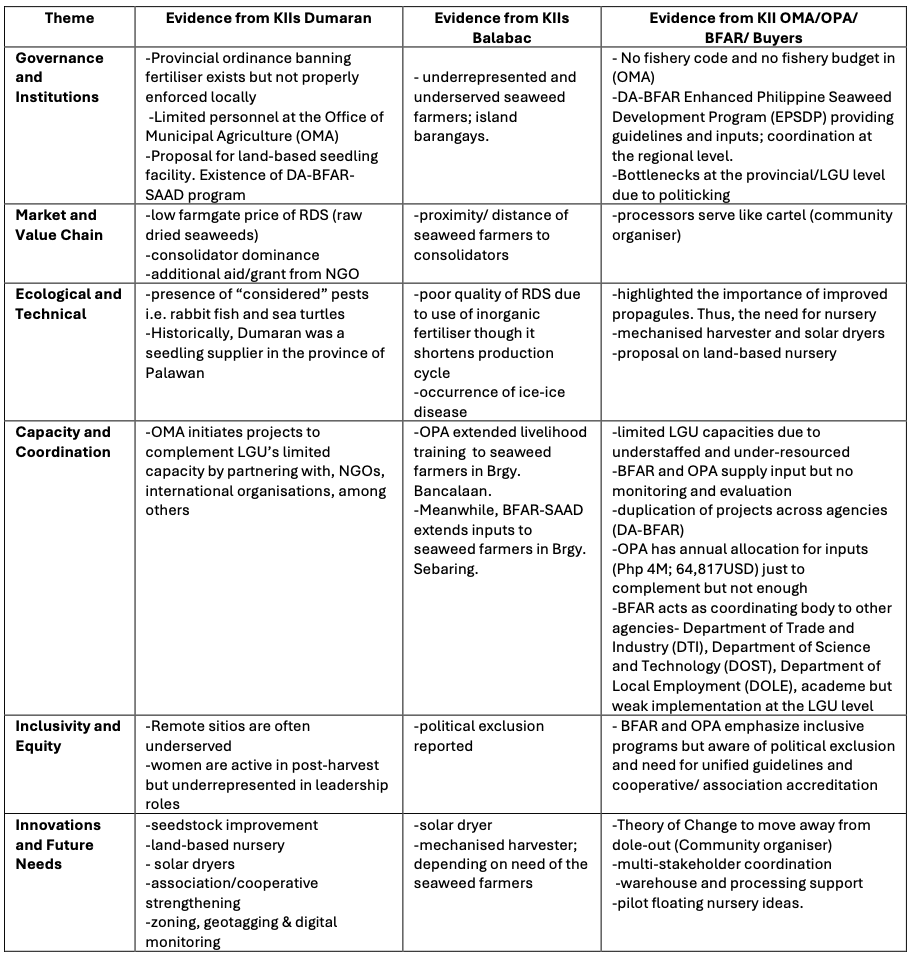
“It is evident that the governance and institutional structures in Dumaran and Balabac are fragmented, not properly enforced, under resourced and lack proper monitoring and evaluation. This reinforces socio-ecological feedbacks that include underperforming seedstocks, low farmgate price and buyer dominance,” said Maria.
“Consequently, leverage points can include: tissue-cultured seedstock, land-based nurseries, amalgamation of associations or cooperatives, enforcement of zoning permits, proper monitoring, and value-adding innovations at the source,” she concluded.