

Crawford Fund 2026 Annual Conference summary and action agenda
August 26, 2026
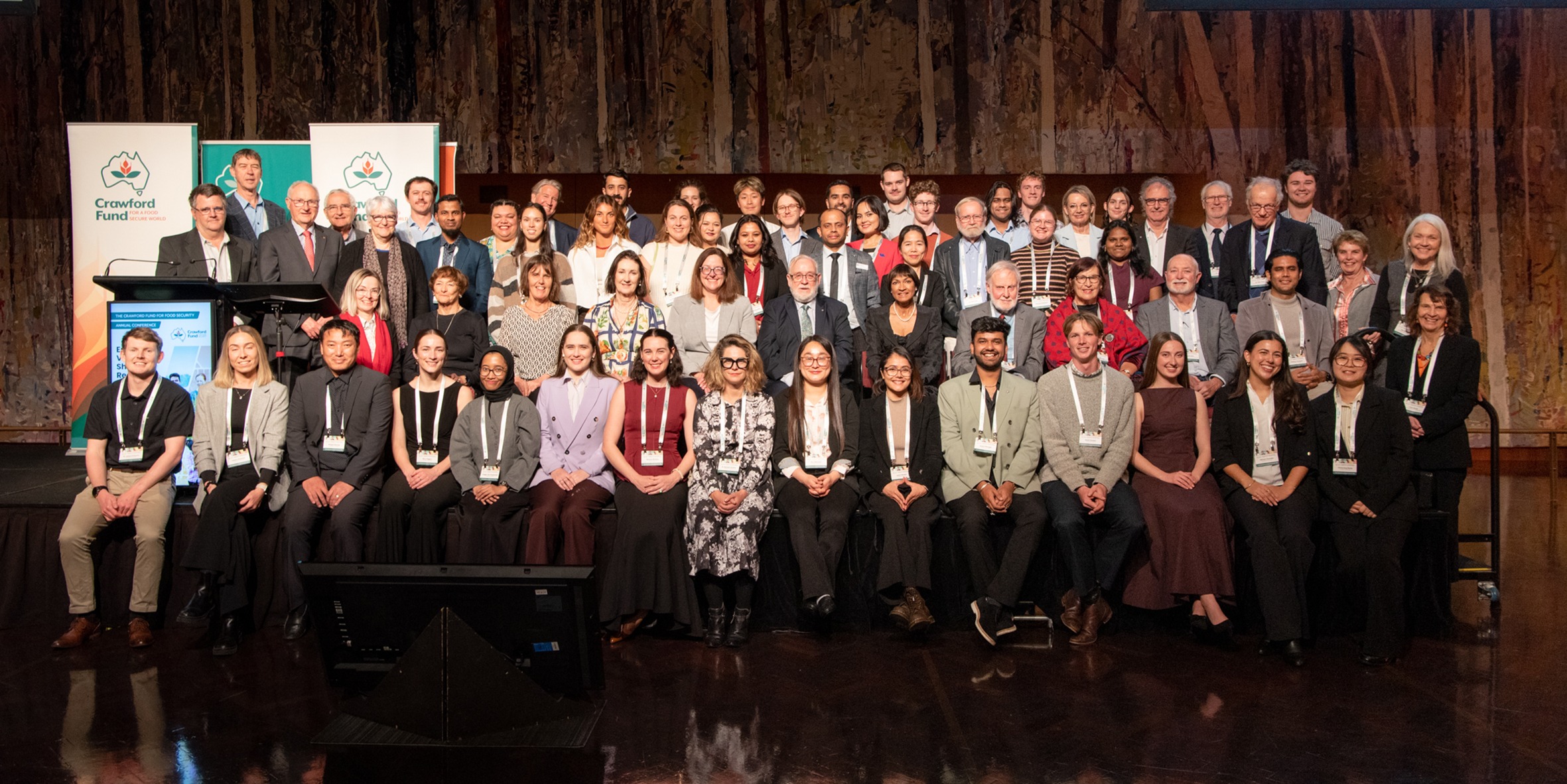
Sustained, long term investment in international agricultural research, strengthening regional partnerships and more meaningful roles for young people in decision making were just some of the actionable recommendations to emerge from this year’s Crawford Fund for Food Security Annual Conference.
The 2026 Crawford Fund for Food Security Annual Conference brought together more than 400 participants from Australia and around twenty other countries to examine how emerging voices, research partnerships and regional integration can contribute to a more food-secure world. Across the presentations and discussions, one message was consistent: food security cannot be addressed through isolated interventions. It depends on connected systems of science, people, institutions, markets, finance and long-term regional partnerships.
The Conference highlighted that food security must be approached as an interconnected system. Effective science and adaptation need to work across food, land, water and climate, recognising the relationships between production, livelihoods, markets, infrastructure and the environment.
Solutions must also be grounded in local circumstances. Case studies from Africa, India, Vietnam and the Pacific demonstrated that science alone is not enough. Lasting impact depends on understanding culture, conditions and infrastructure, and on building genuine partnerships in which local communities and institutions help shape decisions and implementation. Trust emerged as a foundation for successful and enduring partnerships. Regional cooperation works best when relationships are sustained over time, knowledge flows in both directions and partners recognise mutual interests and benefits. The Conference further reinforced the case for treating agricultural research as long-term strategic infrastructure. International agricultural research delivers substantial economic, agricultural and food security returns, yet investment in many regions is declining. Making those returns more visible will be essential to building the case for sustained investment in an increasingly competitive funding environment.
Food security must be considered as a system
Consultations on Australia’s National Food Security Strategy have emphasised the importance of factors including production, inputs, productivity, supply chains, climate change, workforce, innovation, trade, manufacturing, access to fuel and fertiliser, storage and transport, among others. Australia is a strong food producer, but food security depends on more than the ability to grow food. The strategy covers supply chain resilience, climate, workforce, innovation, trade, critical inputs, infrastructure, nutrition and biosecurity.
COP31: the opportunity to promote the need for improved access to finance
The innovative approach to COP31, encompassing the COP31 meeting in Türkiye as well as the Leaders meeting in the Pacific, Australia as president of negotiations and the focus on emerging voices, were all identified as a genuine opportunity for our input and influence.
Australia’s engagement in multilateral forums, including COP31, provides an opportunity to amplify several key messages. These include the importance of regional partner countries being able to access finance and investment to address climate change, and the need to accelerate investment and the implementation of key initiatives, including maintaining a focus on the 1.5-degree target. Access to finance was highlighted as the binding constraint for small island states facing sea level rise, saltwater intrusion, and new pests and diseases.
Research should be treated as infrastructure
Speakers highlighted that true impact from investment in international agricultural research can take decades. Major global resources such as gene banks to conserve crop varieties need care forever, and research should be funded as long-term infrastructure, not in short cycles. Despite returns of ten to one, public investment in research has been falling in real terms for the last twenty years. It was also emphasised that much more needs to be done to highlight the return on investment provided by research and development to the agriculture sector as a means of encouraging more investment at a time when there is heavy competition for funding.
Recognise that the returns on investment in international agricultural research far exceed the cost
CGIAR’s own external assessment found a ten-to-one benefit- cost ratio on investments since 1971, with no sign of diminishing returns. Australia benefits significantly from its investment in international agricultural research in developing nations. ABARES found that an extra dollar of agricultural research and development investment between 2011 and 2021 generated $7.82 in gross value added, among the best returns in any area of public spending. The Conference heard about a four-year ACIAR-funded project in Vietnam’s Mekong Delta promoting climate-smart rice production where Farmer incomes rose 10.5 per cent, production costs fell 5.6 per cent, fertiliser costs fell 14.2 per cent, and farm gate prices rose 2.7 per cent.
Champion the benefits of regional integration
Australia is a shareholder in the global system, not a donor to it: no country can adapt to climate and other changes on its own. Australia should invest in international agricultural research because our own food security, biosecurity, agricultural productivity and regional security depend upon a functioning international research system.
Examples given in the conference include wheat grown in Australia carrying genetics that trace back to CGIAR breeding, and wild chickpea seed from Türkiye conserved in global seed vaults, that is allowing Australian growers to plant successful chickpea crops further south than ever before. Australia’s investment in Pacific research into the causes of TR4 in Bananas (Panama Disease) has provided Australian growers with decision-making processes for different settings. Where incursion is the threat, the focus is prevention, surveillance and biosecurity. Where the disease has arrived, it is cultivar diversity, and where it is widespread, it is reducing inoculum and building soil health. Zero tillage from the Ganges Delta is now used in Peru, and Kenyan black soldier fly technology is being adapted for the Pacific.
Engage more young, emerging voices to influence, not just attend
A key theme was “emerging voices” with speakers highlighting that there are 1.3 billion young people in the world today who should be recognised as climate action leaders, innovators and implementation partners. Nearly half of all employed young people work in agrifood systems. FAO estimates that ending unemployment among young people not in work, education or training could add US$1.5 trillion in value, with about 45 per cent of that coming from agrifood systems. If adaptation is the defining challenge, young people are best placed to meet it – not because they are protected from climate impacts, but because they have spent their whole lives adapting. Recommendations included deliberate investment in adaptation capability, moving from consultation to genuine partnership, and redesigning funding so that youth-led work outside formal organisations can be supported. There is much to be gained by moving young people from the consultation list to the decision.
An Agenda for Action
The conference points to an agenda for action for the Crawford Fund for Fund for Food Security
- advocate for food security as an interconnected national and regional system;
- make the case to Australia’s government and agricultural research sector for sustained investment in international agricultural research as strategic infrastructure.
- strengthen regional partnerships based on mutual benefit, trust and local leadership;
- create meaningful roles for emerging voices in shaping decisions, investment and implementation;
- use opportunities including Feeding Australia and COP31 to translate these messages into policy and investment.