

“The conference gave me a front row seat to the conversations shaping food security policy and research across our region…” – scholar reflections from SA
September 16, 2026
The Crawford Fund for Food Security held its Annual Conference last month at Parliament House in Canberra. The event brought together leading experts in agricultural science, research, policy, development and industry to explore the theme Emerging Voices Shaping Regional Integration for a Food Secure World, with a particular focus this year on the theme’s Emerging Voices element.
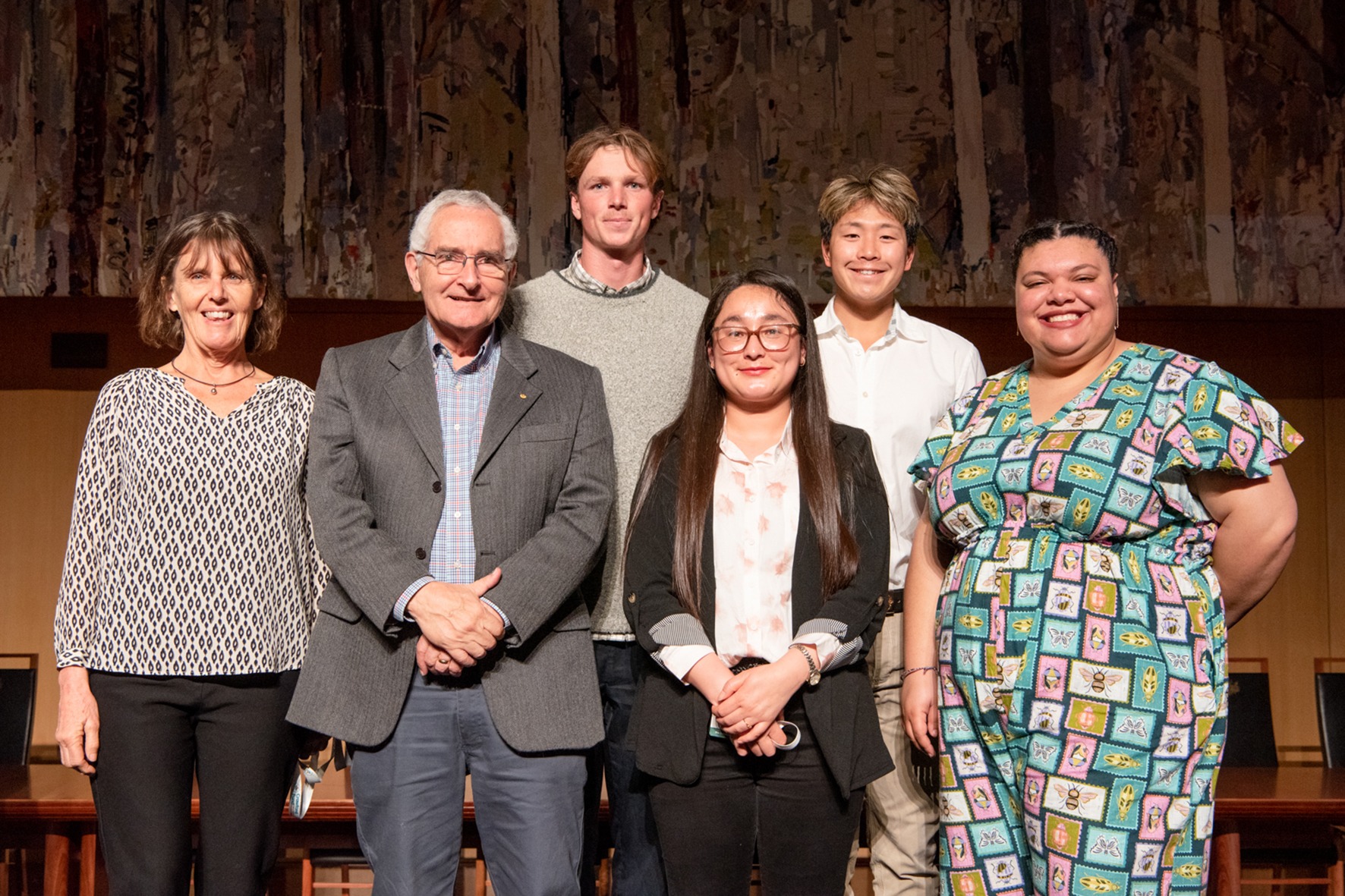
The Crawford Fund is committed to encouraging the next generation working in international agriculture for development through conference scholarships awarded by our State and Territory committees and scholar supporters. This year, we introduced a poster session showcasing the work of nine young researchers and created more opportunities for scholars and early career researchers to take part in conference Q&A sessions, helping to raise their profiles and expand their networks.
Our conference scholarship program started in 2010 in the hope that by experiencing the Crawford Fund for Food Security conference and network, our special program of activities around the conference and being mentored by inspirational experienced researchers, young researchers would be inspired and energised to be more involved. The results have been fantastic, with a great mix of youth and experience at our flagship event each August and a growing and enthusiastic conference scholar alumni approaching 525.
Our competitive conference scholarships are offered to young people with a genuine interest in international agricultural research and development to attend the conference and a special set of activities that we have developed and shaped over the past 16 years.
One of the requirements of the scholarship is that each scholar provides us with a reflection on their experience. We will be providing these reflections over the coming weeks, grouped by State/Territory.
Once again, we would like to thank our wonderful mentors, mentioned alongside the scholar they supported, who volunteer their time and offer valuable guidance, support and insights to the scholars throughout the conference.
Highlights of the experiences of our South Australia-based scholars have been captured below:
“After attending the 2026 Crawford Fund Conference, I am more certain about my career path in agriculture, that the possibilities are abundant locally and globally.” – ‘Elijah’ Zhaohan Luo
“If there is one thing I will carry forward from the experience, it is to be more intentional about seeking opportunities, starting conversations and building genuine professional relationships.” – Saru Maharjan
“At the conference, a standout session was the COP31 panel. Hearing from Sally Higgins, Youth Climate Champion for COP31, was powerful; seeing someone so young take charge reminded me that there is no single, linear pathway into this field, and that anyone can make a difference.”– Aiyana Poe
“The benefits of the conference don’t stop at Parliament House, they have continued to the small holder farm in northern Tanzania on which I write this reflection. The conference has given me the connections and confidence to ask and learn from those with the most experience.” – Austin Redden
Read on for the full reflections:
‘Elijah’ Zhaohan Luo, Minnipa Agricultural Centre-SARDI
Mentor: Kaye Basford
I had been doing field research in dryland farming systems since I graduated with a bachelor’s degree in agricultural science in 2021. Yet, my attention to agricultural research had never ventured beyond the border of South Australia, and the concept of international agriculture was alien to me, until I attended the 2026 Crawford Fund Conference, supported by the Crawford Fund Scholarship. This event was an eye-opener that filled my mind with all the possibilities, which my knowledge and experience in agriculture can really make a difference on a global scale.
This scholarship had introduced me to a group of diverse, open-minded and ambitious peers who are keen to make a difference in their domain of the agricultural industry, whether be that in research, policy-making or international affairs. I was also very impressed by the high quality of assigned mentors and other participants I was able to connect with both in the two scholar days and in the conference itself. In addition, I appreciated the opportunities to communicate directly with policy makers from the federal government, international researchers and climate advocates about issues that I believe to be crucial to Australia’s future food security.
My first main take away from this conference is that the threat of geopolitical tension and climate change to future food security is direct and imminent – not just to Australians, but more severely to many residents in developing nations around the world – especially to our island nation neighbours in the Asian-pacific, due to a lack of arable land, out-of-date technology and key-knowledge gaps in production caused by inequality in wealth distribution and education. This brings me to my second main takeaway, is that no nation can face these challenges alone. Australia must bring our neighbours on board by more frequent international collaboration in agricultural research to promote and assist the spread of sustainable agriculture by the distribution of agricultural knowledge and farming technologies to gradually close the key knowledge gaps, as well as building good rapport between everyone involved. I am also made aware that for any of these collaborations to be meaningful, our international research programs must be tailored to local needs and practices, which combines the Australian research methods and technologies to local farming systems to make incremental yet important changes in local farming practice to create a net surplus in generational wealth and education levels. This will be a steep learning curve, and we are required to keep an open-mind and be ready to learn at any opportunity to understand local culture and practice.
Overall, after attending the 2026 Crawford Fund Conference, I am more certain about my career path in agriculture, that the possibilities are abundant locally and globally. I would like to have a go in working in different sector of the industry in Australian and overseas, and I am ready to build new relationships, face new challenges and adapt along the way, knowing that I have a solid support network behind me.
Saru Maharjan, Adelaide University
Mentor: Russell Reinke
Attending the 2026 Crawford Fund Annual Conference in Canberra as a Crawford Fund Scholar was an experience that gave me much more than I initially expected. I went to Canberra looking forward to learning more about agriculture and food security, but I returned with new perspectives, meaningful connections and greater confidence in how I engage with people professionally.
The dedicated RAID Crawford Fund scholar program was one of the most valuable parts of the experience. The professional development and networking activities encouraged me to step outside my comfort zone and approach networking differently. I realised that networking is not simply about introducing yourself or exchanging contact details. It begins with genuine curiosity, asking thoughtful questions, listening to people’s experiences and being open to learning from them. Being able to practise this during the conference made the learning particularly meaningful.
The membership component added another valuable dimension. I was fortunate to have Professor Russell Reinke as my mentor, and I appreciated his willingness to share his experiences, perspectives and guidance. Our conversations encouraged me to think more carefully about my interests and career direction and reminded me of how valuable good mentorship can be particularly at the beginning of a professional journey. The confidence sessions also broaden the way I think about food security and agriculture.
Hearing from the Hon. Julie Collins MP, Ms Victoria Anderson, and many other speakers was inspiring. Sessions exploring agri-climate solutions, climate adaptation, economic stability, regional cooperation and food system resilience helped me appreciate how interconnected these challenges are. I was particularly interested in discussions about turning climate conversations into practical action and how research partnerships and cross border collaboration can strengthen resilient food systems. The poster sessions showcasing young researchers were another valuable addition, demonstrating the diversity of emerging research and ideas.
Coming from a Food Science and Nutrition background, the conference helped me look beyond the technical aspects of food and consider the broader system in which food science operates. Food security is influenced not only by how food is produced or processed, but also by climate, policy, economics, communities, research and international cooperation. This broader perspective was one of my most important takeaways.
Equally memorable where the people I met. Conversations with fellow scholars from different disciplines and backgrounds showed me how much we can learn simply by sharing our experiences and being interested in one another’s work.
If there is one thing I will carry forward from the experience, it is to be more intentional about seeking opportunities, starting conversations and building genuine professional relationships. I want to continue learning beyond my own discipline and remain open to perspectives that challenge and broaden my thinking.
I’m sincerely grateful to The Crawford Fund, the organisers, the speakers, mentors and fellow scholars for creating such a welcoming and enriching experience. The Scholar Program is something I will genuinely cherish and the lessons, connections and confidence I gained in Canberra will remain an important part of my professional journey.
Aiyana Poe, Adelaide University
Mentor: Dr Melinda Krebsz
As I dive into my Masters, exploring barriers to food access in rural South Australia, attending the 2026 Crawford Fund Conference as a scholar came at exactly the right time.
My mentor, Dr Melinda Krebsz, was wonderful, I could not have asked for a better mentor. She went out of her way to create opportunities for me and offer advice throughout the conference, and I look forward to her guidance in the near and far future. This generosity wasn’t unique to my experience, several other mentors also took on multiple students, and the atmosphere overall was genuinely friendly, with everyone introducing themselves, getting to know each other, and supporting one another. With 40 of us this year, each paired with a mentor, the personal attention was remarkable.
Throughout the conference, I made key contacts I plan to draw on for my current research, and I also connected with other early-career professionals working across a wide range of fields.
The networking dinner on the first night set the tone for everything that followed. It was inspiring and easy to talk to people and became the real foundation for the connections I made. After speaking with people that evening, I could go back to them the next day at the conference, solidify the connection, and feel comfortable reaching out again afterwards.
At the conference, a standout session was the COP31 panel. Hearing from Sally Higgins, Youth Climate Champion for COP31, was powerful; seeing someone so young take charge reminded me that there is no single, linear pathway into this field, and that anyone can make a difference. Another highlight was hearing from Victoria Anderson, Secretary of the Department of Agriculture, Fisheries and Forestry, and speaking with her afterwards.
By the final day, a few key messages had stuck with me. Fostering relationships and trust is the most important thing in anything you do, particularly in people-centric research. The line that stayed with me most was that the only person you are destined to become is who you decide to be, a reminder that professionals arrive at where they are by very different paths. I was also struck by the idea that failure is not the point; it’s how you recover and move forward, often resulting in growth. And simply: you have two ears and one mouth, so use your ears more and listen. Underpinning all of this was a focus on what it takes to foster relationships: ethics, respect, active listening, trust, cooperation, and passion.
Reflecting on the conference, it reinforced that food security isn’t just about giving people food; it’s about safe, affordable, nutritious food, which speaks directly to the barriers I am researching in rural South Australia. The conference showed me there are many pathways into international agriculture, and that people in this sector are genuinely willing to lift you up.
I want to sincerely thank the Crawford Fund and the SA Committee for the opportunity to attend and be part of something I have wanted to know more about for a long time. I am grateful to everyone involved for seeing the potential in me.
Austin Redden, Adelaide University
Mentor: John Dixon
Being a Crawford Fund Conference Scholar is an experience I will hold close. From new learnings and connections to professional contacts and friendships, the conference left me feeling optimistic and positive about the future of agricultural development and food security. Much of this optimism came from the calibre of people involved in the Crawford Fund, RAID, and the broader agricultural development and food security space.
The opportunity to attend the conference as a scholar came at an ideal time. As a recent graduate of agricultural science and completing a traineeship at CSIRO I was to head off to East Africa just four days after the conference to work on a smallholder farm, explore and learn as much as possible about local food systems. The conference provided me with a crucial glimpse into the wide variety of organisations, government departments, researchers and professionals working across agricultural development. In many ways, it helped me understand the landscape of the industry, where different organisations fit, how they interact, and the range of pathways available within the sector. This broader understanding has helped me identify areas of interest and consider the directions I might pursue in my own career.
One of the aspects of the scholarship that I am particularly grateful for, and which I found incredibly valuable, was the opportunity to be assigned a mentor. The direction, support and advice provided by my mentor, John Dixon, have been invaluable. Connecting me with relevant professionals in the space of my interest, allowing me to make genuine connections that would be extremely helpful for the upcoming trip to East Africa. In addition, the ongoing support and opportunity to ask questions to someone with such experience in the field going forward will be a lasting impact of the Crawford Fund scholar program.
The scholar days and program gave great opportunity to meet and connect to the other scholars. I learnt a lot from the other scholars, from their experiences, interests and pathways. Learning from each other as young people early in their careers and research, these connections and friendships no doubt will be important going into the future.
As for the conference itself there were many presentations that were very informative and thought provoking. A highlight for me was Dr Milach’s presentation ‘integrated science for a food secure region’. A key point of the science that helps farmer adapt is the science that connects food, land, water and climate. In addition, the need to be working as one system across disciplines and countries. I enjoyed this global perspective and importance of the science and global collaboration having meaningful impact in the fields for farmers around the world.
Upon reflecting on the conference, I feel a strong sense of optimism and inspiration. The benefits of the conference don’t stop at Parliament House, they have continued to the small holder farm in northern Tanzania on which I write this reflection. The conference has given me the connections and confidence to ask and learn from those with the most experience.