

“I left encouraged. I left with new ideas, new friends and new connections. I left with hope.” – scholar reflections from Victoria
September 21, 2026
The Crawford Fund for Food Security held its Annual Conference last month at Parliament House in Canberra. The event brought together leading experts in agricultural science, research, policy, development and industry to explore the theme Emerging Voices Shaping Regional Integration for a Food Secure World, with a particular focus this year on the theme’s Emerging Voices element.
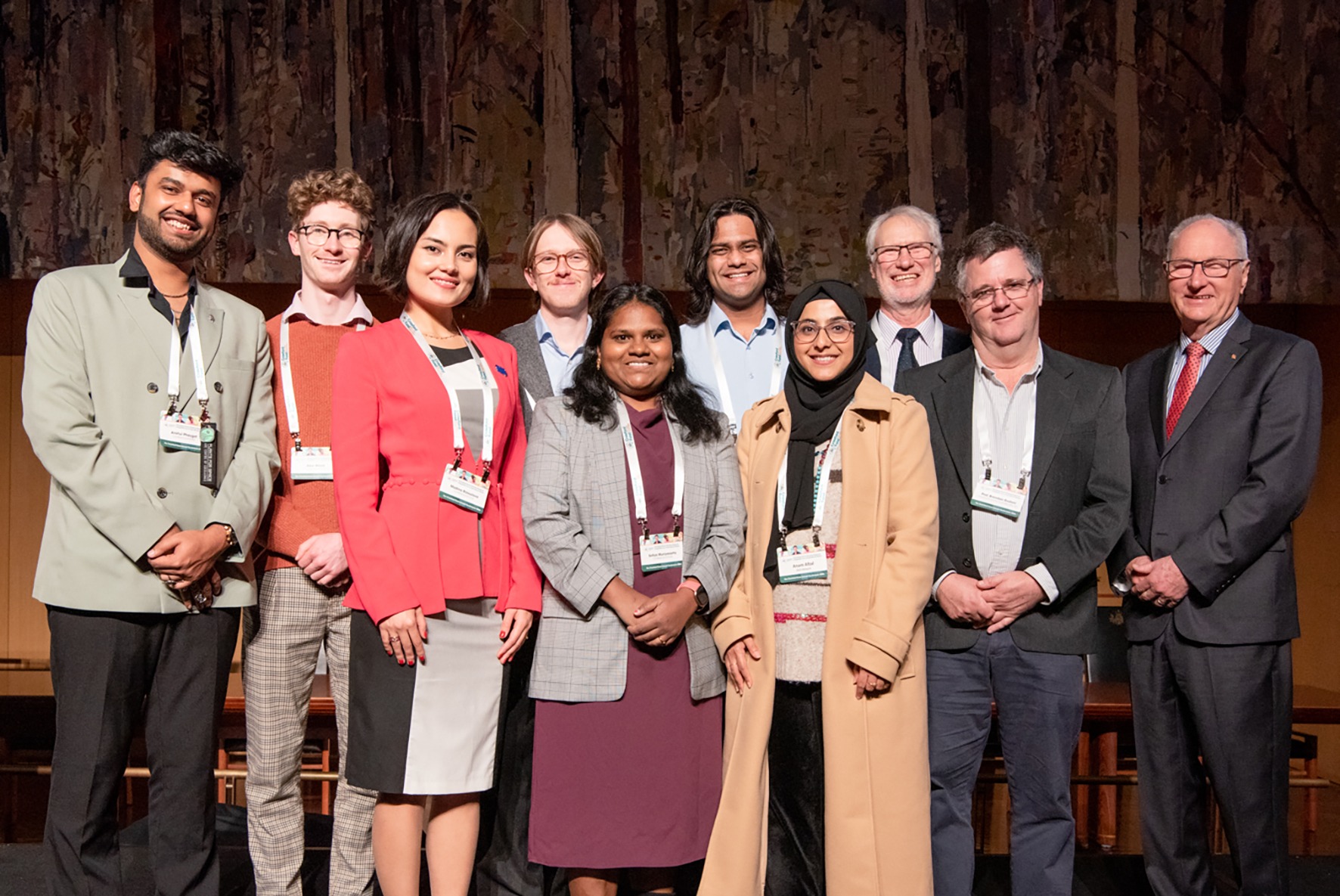
The Crawford Fund is committed to encouraging the next generation working in international agriculture for development through conference scholarships awarded by our State and Territory committees and scholar supporters. This year, we introduced a poster session showcasing the work of nine young researchers and created more opportunities for scholars and early career researchers to take part in conference Q&A sessions, helping to raise their profiles and expand their networks.
Our conference scholarship program started in 2010 in the hope that by experiencing the Crawford Fund for Food Security conference and network, our special program of activities around the conference and being mentored by inspirational experienced researchers, young researchers would be inspired and energised to be more involved. The results have been fantastic, with a great mix of youth and experience at our flagship event each August and a growing and enthusiastic conference scholar alumni approaching 525.
Our competitive conference scholarships are offered to young people with a genuine interest in international agricultural research and development to attend the conference and a special set of activities that we have developed and shaped over the past 16 years.
One of the requirements of the scholarship is that each scholar provides us with a reflection on their experience. We will be providing these reflections over the coming weeks, grouped by State/Territory.
Once again, we would like to thank our wonderful mentors, mentioned alongside the scholar they supported, who volunteer their time and offer valuable guidance, support and insights to the scholars throughout the conference.
Four of our Victorian scholars were supported by our Victorian Committee, and two were generously supported by The Gardiner Foundation. Highlights of their experiences have been captured below:
“I left encouraged. I left with new ideas, new friends and new connections. I left with hope.” – Lawrence Outridge
“Being in the Great Hall of Parliament House gave the experience special significance. At the networking dinner, hearing the Hon Julie Collins MP and witnessing Dr Gabrielle Persley AM receive the Crawford Fund Medal connected emerging researchers with decades of leadership in agricultural development.” – Anshul Phaugat
“What struck me most was how fully the conference lived up to its title. This was a room where young voices were invited to observe and given real weight in shaping the conversation.”– Madina Rassulova
“I returned to Melbourne with a broader perspective on my PhD and my future career.” – Sofiya Muniyasamy
“Developing relationships with fellow scholars was another highlight of the event. I look forward to maintaining these connections and supporting one another throughout our careers.” – Rohan Suresh Kumar
Read on for the full reflections.
Supported by the Crawford Fund for Food Security Victoria Committee:
Lawrence Outridge, University of Melbourne
Mentor: Bill Lewis
The opportunity to attend the Crawford Conference as a postgraduate scholar was a welcome surprise in my academic journey. I have often struggled to position myself as someone who straddles the boundaries between community work, intellectualism, and studies across academic disciplines. But the Crawford Conference, for me, was one giant assurance that the solutions to the challenges of global food insecurity, inequities and development will be discovered not in neat, articulated silos, but in the mixing of disciplines, nations and practices.
Attending the conference not as an agricultural scientist but as an ecologist, I must admit I had some reservations about whether the sessions would be applicable or challenge some of my values about development and political economy. Instead, I met with a group of caring, brilliant researchers, farmers and scholars who are each, in their own fields and contexts, dedicated to carving out a hopeful, better future for all of humanity.
The peers and mentors I met throughout the scholar days were all, like me, not willing to fit neatly into a box. Instead, they were all dedicated to pursuing new knowledge that could only be found at the intersections and margins of traditional fields. They each inspired, challenged, humoured and advocated for me in ways I can only describe as deeply humbling.
One of the standout presentations at the conference itself was the emerging research by Dr Dennis Beesigamukama on the viability of Black Soldier Fly Larvae as an organic fertiliser and animal feed. Hearing about the work of his institution in educating hundreds of thousands of farmers across Africa to use this low-cost, regenerative product was truly inspiring. I especially loved hearing how this practice was also being brought to rural and regional farmers in the Indo-Pacific, and how power dynamics can shift from Western science ‘saving’ the Global South to a truly collaborative, mutual pathway of development, co-sharing, and future imagination. An appreciated reminder that we always have as much to learn as we have to offer.
It reinforced for me the importance of interdisciplinary, transboundary work, and that the future of humanity is built not upon siloed activity but by persevering through the challenges of creative interaction. We are often warned about the vulnerability of global agriculture and food security to climate change. Narratives can be painted of an industrial, all-consuming, exploitative agricultural complex that only contributes to the degradation of the climate and environment.
The Crawford Conference assured me not that we have all the solutions to these challenges, but that thoughtful, equitable, conscious opportunities are being explored by brilliant humans every single day. Its poster sessions reminded me that challenges can always be met through creative, reflexive collaboration. Its scholar days demonstrated to me the hope in the next generation of scientists and practitioners, and the dedicated mentors who want to carve out opportunities for us.
I left encouraged. I left with new ideas, new friends and new connections. I left with hope. Many thanks to the Crawford Fund for providing me with such an opportunity.
Anshul Phaugat, ARC Centre of Excellence Plants for Space, La Trobe University
Mentor: Brendan Rodoni
Attending the 2026 Crawford Fund Conference and Scholar Program was more than a professional opportunity; it changed how I see my place in the wider food-security community. I arrived in Canberra as a PhD researcher focused on controlled-environment agriculture and left with a clearer understanding that meaningful agricultural research is built not only on good science, but also on listening, partnership and the courage to communicate why our work matters.
The Scholar Days created this sense of purpose before the main conference began. Conversations with my mentor, fellow scholars, RAID members, international researchers and former Crawford scholars made international agricultural research feel both real and accessible. Hearing former scholars describe their journeys showed me that the scholarship is not a three-day experience, but an entry into a generous, enduring network. Su McCluskey’s reminder that “we have two ears and one mouth” captured an important lesson: work in international development must begin with listening. Suzie Newman’s account of ACIAR demonstrated that effective research is a two-way street, grounded in trust, local priorities and long-term relationships. Sessions on international careers, ethical partnerships and media communication gave me practical next steps.
Being in the Great Hall of Parliament House gave the experience special significance. At the networking dinner, hearing the Hon Julie Collins MP and witnessing Dr Gabrielle Persley AM receive the Crawford Fund Medal connected emerging researchers with decades of leadership in agricultural development. Returning the following morning among more than 400 researchers, policymakers, students and practitioners made food security feel like a shared national and regional responsibility.
The theme, “Emerging Voices Shaping Regional Integration for a Food Secure World,” was reflected throughout the program. Dr Sandra Milach’s call to treat food, land, water and climate as one connected system strongly resonated with my research. The Pacific-led Talanoa session reinforced that climate solutions must be shaped with, not delivered to, affected communities. Case studies: from climate-smart rice and salinity-resilient cropping to black soldier fly systems and protecting bananas from TR4, showed how research translates into practical resilience. Dr Stefan Schmitz’s address on crop diversity and genebanks emphasised the need for patient, cross-border investment, while Dr Himanshu Pathak highlighted the power of regional scientific networks.
My personal highlight was being selected as an Emerging Voice and presenting “Food Security in a Box.” Sharing my research on mobile growth pods for producing fresh food in harsh, remote and resource-limited environments at Parliament House was exciting and humbling. It challenged me to move beyond technical details of light, nutrients and crop physiology and explain the human purpose of the work: bringing nutritious food closer to communities facing poor soils, water limitations, high prices and fragile supply chains.
I leave with new connections, stronger communication skills and a renewed sense of responsibility. Most importantly, I now understand that impactful research is defined not only by what we discover, but by whom we listen to, whom we work with and how effectively our science creates lasting value for communities.
Madina Rassulova, University of Melbourne / City of Greater Bendigo
Mentor: Bill Lewis
Attending the Crawford Fund Conference as a Scholar, representing the VIC Committee, was an extraordinary experience. Coming in as a food policy practitioner in Victorian rural local government and a viral science communicator, I hoped to learn about the latest food system research from other regions of Australia and the stories worth carrying to a wider audience.
The conference theme, Emerging Voices Shaping Regional Integration for a Food Secure World, set the tone for two days. Alongside the main sessions, the Scholar Activities gave us the chance to speak directly with top professionals and hear the stories behind their work, conversations that proved just as formative as the conference itself.
In one of these sessions that Su McCluskey, Chair of the Crawford Fund, shared wisdom on partnership building that has stayed with me since: “We have two ears and one mouth for a reason.” I carry that principle into my work convening stakeholders across food systems. In another, Larelle McMillan spoke about her move into CSIRO from an Arts background, a story that resonated with my own non-linear path.
A recurring highlight of the conference was the diversity of the people in the room. Meeting other young Crawford Fund Scholars, each driving distinct innovations for the food systems challenges ahead, gave me genuine hope for what collective, cross-disciplinary action can achieve. The Secretary of DAFF, Victoria Anderson, named the Australia-Pacific WFF Youth Food Lab a model for next-generation agrifood leadership in her opening address, a moment of real pride, as I am honoured to be part of that inaugural cohort.
What struck me most was how fully the conference lived up to its title. This was a room where young voices were invited to observe and given real weight in shaping the conversation. This was evident in Sally Higgins’ address on young people as the greatest resource for building sustainable systems, and in how many sessions were led by scholars and advocates of my own generation.
Conversations with Joseph Vile and Imelda (Dada) Bacudo about their preparations for COP31 offered a candid look at the work behind global climate negotiations. Dr Dennis Beesigamukama’s presentation on the insect-based circular bioeconomy showcased a novel solution I had not encountered before, while Dr Sandra Milach’s remarks on what the next decade of investment must deliver underscored the urgency ahead. The Scholars’ poster sharing session was the quietly inspiring part of the conference, showing the calibre of research my peers are leading.
As one of relatively few voices from Central Asia in the room, I felt both the weight and the privilege of that representation.
After the conference, I was invited to CSIRO HQ to present at an ATSE workshop as an Emerging Professional, and felt proud carrying the Crawford Fund Scholar title into that room. I came back from Canberra a different person, with a sharper sense of purpose and a wider circle of people to build a resilient future with. I thank the Crawford Fund Victoria Committee for the trust placed in me.
Sofiya Muniyasamy, La Trobe University
Mentor: Brendan Rodoni
Being selected as a 2026 Crawford Fund Conference Scholar from Victoria and attending the Scholar Program and Annual Conference in Canberra was one of the most valuable experiences of my PhD journey so far. As a PhD researcher working on lentil, plant physiology, carbon and nitrogen metabolism, I often focus closely on my experiments and data. The Crawford Fund experience encouraged me to step outside that individual research focus and think about how agricultural science can contribute to the much broader challenges of food security and international agricultural development.
The three days gave me opportunities to interact with researchers, policymakers, mentors and other young researchers from different backgrounds. Attending the networking dinner and conference at Parliament House was a particularly memorable experience. Listening to discussions about agriculture, regional collaboration and food security made me realise that scientific discoveries alone are not enough. Research needs strong partnerships, communication and links with policy and communities to create meaningful impact.
One of the biggest highlights for me was meeting Dr Himanshu Pathak, Director-General of ICRISAT, and Dr Janila Pasupuleti, who works in genomic prediction and crop breeding. I really enjoyed listening to their research journeys and discussing agricultural research opportunities with them. Both kindly shared their contact details with me. Janila also connected me with Dr Shiv Kumar Agrawal, a lentil breeder at ICARDA. Since my PhD research is focused on lentil, I see this as a very valuable connection and something I hope to build on in the future.
I was also very fortunate to have Professor Brendan Rodoni as my mentor during the Scholar Program. His guidance and encouragement helped me become more confident in approaching people and making meaningful professional connections. I have since met Brendan again at La Trobe University, where he showed me some of the laboratory and sequencing facilities and encouraged me to stay connected. This made me realise that mentorship and networking do not need to finish when a conference ends.
Another important part of the experience was learning more about the RAID Network. Meeting RAID members and hearing about their experiences showed me that there are many different pathways to become involved in international agricultural research and development. It also encouraged me to think about how I can contribute to this community as a PhD researcher.
One of my main take-home messages from the Scholar Program was to remain curious, say yes to valuable opportunities, communicate my science beyond my immediate research area and build genuine relationships with people. I also learned that networking is not simply about collecting contacts; it is about listening, learning, sharing ideas and maintaining relationships.
I returned to Melbourne with a broader perspective on my PhD and my future career. I now see my research not only as understanding carbon and nitrogen metabolism in lentil, but also as one small contribution towards developing more productive, nutritious and sustainable food systems.
I am very grateful to the Crawford Fund Victorian Committee, Bill Lewis, as well as Lucy Broad, Director of Communication and Outreach, Larissa Mullot, Communications Manager, and the wider Crawford Fund team. Lucy and Larissa are closely involved in the Crawford Fund’s communication, outreach and Scholar Program activities. my mentor Professor Brendan Rodoni, RAID and my supervisor Dr. Marisa Collins for giving me this wonderful opportunity. The experience has strengthened my motivation to continue developing as a plant scientist and, in the future, contribute to agricultural research that creates impact beyond academia.
Supported by The Gardiner Foundation:
Rohan Suresh Kumar, Department of Agriculture, Fisheries and Forestry
Mentor: John Allen
Attending the Crawford Fund’s 2026 Conference was a highlight of my year and a great learning opportunity. The conference connected me with experts and organisations working at the forefront of global agrifood systems. It was a pleasure to experience the diversity of thought, expertise and innovation shaping the future of agriculture. I was grateful for the opportunity to attend the conference as a scholar. It broadened my perspective on the challenges facing the sector and the innovative solutions being developed to address them.
To help connect me with others during the conference, the Crawford Fund team kindly paired me with Dr John Allen, whose breadth of knowledge, insight, experience and connections left a strong impression on me. While the conference’s packed schedule limited my time with John, I am grateful to have made such a meaningful professional connection and hope to continue engaging with him beyond the conference.
I am currently a graduate with the Department of Agriculture, Fisheries and Forestry. This program brings young professionals into the department, which aligns strongly with the conference theme of ‘Emerging Voices Shaping Regional Integration for a Food Secure World.’ The conference facilitated connections between young scholars and influential individuals and organisations, demonstrating the value of fostering the next generation of leaders in the agrifood sector.
Ms Sally Higgins (Youth Champion for COP31) was a compelling young voice at the conference. Hearing about her journey into agriculture following the pandemic and her advocacy for young people, particularly those in regional Australia, was particularly impactful. Seeing someone down to earth discuss issues affecting regional communities while representing young people on the global stage was both exciting and encouraging.
Hearing Dr Stefan Schmitz speak passionately about the importance of seed banks and their role in safeguarding genetic diversity for future agricultural resilience inspiring. Particularly compelling were the broader themes he highlighted, including the importance of global collaboration, the significant long term benefits that can arise from relatively small amounts of targeted funding, and the recognition that agricultural security extends beyond production alone. It relies on a complex network of supporting systems, institutions and partnerships.
The conference also fostered valuable conversations between scholars, scientists and other professionals during tea breaks and the research poster session. These opportunities allowed me to engage with conference attendees, ask presenters follow up questions and establish new professional connections. The poster presentations show cased cutting edge advancements in Australian agrifood research and highlighted the wealth of knowledge and experience that early-career researchers bring from around the world.
Beyond the formal sessions, developing relationships with fellow scholars was another highlight of the event. I look forward to maintaining these connections and supporting one another throughout our careers.
The conference strengthened my understanding of the opportunities and challenges facing agrifood systems both in Australia and globally. I am eager to apply these learnings in my role as a public servant and contribute to the continued growth and resilience of the sector.
I would like to express my sincere gratitude to the Gardiner Foundation for providing me with the opportunity to attend the conference as a scholar. I am also excited to join the Researchers in Agriculture for International Development (RAID) network and continue expanding my professional network with like-minded individuals committed to strengthening global agrifood systems.
Alex Wood, University of Melbourne / World Food Forum Australia Youth Chapter
Mentor: Marta Monjardino
PENDING