

Evaluating the Transition to Organic Agriculture in Bhutan
November 26, 2026
The Crawford Fund’s highly sought after Student Awards are one way we support and encourage the next generation of Australians into study, careers and volunteering in international agricultural research.
Our 2027 Student Awards are now open. Apply here!
The awards are funded by our State and Territory Committees and made possible by organisations including ACIAR, international centres, Australian and overseas universities and NGOs who host our awardees.
Eighteen talented university students from around Australia were awarded our 2025 Student Awards. As part of this cohort, we would like to share the experience of Ugyen Yangchen from Murdoch University who travelled to Bhutan to undertake research evaluating the country’s transition to organic agriculture – farmers’ readiness, consumer preferences and institutional support. The project was undertaken in collaboration with the Royal University of Bhutan.
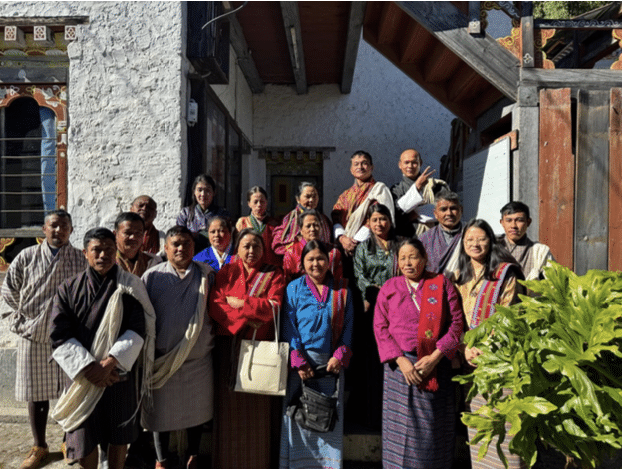
“In 2006, Bhutan declared a policy to achieve 100 per cent organic agriculture nationwide by the year 2020. And, as 2020 approached, I set out to assess how Bhutan was faring in its commendable pursuit. I collected quantitative data while at the Centre for Sustainable Mountain Agriculture (CSMA) at the College of Natural Resources, Royal University of Bhutan,” said Ugyen.
Data was collected from producers, consumers and stakeholders using surveys, key informant interviews and stakeholder meetings. This quantitative data on consumer and farmer perceptions, and farmer readiness to convert to organic farming was collected in 2019 -2020 during the COVID-19 pandemic. That data alone did not adequately reveal the uptake of organic farming and consumption in Bhutan, she explained.
Furthermore, in recent years, the Government’s National Centre for Organic Agriculture has implemented several organic programmes and trainings that have impacted the development of organic farming compared to when the first dataset was collected in 2019-20.
“An updated qualitative approach was deemed necessary to provide further insights that the earlier survey data could not provide. As such I designed a set of qualitative research instruments that would elicit rich in-depth information about the uptake of organic agriculture and provide greater understanding for the strategies needed to address the challenges and barriers and to better develop the enabling environment to achieve 100% organic farming in Bhutan,” she said.
“The support provided by the Crawford Fund Student Award allowed me to travel to Bhutan this year to collect qualitative data for my research,” said Ugyen.
Ugyen designed and implemented four participatory Focus Group Discussions (FGDs) at four Gewogs (blocks) across four districts in Western Bhutan, and 15 Key Informant Interviews with representatives from the Department of Agriculture, National Centre for Organic Agriculture, the Department of Agricultural Marketing and Cooperatives, the District Agriculture Officers of four districts, and Gewog Extension Workers of four Gewogs.
“These conversations allowed me to gain an in-depth understanding by addressing the gaps in the quantitative dataset. For example, I was able to explore the reasons why some farmers decided to convert to organic farming, their challenges and perspectives on organic farming. The qualitative approach also allowed me to further interrogate the readiness of support structures in the goal of transforming agriculture wholesale to organic,” she said.
In particular, Ugyen’s study sets out to assess:
- farmer perceptions and readiness to convert to organic agriculture,
- consumer perceptions, preferences and willingness to pay for organic produce, and
- the readiness of supporting structures and institutions to enable a transition towards an organic agro-food system in Bhutan.
Her research findings include:
- key stakeholders have invested in capacity development of organic farmers including raising awareness about principles and concepts, certification, and provided support in agricultural input supply;
- significant challenges exist including lack of coordination between organic farmers and aggregators; limited supply of biopesticides and biofertilisers; underdeveloped value chains, transportation, scale of production, and postharvest infrastructure;
- obtaining premium prices for organic produce is difficult because an organic market is not established; and,
- for organic farming to develop, adequate investment into the sector is required.
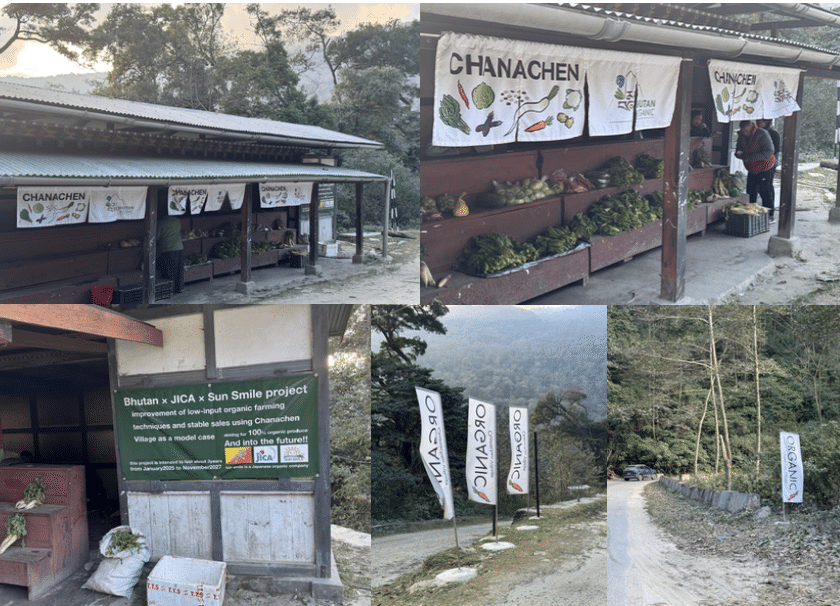
An organic outlet along the Thimphu-Phuentsholing highway. The shed was constructed with supported from the Bhutan – JICA, Sun Smile Project.
“My fieldwork in Bhutan did reveal a powerful truth that is impossible to ignore: women are the backbone of organic farming. With men migrating for seasonal work and youth choosing non-farm jobs, women are left managing farms, households, and families—often all at once,” said Ugyen.
“To this day, the country is nowhere near achieving its aspirational 2020 goal. The availability of organic inputs and management techniques, as well as the development of an enabling environment—training, certification, marketing, and availability —remain grossly underdeveloped. Additionally, there is little to no evidence for the level of interest Bhutanese farmers have for the transition to organic farming, and the same can be said for the market – to what extent are consumers interested in purchasing organic produce and are they prepared to pay a premium?,” she said.
“Despite all these challenges, organic farmers are surprisingly optimistic about the prospective opportunities that the Gelephu Mindfulness City will create demand for organic produce from the surrounding villages once the city is in operation,” she said.
“Farmers continue organic practices—driven by trust in their local extension officers, belief in healthier food, and commitment to protecting their soil. There were interesting and positive findings too. In Chanachen, Geling Gewog with support from the Sun Smile project (Bhutan and JICA), an organic outlet was constructed along the busy Thimphu–Phuentsholing highway. One woman farmer collects produce from her neighbours and sells it to travellers. It’s small, but it works— and it shows what farmers can do when given a little support. They dream of a bigger space, a proper shed, maybe even a cold store someday,” she concluded.
Human Research Ethics approval was obtained for this field work from Murdoch University Human Research Ethics Committee.