

Food (and) security lessons for a warming world
October 30, 2026
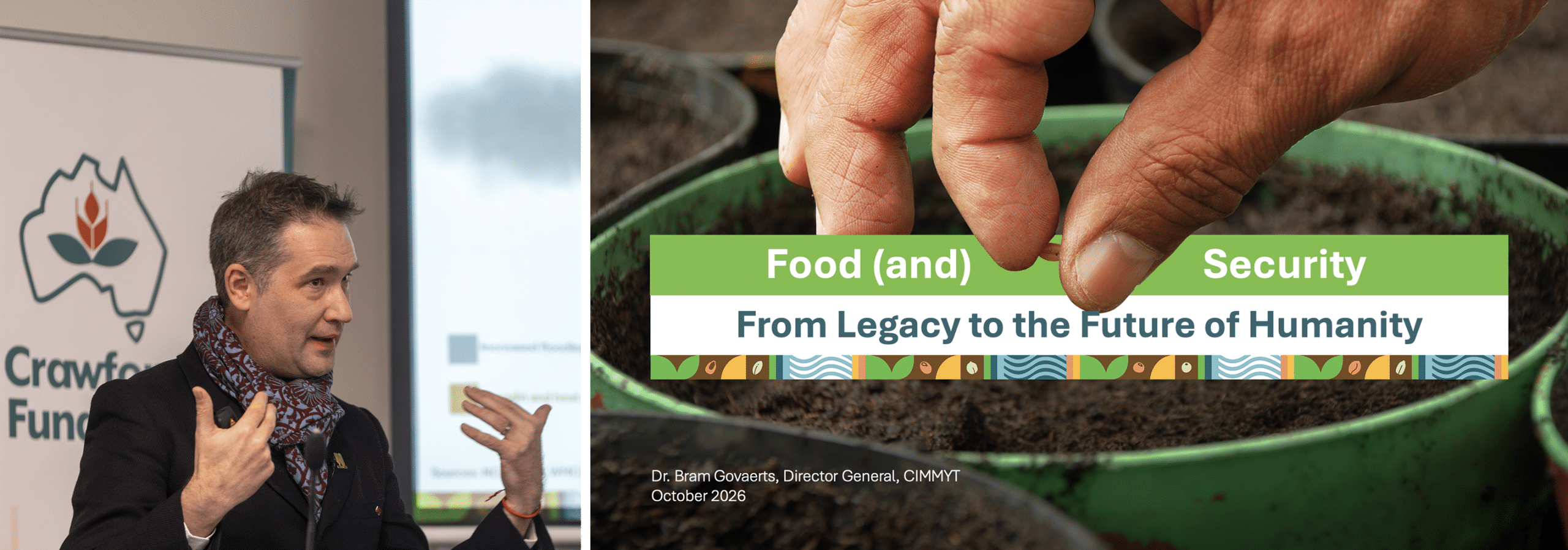
The Crawford Fund for Food Security’s ACT Committee recently co-hosted a seminar on Food (and) Security – From Legacy to the Future of Humanity delivered by Dr Bram Govaerts, Director General (CEO) of CIMMYT, a leading international agricultural research and development organisation advancing food and nutrition security worldwide.
As Australia and its Pacific partners prepare for COP31 meetings in Turkiye next month, it was timely to hear Dr Govaerts, a leading voice on global food security, call for agriculture to be seen as strategic infrastructure central to geopolitical and economic stability, supporting food systems to withstand global shocks, from pandemics and climate stress to conflict.
“Food security has always been about more than food. Agriculture provides livelihoods, anchors communities and economies, and can help build stability and cooperation even in times of profound political tension,” said Dr Govaerts, a bioscience engineer and international food security specialist.
CIMMYT’s own history illustrates this connection: born from an international partnership during the Second World War, its science helped avert looming food crises in Mexico, India, and Pakistan and sustained scientific collaboration across political divides during the Cold War. In his address, Bram explored what CIMMYT’s history can teach us about the challenges ahead.
“At a time of conflict, geopolitical competition, extreme weather, and disruption to energy, fertiliser, and global trade, the task is not simply to respond to the current food security crisis, but to adapt forward, building food systems capable of withstanding the next shock,” he said.
Drawing on innovations in drought- and heat-tolerant crops, nitrogen management, artificial intelligence, pest and disease surveillance, and early warning, Dr Govaerts examined how science can help build this resilience, and explained that technology alone is not enough.
“Farmers and consumers must be at the centre of innovation, and stronger systems are needed to connect scientific discovery with the people, markets, and communities it is intended to serve,” he said.
The lecture had particular resonance for Australia. CIMMYT germplasm sits in the pedigrees of most Australian wheat varieties, while Australia’s world-class capabilities in agricultural science, biosecurity, and climate adaptation have implications well beyond its borders.
“As food security, supply chains, and agricultural resilience become increasingly important to stability across Southeast Asia and the Pacific, Australia has an opportunity to help shape a new era of international agricultural cooperation,” he said.
“Ultimately, agriculture is not simply a development concern. It is strategic infrastructure and a foundation for economic and national security. And at a time when the international system is under growing strain, the shared necessity of feeding people can also provide something increasingly scarce: common ground,” he concluded.
Appointed Director General in 2021, Dr Govaerts leads CIMMYT’s global efforts to accelerate agricultural innovation, strengthen partnerships, and scale solutions across the Global South.
As part of his visit to Canberra for this lecture, Dr Govaerts was interviewed for the ABC’s Country Hour program. The extended interview is available here and runs from 33m54s to 43m42s.