

Rethinking high-value cash cropping and rural livelihoods in Nepal’s mid-hills
September 17, 2026
The Crawford Fund’s highly sought after Student Awards are one way we support and encourage the next generation of Australians into study, careers and volunteering in international agricultural research.
The awards are funded by our State and Territory Committees and made possible by organisations including ACIAR, international centres, Australian and overseas universities and NGOs who host our awardees.
Our 2027 Student Awards will open in November.
We would like to share the experience of Ananda Raj Devkota, a 2025 Student Awardee from the Australian National University, who travelled to Nepal as part of his research into Rural Livelihoods and Vulnerability to Environmental and Socio-Economic Change: A Case of High-Value Agriculture Communities in the Middle Hills of Nepal.
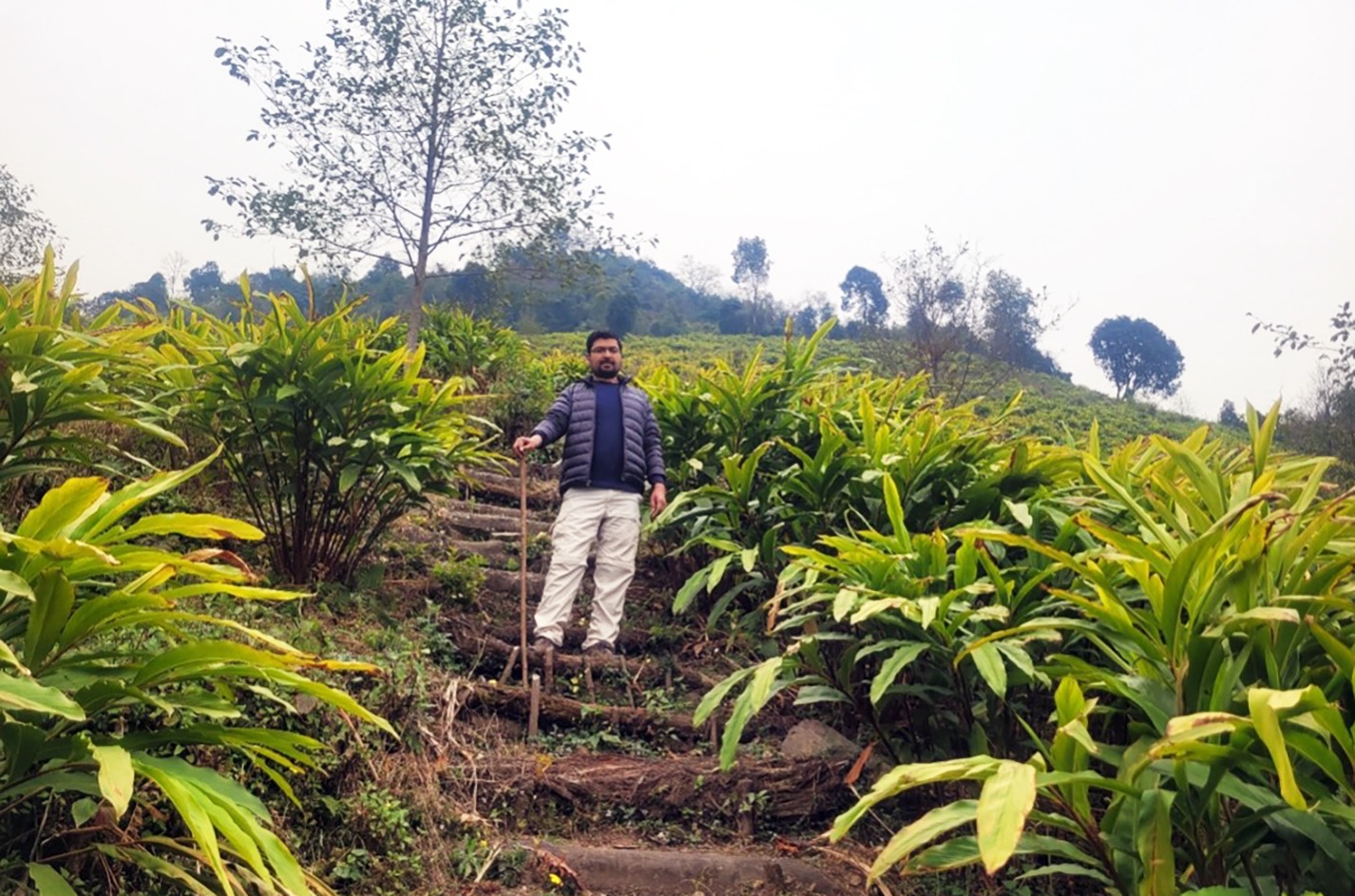
A blog (and images) by Ananda Raj Devkota
Past policy narratives portrayed agriculture as a pathway out of poverty for impoverished populations in the Global South. Yet, for many rural households in the region, agriculture has failed to deliver sustained improvements in livelihoods or retain younger generations in farming. Rural economies are now reshaped by migration of farm labour and the onset of climate stress. In response to these pressures, rural households are realigning their strategies – moving away from subsistence farming, diversifying into non-farm sectors and engaging in high-value agriculture. High-value farming is promoted as an opportunity for rural households to improve their assets, enhance capabilities, and build resilience. However, whether such agriculture can provide sustainable and equitable livelihood pathways remains an open question.
In Nepal, these global shifts are clearly visible. Nepalese mid-hill regions traditionally reliant on rice- and maize-based farming are now transitioning toward commercial agriculture. Farmers increasingly cultivate vegetables, raise small livestock such as goats on a commercial scale, and adopt high-value crops, including coffee, kiwi, asparagus, and large cardamom.
These transformations are happening under intensifying climatic stress and labour outmigration. Farmers report rising temperatures, erratic rainfall patterns, declining winter precipitation, prolonged dry spells, increasing outbreaks of crop and livestock diseases, and disappearing natural springs. At the same time, labour outmigration has intensified, resulting in ageing rural populations and farm labour shortages in rural areas. Within this uncertain environment, farmers in Nepalese mid-hills are adopting large cardamom as an environmentally friendly and less labour-intensive high-value crop that offers improved livelihoods for the poor.
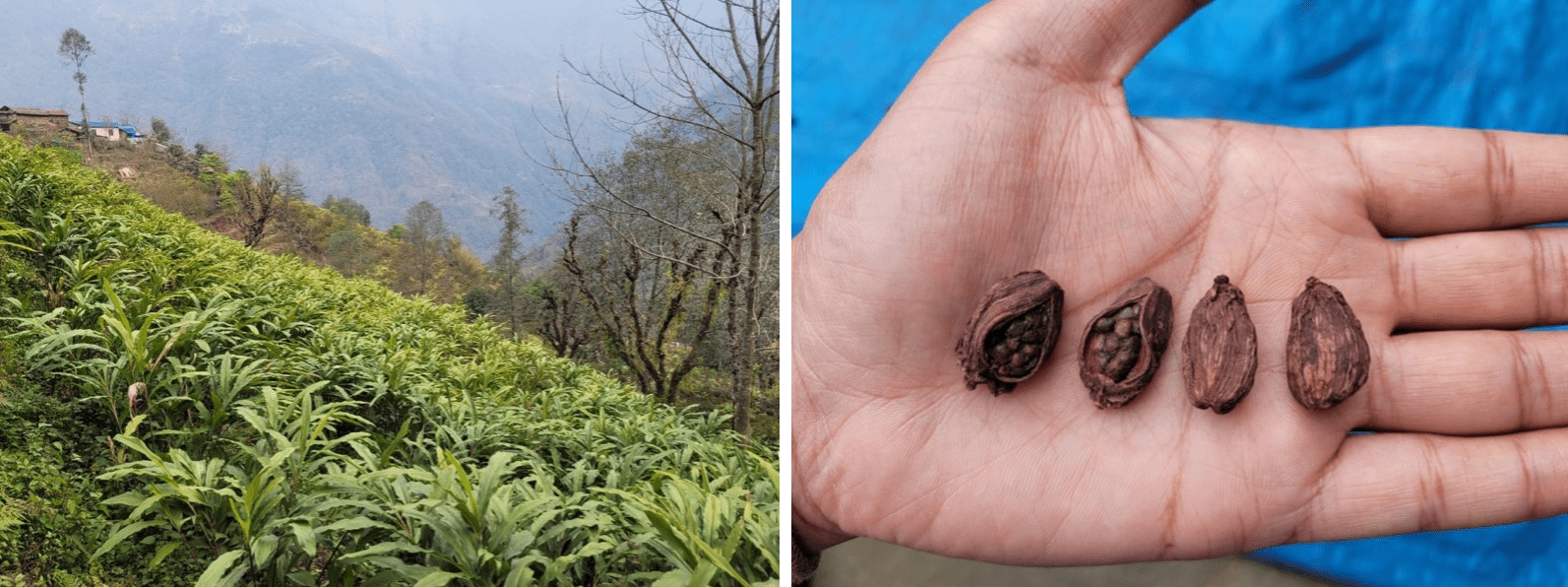
Large cardamom (Ammomum subuatum Roxb.), also known as black cardamom, is a perennial, high-value spice crop widely grown in the eastern Himalayan region, including eastern Nepal, Bhutan, and Sikkim and Darjeeling hills of India. It is a key ingredient in South Asian and Middle Eastern cuisines and commands high export value. Nepal is currently the world’s largest producer of large cardamom, and the crop has become the country’s most important agricultural export commodity. In recent years, its cultivation has expanded westwards from eastern Nepal into central and western hill districts like Lamjung, driven by strong export demand and high prices.
Large cardamom suits Nepal’s rugged hill geography. It thrives on shaded, moist slopes along mountain streams, requires comparatively less labour than cereal crops, and offers much higher returns per unit of land. In a region where staple crop farming suffers from low productivity and rising input costs, large cardamom has emerged as an important source of cash income for many households.
However, despite its income-enhancing potential, large cardamom has, in many cases, proven to be an unstable and risky livelihood option. Farmers are exposed to market volatility caused by fluctuations in global supply and demand, as well as persistent concerns over price manipulation by traders in India, through whom the most exports are channelled. At the same time, production is increasingly affected by environmental stressors such as drought and disease and pests.
These dynamics appear to be increasing household vulnerability, with some farming households experiencing declining incomes, food insecurity, and mounting debt, particularly during the bust of cardamom prices and production. Poor and marginalised households appear to have been most affected, as they possess fewer assets and have limited capacity to absorb shocks.
Different households have navigated the cardamom bust in distinct ways. Among the better-off farmers, some have been able to adapt and even prosper despite declining cardamom returns, for example by drawing on savings accumulated during earlier boom periods, diversifying into other high-value crops and accessing government support, such as grants for large cardamom plantation revival.
Middle-income households, in areas less affected by pests or drought and with access to sufficient land, have managed to maintain moderate production levels. Even with lower market prices, they can generate enough income to meet household needs and navigate periods of decline.
In contrast, many poorer households – such as marginalised low-caste Dalits – remain excluded from cardamom farming altogether.
These varied outcomes highlight the role of structural and social factors in shaping livelihood outcomes. Market conditions, price fluctuations, and environmental stress directly influence production and income. At the same time, unequal land distribution, access to capital, caste-based inequities, and the strength of social networks determine which households can adapt to the cardamom bust and which cannot.
These observations prompt a broader reflection on the role of high-value cash crops in rural development. While such crops can enhance income and provide opportunities for some, they are not inherently transformative or universally beneficial. Their effectiveness depends on a range of enabling conditions.
For rural development policies, this suggests the need for a more holistic approach. Efforts should focus not only on promoting high-value crops but also on improving market conditions, strengthening farmers’ adaptive capacities, and addressing structural inequalities.
Ultimately, the case of large cardamom farming in Lamjung reveals both the promise and limitations of high-value cash crops. They offer opportunities for livelihood improvement, but also expose farmers to market-, production- and environment-related vulnerability. Recognising and addressing these complexities is essential for designing pathways towards more resilient and inclusive rural livelihoods.
[Note: This blog draws on the author’s ongoing PhD research and is based on insights from a field visit to the Lamjung district in western Nepal, in October 2025, supported by the Crawford Student Award. As the underlying research and thesis are still in progress, the observations and interpretations presented here are preliminary and subject to further refinement.]