

Investigating lick block impacts on production and methane emissions in dairy buffalo in Laos
May 22, 2026
The Crawford Fund for Food Security’s highly sought after Student Awards are one way we support and encourage the next generation of Australians into study, careers and volunteering in international agricultural research.
The awards are funded by our State and Territory Committees and made possible by organisations including ACIAR, international centres, Australian and overseas universities and NGOs who host our awardees.
We would like to share the experience of Isobel Clift, from the University of Sydney, a 2025 Student Awardee, who travelled to Laos to undertake research investigating the impact of emission control blocks on production and enteric methane emissions in dairy buffalo as part of an ACIAR project (AH/2012/068) in collaboration with AgCoTech and Laos Buffalo Dairy.
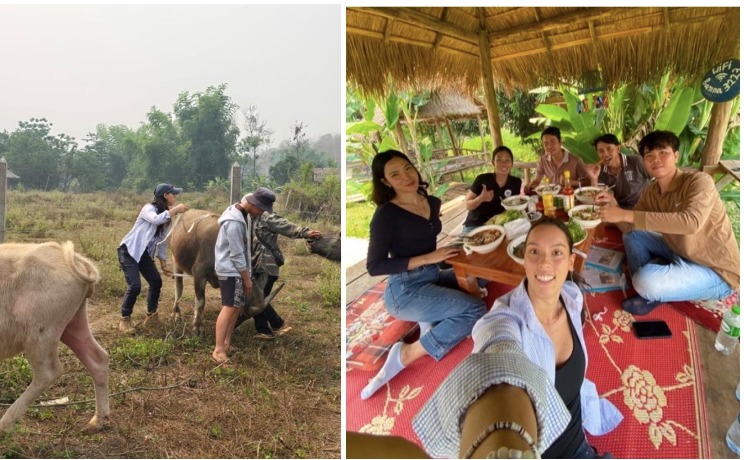
“My Crawford Fund Student Award allowed me to contribute to ongoing research examining the impact of an Emission Control Block (ECB) on livestock productivity, health and farmer livelihoods in Laos,” said Isobel.
“Buffalo and cattle are important livestock species for smallholder farmers in Laos. However, Laos agriculture is characterised by low-input, low-output systems, which often result in low productivity and relatively higher methane emissions,” she said.
The Lao People’s Democratic Republic is a developing country where many rural households rely on subsistence agriculture for their livelihoods. Buffalo and cattle are important livestock species in smallholder farming systems, providing a source of income, nutrition and food security. However, low-quality feed and limited management of reproduction, disease and nutrition contribute to low animal productivity and relatively high methane emissions.
Methane is a significant greenhouse gas produced naturally during digestion in ruminants such as cattle and buffalo, contributing to climate change. In Laos, inefficient, low-productivity livestock systems can result in relatively high emissions, while limiting milk and meat production.
ECBs are molasses-based lick blocks containing locally sourced ingredients. This supplement is designed to reduce methane emissions in cattle and buffalo, while promoting milk production and growth. Numerous preliminary ECB feeding trials across Southeast Asia have shown promising results in cattle and buffalo, and practicality for smallholder implementation must be further explored.
Isobel’s visit to Laos followed on from her involvement in an ECB feeding trial at the Laos Buffalo Dairy for her Honours project with the University of Sydney in 2025. However, this time she had the opportunity to expand on this research within a collaborative project between AgCoTech Lao and Care International, a humanitarian organisation. This primarily involved SHARP+ surveys, targeting local smallholder farmers. These surveys aimed to holistically monitor and evaluate their farming system, examining labour input, income, livestock, crop and agroforestry production, climate resilience and knowledge, market access, and the tangible impact of ECBs.
“During the trip I assisted with the collection of livestock data and contributed to the review and analysis of survey datasets from farmers in multiple villages. The work highlighted the potential of this lick block to improve animal condition and productivity, suggesting it may have wider applications in regions facing similar environmental, nutritional or socioeconomic challenges,” she said.
“Working in remote villages highlighted the practical challenges of conducting livestock research in a resource-limited environment, and the need for creativity and innovation in this setting. For example, simple tools, such as the weight tape, provided a valuable method to estimate animal weight, where infrastructure and access to technology was limited,” said Isobel.
“Participating in reviewing the surveys also gave me a much greater understanding of the integrated socioeconomic, environmental and nutritional challenges from the perspective of a Lao farmer.”
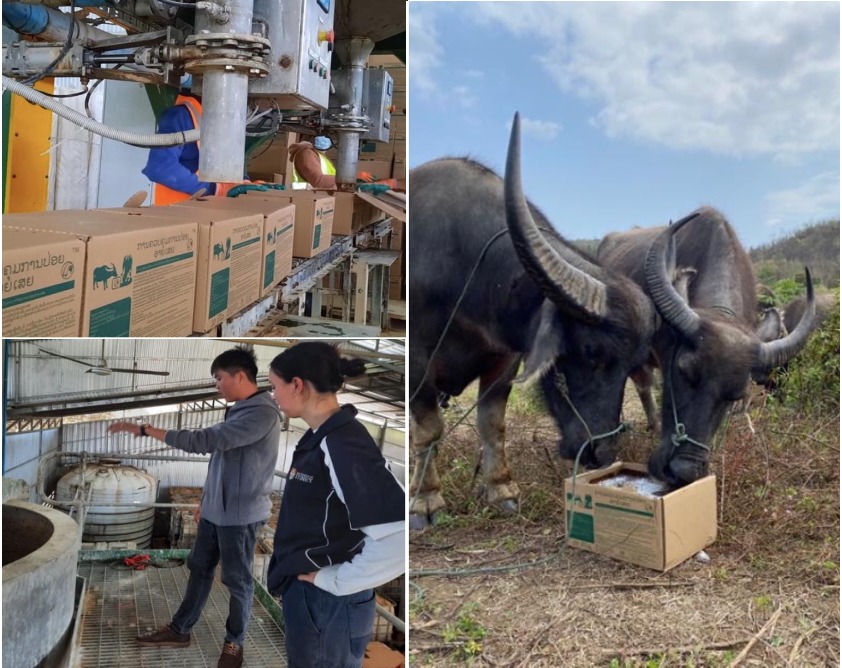
Isobel also spent time at the Laos Buffalo Dairy and AgCoTech factory, where she was able to observe the ECB manufacturing process, learning the intricacies of producing an optimal product. The team produced multiple batches utilising local ingredients designed to reduce animal-sourced methane emissions.
“One of the most rewarding aspects of the experience was seeing the lick-blocks I’d spent the last year researching being used practically in the field. I observed how the livestock interacted with this technology and noticed visible improvements in the animals’ body condition only a few weeks after we introduced the ECB, reinforcing the potential value of the intervention for smallholder farmers,” she said.
According to Isobel, previous ECB research in Cambodia, Indonesia and Laos has demonstrated promising results suggesting improved weight gain, milk production and reduction in methane emissions in animals supplemented with the block. This research supports both Laos and Australia’s commitment to reducing livestock-sourced greenhouse gas emissions, whilst also contributing to Lao’s national objectives to reduce food insecurity and malnutrition.
“Climate change poses a significant threat to the Laos and Australian agricultural industries, with significant potential implications on public health, food security and agricultural livelihoods. This project strengthens Australia’s contribution to climate-smart agricultural innovation and regional collaboration within the Asia-Pacific, harnessing the experience and knowledge of a range of stakeholders, including the University of Sydney, AgCoTech Laos, Care International, and the National University of Laos,” she said.
“The positive response from surveyed farmers suggests this intervention may provide an opportunity for improving sustainable livestock farming beyond Laos. The concept of utilising a lick-block containing local, affordable ingredients, may be considered for implementation in both smallholder-dominant, developing countries, or regions, including within Australia, facing similar environmental and nutritional challenges where productivity is reduced, access to technology is limited and enteric methane emissions are exacerbated,” said Isobel.
“This experience truly ignited my passion and excitement to continue working in sustainable agriculture for development, and I’m looking forward to what comes next,” she concluded.