

Seeds of opportunity: conference afternoon Keynote Address
August 21, 2026
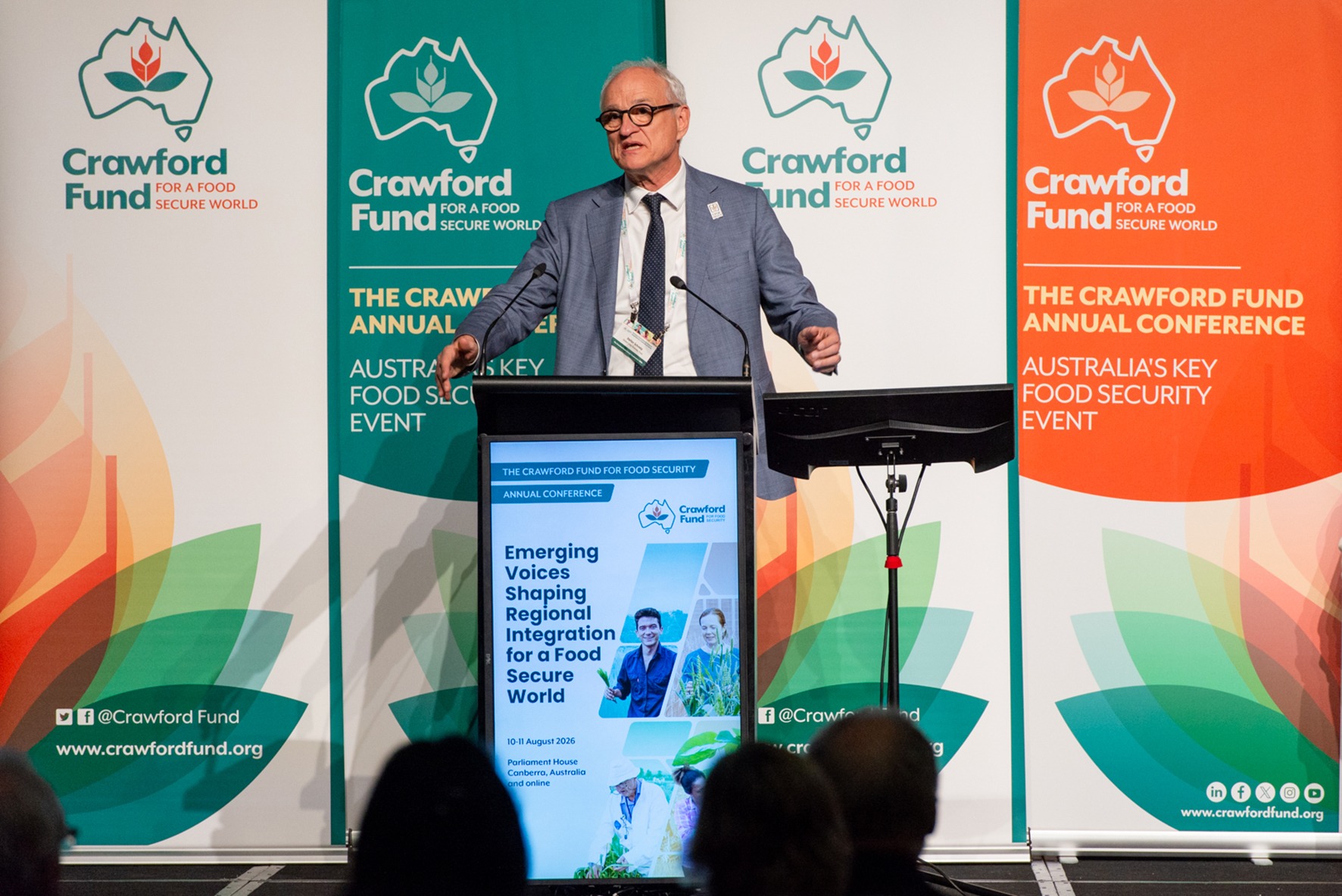
At the recent 2026 Crawford Fund Annual Conference, Emerging Voices Shaping Regional Integration for a Food Secure World, it was our pleasure to host Dr Stefan Schmitz, Executive Director of Crop Trust, a non-profit international organisation dedicated to conserving crop diversity and making it available for use globally, forever, for the benefit of everyone.
His address was titled “Seeds of Opportunity: Regional Cooperation for Food Security in an Uncertain World.”
In this afternoon keynote, Dr Schmitz explored how greater regional integration and international cooperation can strengthen food-system resilience.
Drawing on his extensive experience in food security, agriculture and rural development, Dr Schmitz considered the importance of multi-country research platforms, shared climate-adaptation strategies, trilateral partnerships and cross-border innovation.
His address highlighted the need for countries and institutions to work together to conserve agricultural diversity, strengthen research and ensure food systems are equipped to respond to climate change and other emerging challenges. He focused on the increasing importance of gene banks in an uncertain world, particularly in the face of climate change.
“Collect, conserve, cooperate, and everybody eats. Don’t, and everybody’s options quietly shrink,” said Dr Schmitz.
He also outlined the analysis undertaken by Crop Trust, putting a price on the cost of maintaining gene bank infrastructure and operations each year.
“We have costed it carefully and the number is not what most people expect, to secure the essential operations of all the world’s unique and valuable crop collection in perpetuity, it takes about US$34 million a year,” he said.
“That’s US$34 million for the crop diversity that underpins the food security of everyone in this room and everyone we will ever meet,” he said.
Dr Schmitz’s keynote opened the conference’s final session, which examined shifts in regional integration and the partnerships needed to support a more resilient and food-secure future.
The recording of this keynote address, chaired by Dr Larelle McMillan, Research Director – Sustainability, CSIRO Agriculture & Food is available below:
Dr Schmitz concluded his address with two recommendations.
“Australia is writing its first national food security strategy, and COP31 is around the corner. I hope this will be an opportunity to change the way we view gene banks. First, change the category. Stop budgeting crop diversity as a project and start treating it the way you treat a port, a road or a research station. It is not an activity. It’s a foundation the activities stand on. At COP31, conservation of crop diversity belongs in the infrastructure paragraph, not the annex,” he said.
“Secondly, change the time horizon, they should channel at least a small portion of the funds, a legacy contribution, into long-term mechanisms. Not instead of projects, but alongside them because a project buys you five years of results and an endowment buys you a century of capability,” he concluded.
The Crawford Fund’s annual conference – Australia’s key food security event – was held in the Great Hall, Parliament House, Canberra on 11 August with over 400 experts, policymakers, researchers, students and leaders hearing from specialists from Asia, the Pacific, Africa and Australia.