

From policy to practice: supporting climate-resilient agriculture in Fiji
May 25, 2026
The Crawford Fund’s highly sought after Student Awards are one way we support and encourage the next generation of Australians into study, careers and volunteering in international agricultural research.
The awards are funded by our State and Territory Committees and made possible by organisations including ACIAR, international centres, Australian and overseas universities and NGOs who host our awardees.
We would like to share the experience of Hannah Churton, from the Queensland University of Technology, a 2025 Student Awardee, who travelled to Fiji to undertake research into how policy frameworks and support systems shape climate-resilient agriculture.
Hannah’s project examined how policy frameworks and support systems shape climate-resilient agriculture in Fiji. It was guided by the question: how do policy frameworks help or hinder the development of climate-resilient agriculture in practice? Drawing on interviews with stakeholders across government, regional organisations, development programs, and international institutions, the findings are exploratory and based on a small number of in-depth interviews.
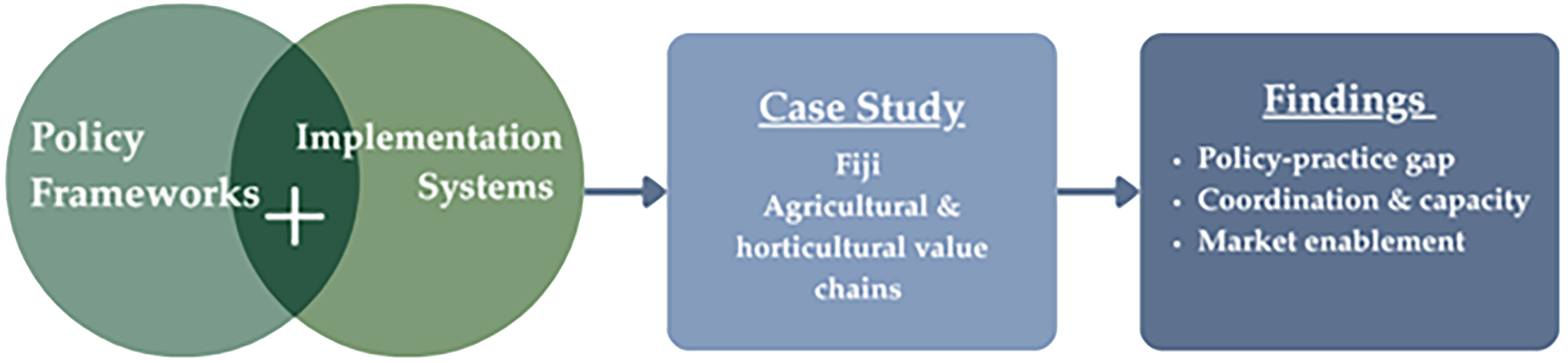
“In March, I travelled to Suva, Fiji, to undertake field-based research focused on the role of policy frameworks in shaping climate-resilient agriculture in practice, and I conducted semi-structured interviews with six stakeholders working across government, regional organisations, development programs, and international institutions,” said Hannah.
“During the scoping of interviewees, it became clear that the study’s original focus on value-adding within horticultural systems was too narrow. Stakeholders were working across broader issues, including climate impacts, coordination, market access, and institutional capacity, that affect the agricultural system as a whole,” she said.
In response, the scope of Hannah’s project was broadened to look at agriculture and climate resilience more broadly. Interviews therefore focused on how agriculture is responding to climate change, and what challenges and opportunities exist in practice. This shift also aligned more closely to Hannah’s PhD research on how governance systems support climate-aligned transitions.
“Given the small number of interviews and the purposive selection of stakeholders, the findings are necessarily exploratory rather than definitive. They are intended to identify key themes and surface practical insights, rather than represent the full range of perspectives across Fiji’s agricultural sector,” she said.
Hannah’s central finding is that Fiji has strong policies linking climate change and agriculture, but a persistent gap exists between policy and practice. Implementation is consistently constrained by limited capacity, uneven coordination, and reliance on external funding, meaning support does not reliably reach farmers as intended. Strengthening extension services, improving access to finance and infrastructure, and better aligning funding mechanisms with local priorities will be critical to improving outcomes.
“The policy-to-practice gap identified in Fiji mirrors challenges at the centre of my broader PhD research examining climate-resilient agriculture in Queensland’s Greater Whitsunday region, and points to genuine opportunities for ongoing collaboration between Queensland and Pacific partners,” she said.
For background, Fiji is a small island developing state (SIDS), where agriculture is central to livelihoods, food security, and economic activity, particularly for rural communities, and climate change is already reshaping the conditions in which Fiji’s farmers operate. Temperatures have risen by approximately 0.8 – 1.0°C over the 20th century, sea levels are rising at around six millimetres per year (above the global average) and the frequency and severity of extreme weather events is increasing.
Extreme events can have significant economic impacts: Tropical Cyclone Winston (2016), for example, caused damage equivalent to around 20% of Fiji’s GDP. For SIDS more broadly, the combination of small land area, geographic isolation, limited resources, and fragile economies means that climate impacts are often more acute and harder to absorb than in larger countries.
In response, Fiji has developed a relatively comprehensive policy architecture for climate adaptation. Climate resilience is now embedded in national development strategies, agricultural sector plans, and regional frameworks. Despite being highly vulnerable, Fiji performs relatively well on adaptation readiness, ranking 66th out of 181 countries on the Notre Dame Global Adaptation Index.
“While these frameworks are well developed on paper, there is less clarity on how they translate into action on the ground, particularly for farmers and businesses responding to changing conditions. This project set out to examine that gap: to understand what is helping or holding back progress, and what Fiji’s experience can tell us about the practical challenges of implementing climate-resilient agricultural policy,” explained Hannah.
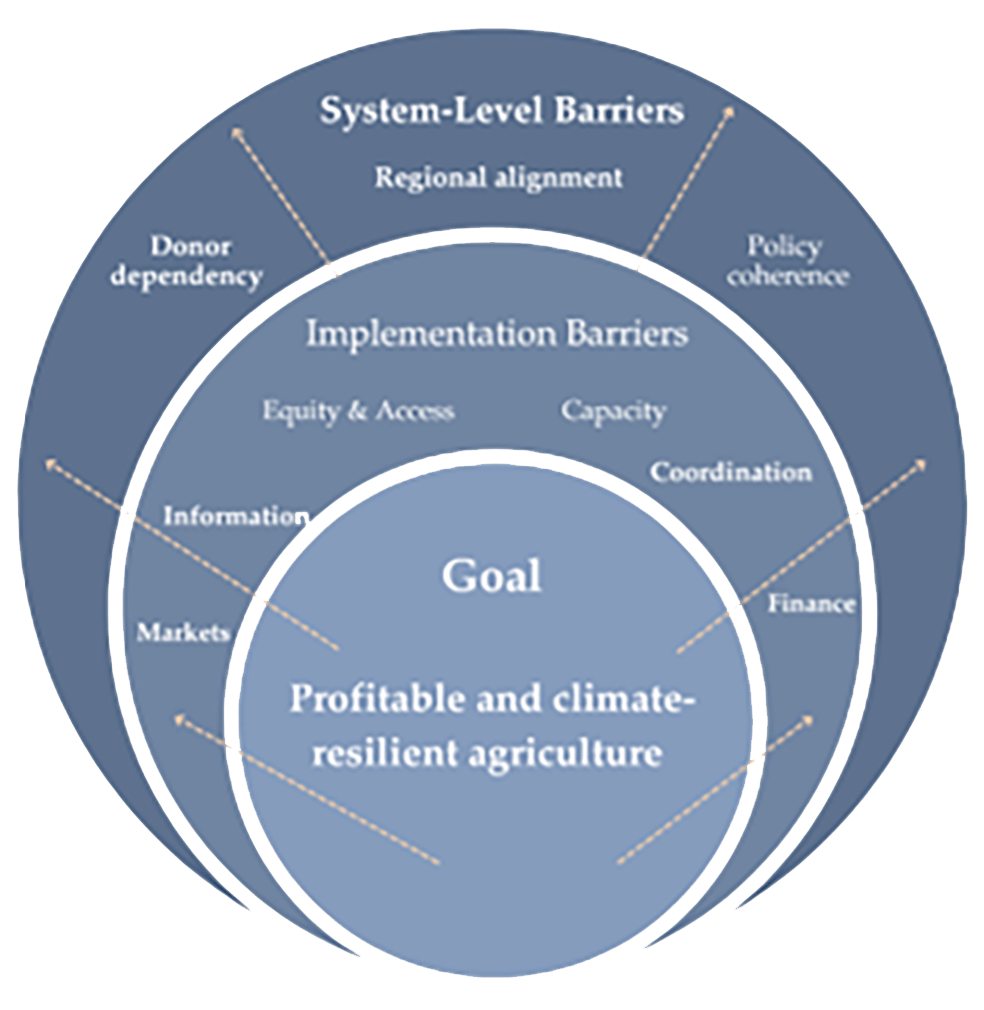
Hannah’s key findings include:
- Agriculture in Fiji is already being reshaped by climate change, not as a future risk, but as a present-day reality. Across interviews, stakeholders consistently described a system under pressure from multiple, overlapping climate impacts.
- Climate change impacts are not evenly distributed, with conditions varying significantly across the country, meaning farmers are operating under very different constraints depending on location.
- As a result, agricultural systems are becoming more difficult to manage. Planting calendars are shifting, soil quality is declining in some areas, and pest and disease pressures are increasing. At the same time, systems exist to support recovery, although they are often not immediately visible to farmers. A regional gene bank holding over 2,000 genetic resources plays a critical role in post-disaster recovery across the Pacific, providing planting material that allows farmers to re-establish production after extreme events.
- The impacts of these changes are not felt equally. Women, who make up a large proportion of subsistence and market farmers, face reduced yields and greater difficulty accessing markets. Older farmers are increasingly affected by rising temperatures, while younger people are often disengaging from agriculture altogether, with limited incentives to remain in the sector.
- Despite these pressures, there are clear and growing market opportunities for Fijian agricultural products. Kava is the most prominent example. Following the lifting of import restrictions in key markets such as the European Union and Australia in 2020, demand has increased significantly. Similar opportunities exist in crops such as taro, ginger, and turmeric.
- However, these opportunities are not easily accessible to most farmers. Farming in Fiji is predominantly small-scale and subsistence-oriented, meaning individual investment in post-harvest infrastructure (such as washing, drying, and storage facilities) is rarely viable.
“The most consistent finding across interviews was that the core challenge lies not in the absence of policy, but in how the system functions on the ground,” said Hannah.
“The main barriers to more resilient and productive agriculture in Fiji are not the absence of good policy, but what happens between policy and practice,” she said.
According to Hannah, the findings from this research highlight strong parallels between agricultural challenges in Fiji and Queensland’s Greater Whitsunday region, a major horticultural growing area navigating its own challenges around climate resilience, market access, and coordination across federal and state policy.
In Queensland, as in Fiji, fragmented coordination between levels of government, capacity constraints, and misaligned funding cycles create gaps that farmers and businesses are often left to navigate on their own.
Queensland’s tropical and subtropical horticulture sector faces increasing climate variability, supply chain pressures, and the need to support farmers in accessing higher-value markets. The barriers identified in Fiji, including limited post-harvest infrastructure, challenges in meeting export standards, and uneven access to finance and extension services, are also evident in parts of Queensland, particularly in more remote growing regions.
“This research strengthens Queensland’s engagement with the Pacific at a practical level, building direct relationships that can support ongoing collaboration. Queensland’s experience in tropical export horticulture, post-harvest technology, and agricultural extension means it is well placed to contribute to addressing the gaps identified in this research, making the relationship genuinely two-way, with clear opportunities for knowledge exchange and practical collaboration,” she concluded.