

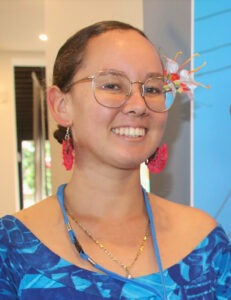
Ms Selane Tairea

Research Officer, Te Puna Vai Marama – Cook Islands Centre for Research, University of the South Pacific

Selane Tairea is a Research Officer at Te Puna Vai Marama Cook Islands Centre for Research. She holds a background in psychology and statistics and specializes in community-based data collection, analysis, and reporting. Selane has a passion for blending research with purposeful community engagement. Her work includes national surveys, professional development, program design, and policy dialogue. Selane has worked closely with local farmers to document the on the ground impacts of climate change and is working in collaboration with agencies to develop solutions that reflect local realities. Her contributions to the Pacific regional research agenda is the focus on making research more grounded, inclusive, and useful for decision-making. Serving amongst a number of NGOs in the Cook Islands she pushes for people to understand that “If you want to do research in the Cook Islands but you do not work with the community, you are not going to get far.”  


ABSTRACT

Aka’tika Uira (Realign the Wheel): An analysis of the climate adaptation methods adopted by farmers in Rarotonga, Cook Islands

Climate change is already a critical issue for Pacific nations and threatens the ability of local farmers to produce crops. Despite this issue, farmers have been historically left out when it comes to research. Understanding Pacific farmers’ experiences of climate change, the way they adapt in response, and the challenges they face in sustaining their production is essential. This study analyses the adaptation methods used by farmers in Rarotonga, Cook Islands, using data from a survey conducted by PHOAFS Regional Research Agenda partners across multiple Pacific countries. A sample of 174 farmers were surveyed across August-September 2024.  Descriptive and bivariate analyses were employed. Farmers reported experiencing inconsistent rainfall (49%), rising temperatures (50%) and increasing frequency and/or severity of droughts (49%). Overall, most farmers (87.9%) had made at least one adaptation method in response to changing weather patterns, and were more likely to adapt in response to increasing drought conditions. The major adaptation methods implemented by Rarotonga farmers were crop and soil management methods (52% of all adaptations), such as crop rotation, mulching, and composting. Contrary to other bits of research, there were no demographic factors influencing farmers’ likelihood of adapting. The findings from this research illustrate that farming is holistic. And point to a practical focus on increasing support from the government through improving opportunities for education and access to resources.