

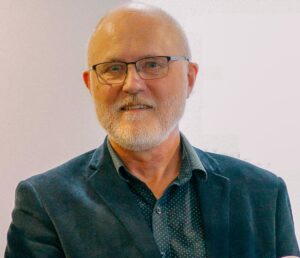
Prof Richard Eckard

Professor of Carbon Farming at the University of Melbourne and Zero Net Emissions Agriculture CRC Program Leader
Richard’s research focuses on carbon farming and accounting towards carbon neutral agriculture and options for agriculture to respond to a changing climate.

He has developed the first greenhouse gas accounting tools, for all sectors of agriculture in Australia, that now form an agreed national standard for agriculture.

Richard is a science advisor to the Victorian, Australian, New Zealand, UK and EU governments, the International Livestock Research Institute and the UN Food and Agriculture Organization on climate change adaptation, mitigation and policy development in agriculture.

Richard was recently named on the Reuters list of the world’s 1,000 most influential climate scientists.


ABSTRACT

Can we feed the world with net zero emissions?

Agriculture produces between 12 and 14% of global greenhouse gas (GHG) emissions, excluding transport and processing. While there are options to reduce GHG emissions from agricultural production, food security could also be considered the most legitimate form of GHG emission. The main GHG emissions from agriculture are methane, associated with rice and livestock production, and nitrous oxide associated with nitrogen inputs. Agricultural land can also sequester carbon in soils and trees and, while this is an important contribution, it is perhaps only reversing the land use change disturbance created for agriculture in the first place. A recent assessment by the Net Zero Australia plan concluded that current reliance by the large industrial emitters on the land sector to provide their offsets are questionable, as agriculture on its own will struggle to meet its stated value chain targets, including insetting all available sequestration. Reducing livestock numbers has often been touted as an overly simplistic solution to reducing agricultural GHG emissions, forgetting that most livestock exist in lower socio-economic regions and are integral to their food security and livelihoods. Taking a more multi-functional perspective of livestock in subsistence agricultural systems, shows that the GHG emissions attributable to meat or milk can be much lower than industrial farming systems. Livestock are integral to a largely vegetarian diet in subsistence agricultural systems, without which industrial fertilisers and diesel would be required to produce crops. The production and use of industrial fertilisers contributes approximately 5% of global GHG, but almost half of the world’s population are dependent on industrial nitrogen for their food security. Options are emerging to reduce enteric methane by more than 80% and estimates show that improving nitrogen use efficiency can reduce nitrous oxide emissions by over 50%. However, few of these options are profitable in their own right, and even less are relevant to extensive or subsistence agricultural systems. While some agricultural systems can achieve net zero GHG emissions, there inevitable GHG emissions associated with agricultural production. However, the land use sector also manages significant natural resources and perhaps the future lies in striking a balance between biodiversity and mitigation in a more integrated approach.